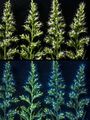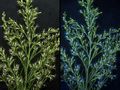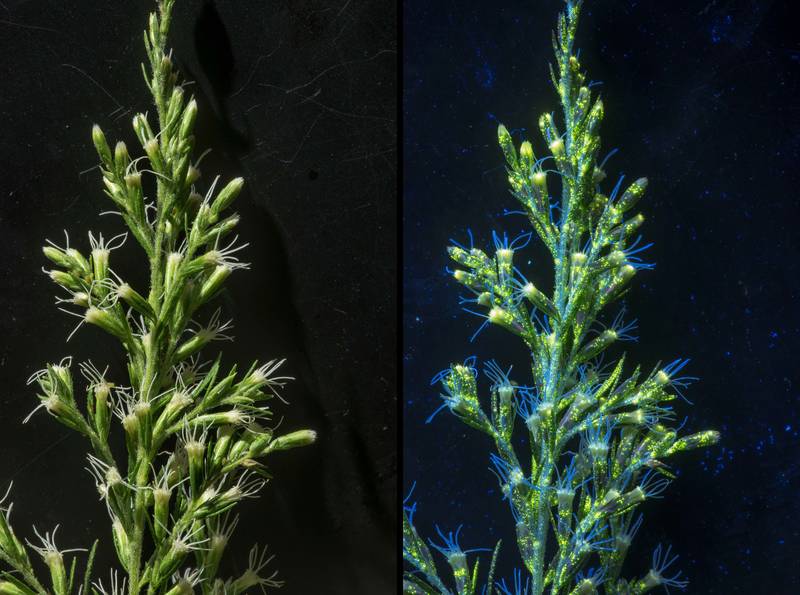

Dog fennel (Eupatorium capillifolium) when exposed to regular daylight as well as when illuminated by a 365 nm ultraviolet (UV-A) blacklight from Lick Creek ParkLick Creek: Background Notes. College Station, Texas


Album 3631: College Station and Sam Houston Forest, Texas, October 11 - 13, 2024
The image presents a comparative analysis of dog fennel (Eupatorium capillifolium), showcasing its appearance under regular daylight and when illuminated by a 365 nm ultraviolet (UV-A) blacklight from Lick Creek Park, College Station, Texas.
**Image Structure**
The image is divided into two distinct sections. The left section displays the plant's natural state under regular daylight conditions, while the right section reveals the same plant exposed to UV-A light from a blacklight. Both images are presented side by side, allowing for a direct comparison of the effects of the different lighting conditions on the plant's appearance.
**Left Section: Natural State**
In this image, the dog fennel appears as a typical flowering plant with green leaves and white flowers. The buds are clustered at the top of the stem, while the rest of the plant is covered in small, pointed leaves that resemble needles. The background is dark gray or black, providing a neutral backdrop for the plant.
**Right Section: UV-A Light Exposure**
When exposed to UV-A light from a blacklight, the dog fennel undergoes significant changes in its appearance. The white flowers become more vibrant and radiant, emitting a bright blue glow that stands out against the dark background. The green leaves also appear to be more intense, with a subtle shimmer effect visible on their surface.
**Key Observations**
* **Flower Coloration:** The white flowers exhibit a striking transformation when exposed to UV-A light, becoming a vibrant blue color.
* **Leaf Intensity:** The green leaves appear more intense and radiant under UV-A light exposure.
* **Background Contrast:** The dark gray or black background serves as a neutral backdrop, allowing the transformed plant to take center stage.
**Conclusion**
The image effectively highlights the dramatic impact of UV-A light on the appearance of dog fennel. By comparing the natural state with the transformed state under UV-A light exposure, it becomes clear that this type of illumination can significantly alter the coloration and intensity of the plant's features. This observation has implications for understanding how different lighting conditions can affect plant appearance and potentially influence their interactions with their environment. – AI vision
🇪🇸 Descripción en español / Spanish Description
La hierba del perro (Eupatorium capillifolium) cuando se expone a la luz diurna regular y también cuando se ilumina con una luz negra de longitud de onda ultravioleta (UV-A) de 365 nm en Lick Creek Park. College Station, Texas, 13 de octubre de 2024. La imagen presenta un análisis comparativo de la hierba del perro (Eupatorium capillifolium), mostrando su aspecto bajo luz diurna regular y cuando se ilumina con una luz negra de longitud de onda ultravioleta (UV-A) de 365 nm en Lick Creek Park, College Station, Texas. **Estructura de la Imagen** La imagen se divide en dos secciones distintas. La sección izquierda muestra el estado natural de la planta bajo condiciones de luz diurna regular, mientras que la sección derecha revela la misma planta expuesta a luz UV-A de una luz negra. Ambas imágenes se presentan lado a lado, lo que permite una comparación directa de los efectos de las diferentes condiciones de iluminación en el aspecto de la planta. **Sección izquierda: Estado Natural** En esta imagen, la hierba del perro aparece como una planta típica con hojas verdes y flores blancas. Los brotes se agrupan en la parte superior del tallo, mientras que el resto de la planta está cubierta de pequeñas hojas puntiagudas que se asemejan a las agujas. El fondo es gris oscuro o negro, lo que proporciona un fondo neutro para la planta. **Sección derecha: Exposición a luz UV-A** Cuando se expone a luz UV-A de una luz negra, la hierba del perro sufre cambios significativos en su aspecto. Las flores blancas adquieren un tono más vibrante y radiante, emitiendo un brillante brillo azul que sobresale contra el fondo oscuro. Las hojas verdes también parecen ser más intensas, con un sutil efecto de brillo visible en su superficie. **Observaciones clave** * **Coloración de las flores:** Las flores blancas exhiben una transformación notable cuando se expone a luz UV-A, convirtiéndose en un color azul intenso. * **Intensidad de las hojas:** Las hojas verdes parecen más intensas y radiantes bajo exposición a la luz UV-A. * **Contraste del fondo:** El fondo gris oscuro o negro sirve como un fondo neutro, permitiendo que la planta transformada tome el centro de atención. **Conclusión** La imagen destaca efectivamente el impacto dramático de la luz UV-A en el aspecto de la hierba del perro. Al comparar el estado natural con el transformado bajo exposición a luz UV-A, se hace evidente que este tipo de iluminación puede alterar significativamente la coloración e intensidad de las características de la planta. Esta observación tiene implicaciones para comprender cómo diferentes condiciones de iluminación pueden afectar el aspecto de las plantas y potencialmente influir en sus interacciones con su entorno. – Spanish translation