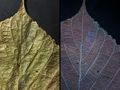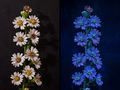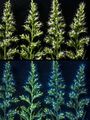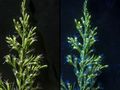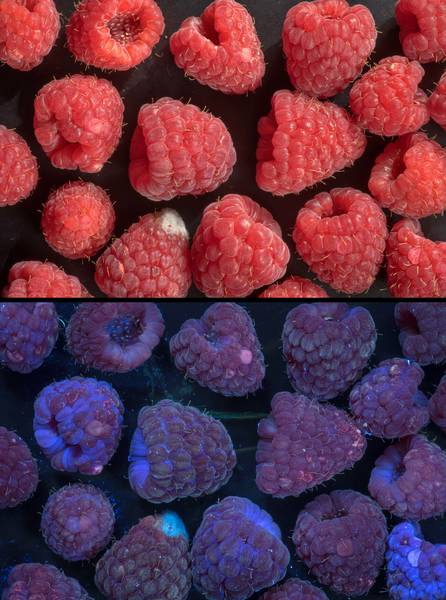

Ripe red raspberry when exposed to regular daylight as well as when illuminated by a 365 nm ultraviolet (UV-A) blacklight from Lick Creek ParkLick Creek: Background Notes. College Station, Texas


Album 3631: College Station and Sam Houston Forest, Texas, October 11 - 13, 2024
The image presents a comparative analysis of raspberries under two distinct lighting conditions: regular daylight and illumination by a 365 nm ultraviolet (UV-A) blacklight from Lick Creek Park, College Station, Texas.
**Image Composition**
* The top half of the image showcases raspberries illuminated by regular daylight.
+ The raspberries appear red in color.
+ They have a vibrant appearance due to the natural light source.
* The bottom half of the image displays the same raspberries when exposed to UV-A blacklight from Lick Creek Park, College Station, Texas.
**Key Observations**
* Under UV-A illumination, the raspberries exhibit a distinct blue fluorescence, indicating the presence of fluorescent compounds within their tissues.
* This phenomenon is attributed to the unique properties of the UV-A light, which causes certain molecules in the berries to emit light at a longer wavelength than they absorb.
**Conclusion**
The image effectively highlights the differences in appearance between raspberries when exposed to regular daylight versus UV-A blacklight. The fluorescent effect observed under UV-A illumination suggests that the berries contain compounds capable of absorbing and emitting light at specific wavelengths, providing valuable insights into their chemical composition. – AI vision
🇪🇸 Descripción en español / Spanish Description
La frambuesa madura roja se ve cuando está expuesta a la luz del día normal y cuando es iluminada por una luz negra ultravioleta (UV-A) de 365 nm en Lick Creek Park. College Station, Texas, 13 de octubre de 2024. La imagen presenta un análisis comparativo de las frambuesas bajo dos condiciones de iluminación distintas: luz del día normal e iluminación por una luz negra ultravioleta (UV-A) de 365 nm en Lick Creek Park, College Station, Texas. **Composición de la imagen** * La mitad superior de la imagen presenta frambuesas iluminadas con luz del día normal. + El color rojo de las frambuesas es visible. + Tienen un aspecto vibrante debido a la fuente de luz natural. * La mitad inferior de la imagen muestra las mismas frambuesas cuando se exponen a luz UV-A negra en Lick Creek Park, College Station, Texas. **Observaciones clave** * Bajo iluminación UV-A, las frambuesas presentan una fluorescencia azul distintiva que indica la presencia de compuestos fluorescentes dentro de sus tejidos. * Este fenómeno se atribuye a las propiedades únicas de la luz UV-A, lo que hace que ciertas moléculas en las bayas emitan luz a una longitud de onda más larga de la que absorben. **Conclusión** La imagen destaca efectivamente las diferencias en el aspecto entre las frambuesas cuando se exponen a la luz del día normal frente a la luz UV-A negra. El efecto fluorescente observado bajo iluminación UV-A sugiere que las bayas contienen compuestos capaces de absorber y emitir luz en longitudes de onda específicas, lo que proporciona información valiosa sobre su composición química. – Spanish translation