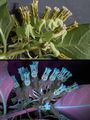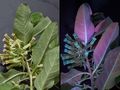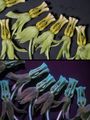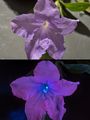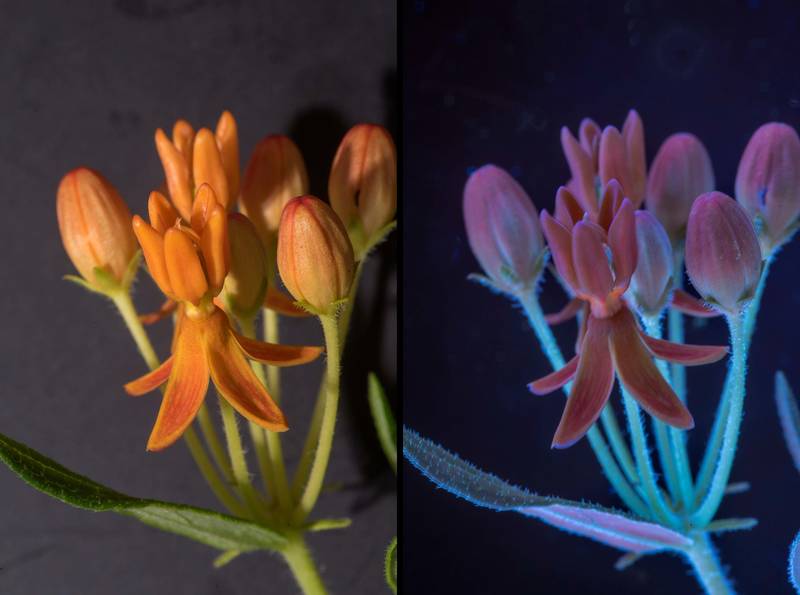

Orange milkweed (Asclepias tuberosa) when exposed to regular daylight as well as when illuminated by a 365 nm ultraviolet (UV-A) blacklight from Richards Loop Trail in Sam Houston National Forest. Texas


Album 3623: College Station - Sam Houston Forest, Texas, September 19 - 21, 2024
The image presents a striking comparison between two photographs of an orange milkweed plant, showcasing its vibrant appearance under different lighting conditions.
* **Daylight Image:**
* The left side of the image displays the orange milkweed plant as it would appear in natural daylight.
* The flowers and stems are depicted in their normal color, with no visible fluorescence or unusual effects.
* This photograph serves as a baseline for comparison to the blacklight-illuminated image on the right.
* **Blacklight-Illuminated Image:**
* On the right side of the image, the same orange milkweed plant is captured under the illumination of a 365 nm ultraviolet (UV-A) blacklight.
* The flowers and stems exhibit a profound change in appearance, emitting a bright blue-green glow that stands out against the dark background.
* This effect is characteristic of fluorescence, where certain materials absorb energy from the UV light and re-emit it at longer wavelengths, resulting in the observed coloration.
In summary, the image effectively illustrates the phenomenon of fluorescence in plants, specifically highlighting how orange milkweed responds to ultraviolet light. The comparison between the daylight and blacklight photographs demonstrates the unique property of this plant, which can be an interesting subject for further study or observation by nature enthusiasts. – AI vision
🇪🇸 Descripción en español / Spanish Description
La Aspidistra (Asclepias tuberosa) cuando se expone a la luz diurna habitual y cuando se ilumina con una lámpara negra de luz ultravioleta de 365 nm desde el Richards Loop Trail en el Bosque Nacional Sam Houston. Texas, 21 de septiembre de 2024. La imagen presenta una sorprendente comparación entre dos fotografías de una planta de aspidistra amarilla, mostrando su aspecto vibrante bajo diferentes condiciones de luz.
**Imagen de luz diurna:**
En el lado izquierdo de la imagen se muestra la planta de aspidistra amarilla como aparecería a la luz del día natural. Las flores y tallos se representan en su color normal, sin fluorescencia visible ni efectos inusuales. Esta fotografía sirve de referencia para compararla con la imagen iluminada por una lámpara negra en el lado derecho.
**Imagen iluminada por una lámpara negra:**
En el lado derecho de la imagen, se captura la misma planta de aspidistra amarilla bajo la iluminación de una lámpara negra ultravioleta de 365 nm. Las flores y tallos muestran un profundo cambio de aspecto, emitiendo un brillo azul-verdoso intenso que destaca contra el fondo oscuro.
Este efecto es característico de la fluorescencia, donde ciertos materiales absorben energía de la luz ultravioleta y la reemiten a longitudes de onda más largas, dando como resultado la coloración observada. En resumen, la imagen ilustra efectivamente el fenómeno de la fluorescencia en las plantas, destacando especialmente cómo la aspidistra amarilla responde a la luz ultravioleta. La comparación entre las fotografías de luz diurna y lámpara negra demuestra la propiedad única de esta planta, que puede ser un sujeto interesante para estudios o observaciones adicionales por parte de los entusiastas de la naturaleza. – Spanish translation