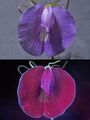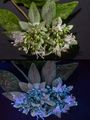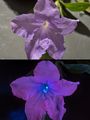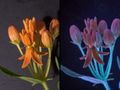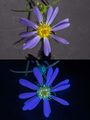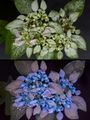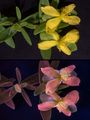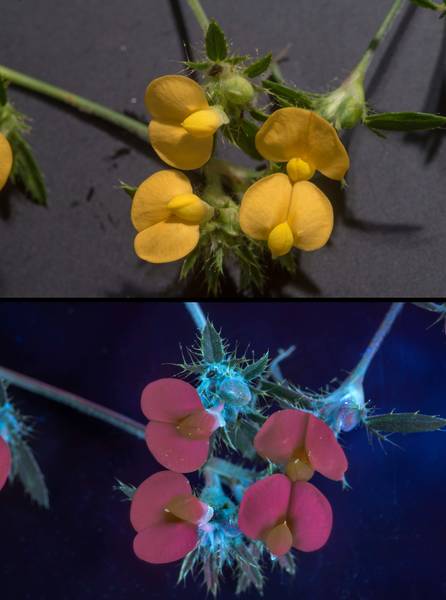

Pencil flower (Stylosanthes biflora) when exposed to regular daylight as well as when illuminated by a 365 nm ultraviolet (UV-A) blacklight from Richards Loop Trail in Sam Houston National Forest. Texas


Album 3623: College Station - Sam Houston Forest, Texas, September 19 - 21, 2024
The image presents a striking contrast between two photographs of the same pencil flower species, Stylosanthes biflora. The top photograph showcases the flower under normal daylight conditions, while the bottom one highlights its unique features when illuminated by a 365 nm ultraviolet (UV-A) blacklight.
**Daylight Conditions:**
* **Flower Color:** In the daytime image, the flowers display a vibrant yellow color.
* **Background:** The background is dark gray, providing a subtle contrast to the flower's bright hue.
**Ultraviolet Light Exposure:**
* **Flower Color Change:** When exposed to UV-A blacklight, the flowers undergo a significant transformation. They transition from their natural yellow color to a deep pinkish-red shade.
* **Background:** The background remains dark gray in both images but appears slightly darker when illuminated by the UV-A blacklight.
**Comparison and Observations:**
* **Color Intensity:** The flower's color becomes more intense under UV-A light, with the pinkish-red hue being more pronounced than the yellow.
* **Background Contrast:** Although the background remains dark gray in both images, it appears slightly darker when illuminated by the UV-A blacklight, creating a subtle contrast between the two photographs.
In summary, the image effectively demonstrates the transformative effect of UV-A light on the pencil flower's coloration. The comparison between the daytime and nighttime images highlights the unique features of this species when exposed to specific wavelengths of light. – AI vision
🇪🇸 Descripción en español / Spanish Description
Flor de lápiz (Stylosanthes biflora) cuando se expone a la luz diurna regular, así como cuando se ilumina con una lámpara negra de ultravioleta de 365 nm desde el Richards Loop Trail en el bosque nacional Sam Houston. Texas, septiembre 21, 2024. La imagen presenta un contraste sorprendente entre dos fotografías de la misma especie de flor de lápiz, Stylosanthes biflora. La fotografía superior muestra la flor en condiciones de luz diurna normal, mientras que la inferior destaca sus características únicas cuando se ilumina con una lámpara negra ultravioleta de 365 nm (UV-A).
**Condiciones de luz diurna:**
* **Color de las flores:** En la imagen diurna, las flores muestran un color amarillo vibrante.
* **Fondo:** El fondo es gris oscuro, proporcionando un contraste sutil con el tono brillante de las flores.
**Exposición a luz ultravioleta:**
* **Cambio de color de las flores:** Al exponerlas a la luz UV-A, las flores sufren una transformación significativa. Pasan de su color natural amarillo a un tono rosado oscuro.
* **Fondo:** El fondo sigue siendo gris oscuro en ambas imágenes pero parece ligeramente más oscuro cuando se ilumina con la luz UV-A.
**Comparación y observaciones:**
* **Intensidad del color:** El color de las flores se vuelve más intenso bajo la luz UV-A, siendo el tono rosado más pronunciado que el amarillo.
* **Contraste de fondo:** Aunque el fondo sigue siendo gris oscuro en ambas imágenes, parece ligeramente más oscuro cuando se ilumina con la luz UV-A, creando un sutil contraste entre las dos fotografías.
En resumen, la imagen demuestra de forma eficaz el efecto transformador de la luz UV-A en la coloración de la flor de lápiz. La comparación entre las imágenes diurna y nocturna destaca las características únicas de esta especie cuando se expone a longitudes de onda específicas de luz. – Spanish translation