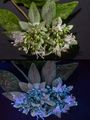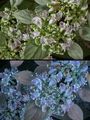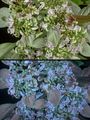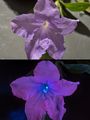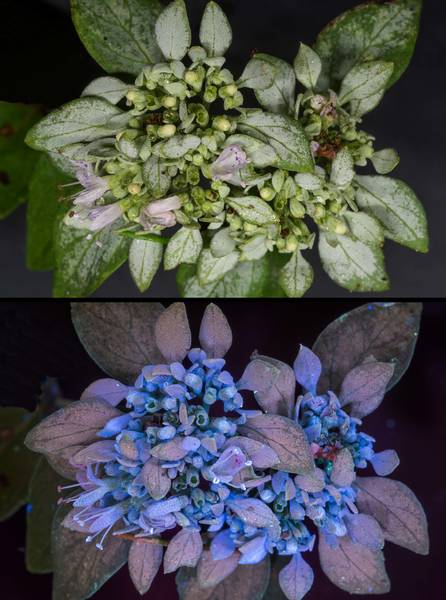

Mountain mint (Pycnanthemum tenuifolium) when exposed to regular daylight as well as when illuminated by a 365 nm ultraviolet (UV-A) blacklight from Richards Loop Trail in Sam Houston National Forest near Montgomery. Texas


Album 3615: Sam Houston Forest, Texas, September 6, 2024
The image presents two photographs of mountain mint flowers, showcasing their appearance under regular daylight and when illuminated by a 365 nm ultraviolet (UV-A) blacklight.
**Photograph 1: Regular Daylight**
* The photograph at the top depicts the mountain mint flower in its natural state, with leaves and stems visible.
* The plant's foliage appears relatively unremarkable, lacking any notable features or patterns that stand out under regular lighting conditions.
**Photograph 2: UV-A Blacklight Illumination**
* In contrast, the photograph at the bottom displays the same mountain mint flower illuminated by a 365 nm ultraviolet (UV-A) blacklight.
* Under this specialized light source, the plant's foliage exhibits a subtle but distinct pattern of purple and blue hues, particularly evident in the leaves and stems.
* This phenomenon is likely due to the presence of fluorescent pigments or other compounds within the plant that respond to UV-A radiation.
**Key Observations**
* The use of a 365 nm UV-A blacklight reveals previously invisible patterns on the mountain mint flower's foliage, providing new insights into its structure and biology.
* This technique may be useful for studying the plant's interactions with its environment or identifying potential therapeutic applications. – AI vision
🇪🇸 Descripción en español / Spanish Description
La menta de montaña (Pycnanthemum tenuifolium) cuando se expone a la luz del día regular, así como también cuando está iluminada por una lámpara negra ultravioleta de 365 nm del Sendero de Richards Loop en el Bosque Nacional Sam Houston cerca de Montgomery. Texas, septiembre de 2024. La imagen presenta dos fotografías de las flores de menta de montaña, mostrando su apariencia bajo luz regular del día y cuando se ilumina con una lámpara negra ultravioleta (UV-A) de 365 nm. **Fotografía 1: Luz Regular del Día** * La fotografía en la parte superior muestra la flor de menta de montaña en su estado natural, con las hojas y tallos visibles. * El follaje de la planta aparece relativamente sin rasgos notables o patrones que destacan bajo condiciones normales de iluminación. **Fotografía 2: Iluminación con Lámpara Negra UV-A** * En contraste, la fotografía en la parte inferior muestra la misma flor de menta de montaña iluminada por una lámpara negra ultravioleta (UV-A) de 365 nm. * Bajo esta fuente de luz especializada, el follaje de la planta exhibe un patrón sutil pero distintivo de tonos morados y azules, particularmente evidente en las hojas y tallos. * Este fenómeno se debe probablemente a la presencia de pigmentos fluorescentes u otros compuestos dentro de la planta que responden a la radiación UV-A. **Observaciones Clave** * El uso de una lámpara negra UV-A de 365 nm revela patrones previamente invisibles en el follaje de la menta de montaña, proporcionando nuevos conocimientos sobre su estructura y biología. * Esta técnica puede ser útil para estudiar las interacciones de la planta con su entorno o identificar posibles aplicaciones terapéuticas. – Spanish translation