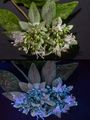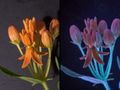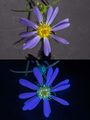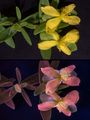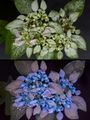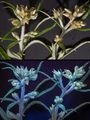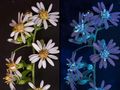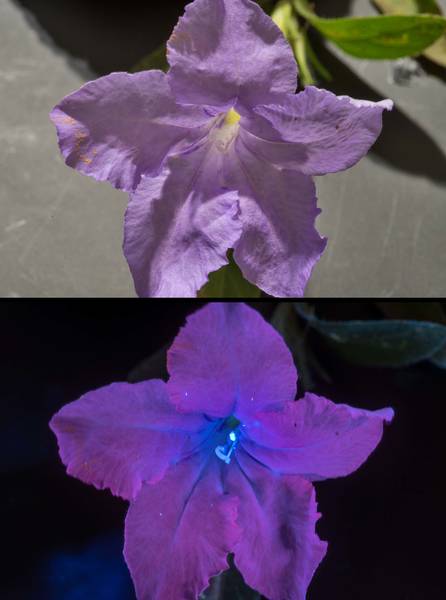

Wild petunia (Ruellia caroliniensis(?)) when exposed to regular daylight as well as when illuminated by a 365 nm ultraviolet (UV-A) blacklight from Richards Loop Trail in Sam Houston National Forest. Texas


Album 3623: College Station - Sam Houston Forest, Texas, September 19 - 21, 2024
The image features two photographs of a wild petunia flower, showcasing its appearance under different lighting conditions. The top photograph is taken using regular daylight, while the bottom one utilizes a blacklight with a wavelength of 365 nm ultraviolet (UV-A) light.
**Top Photograph:**
* **Flower Color:** Under normal lighting, the flowers are purple in color.
* **Background:** The background appears to be dark, possibly due to shadows cast by the surrounding foliage or the photographer's position.
**Bottom Photograph:**
* **Flower Appearance:** When illuminated with UV-A light, the flower exhibits a striking blue-purple luminescence. This effect is likely caused by fluorescent pigments present in the petals that absorb UV radiation and emit visible light.
* **Background:** The background remains dark, possibly due to the intense UV-A illumination overpowering any ambient light sources.
**Conclusion:**
The image effectively demonstrates how different lighting conditions can significantly impact our perception of colors. The use of UV-A light reveals a hidden aspect of the flower's appearance, highlighting its unique ability to fluoresce under specific wavelengths of radiation. This phenomenon is not only visually striking but also provides valuable insights into the complex interactions between light and biological materials in nature. – AI vision
🇪🇸 Descripción en español / Spanish Description
La petunia silvestre (Ruellia caroliniensis?) cuando se expone a la luz del día regular, así como cuando se ilumina con una luz negra de longitud de onda de 365 nm UV-A desde Richards Loop Trail en el Bosque Nacional Sam Houston, Texas. 21 de septiembre de 2024. La imagen muestra dos fotografías de una flor de petunia silvestre, mostrando su apariencia bajo diferentes condiciones de iluminación. La fotografía superior se toma con luz del día normal, mientras que la inferior utiliza una luz negra con una longitud de onda de luz ultravioleta (UV-A) de 365 nm.
**Fotografía superior:** * **Color de las flores:** Bajo iluminación normal, las flores son de color púrpura. * **Fondo:** El fondo parece oscuro, posiblemente debido a las sombras producidas por la vegetación circundante o la posición del fotógrafo.
**Fotografía inferior:** * **Apariencia de las flores:** Cuando se ilumina con luz UV-A, la flor exhibe una impresionante luminiscencia azul-púrpura. Este efecto es probablemente causado por pigmentos fluorescentes presentes en los pétalos que absorben radiación UV y emiten luz visible. * **Fondo:** El fondo sigue oscuro, posiblemente debido a la intensa iluminación UV-A que sobrepasa cualquier fuente de luz ambiental.
**Conclusión:** La imagen demuestra efectivamente cómo las diferentes condiciones de iluminación pueden tener un impacto significativo en nuestra percepción de los colores. El uso de la luz UV-A revela un aspecto oculto del aspecto de las flores, destacando su capacidad única para fluorescer bajo longitudes de onda específicas de radiación. Este fenómeno no solo es visualmente impactante sino que también proporciona insights valiosos en las complejas interacciones entre la luz y los materiales biológicos en la naturaleza. – Spanish translation