
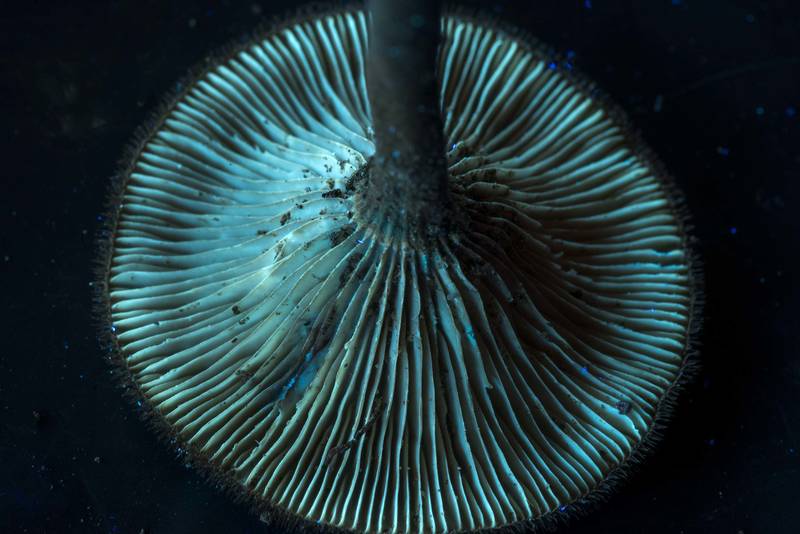

Gills of mushroom Panus tephroleucus in ultraviolet light collected from North Wilderness Trail of Little Lake Creek Wilderness in Sam Houston National Forest north from Montgomery. Texas


Album 3639: College Station, Texas, November 4 - 8, 2024
The image presents a close-up view of the gills of a mushroom, specifically Panus tephroleucus, illuminated by ultraviolet (UV) light. The mushroom was collected from North Wilderness Trail within Little Lake Creek Wilderness in Sam Houston National Forest, north of Montgomery, Texas on November 7, 2024.
**Key Features:**
* **Mushroom Gills:** The image showcases the gills of a Panus tephroleucus mushroom, characterized by their distinctive fan-shaped or semi-circular shape. These gills are typically white to cream-colored and have a smooth surface.
* **Ultraviolet Lighting:** The mushroom is illuminated using UV light, which causes its bioluminescent properties to become visible. This effect creates a striking contrast between the dark background and the glowing gills.
* **Bioluminescence:** The glowing appearance of the gills is due to bioluminescence, a natural process in some fungi where they produce light as a result of chemical reactions within their cells. This phenomenon is often referred to as "glowing mushrooms" or "fluorescent mushrooms."
* **Background:** The background of the image appears dark and featureless, which helps to accentuate the glowing effect of the mushroom's gills.
**Conclusion:**
The image provides a unique glimpse into the fascinating world of bioluminescent fungi. By capturing the glowing gills of a Panus tephroleucus mushroom under UV light, it highlights the intricate details of these organisms and their ability to produce light. This phenomenon is not only visually striking but also contributes to our understanding of the complex interactions between microorganisms and their environments. – AI vision
🇪🇸 Descripción en español / Spanish Description
Los lóbulos del hongo Panus tephroleucus bajo luz ultravioleta recogidos en North Wilderness Trail de Little Lake Creek Wilderness en Sam Houston National Forest al norte de Montgomery, Texas, el 7 de noviembre de 2024. La imagen presenta una vista detallada de los lóbulos de un hongo, específicamente Panus tephroleucus, iluminados por luz ultravioleta (UV). El hongo se recolectó en North Wilderness Trail dentro de Little Lake Creek Wilderness en Sam Houston National Forest, al norte de Montgomery, Texas el 7 de noviembre de 2024. **Características clave:** * **Lóbulos del hongo**: la imagen muestra los lóbulos de un hongo Panus tephroleucus, caracterizado por su distintiva forma de abanico o semi-circular. Estos lóbulos son típicamente de color blanco a crema y tienen una superficie lisa. * **Iluminación ultravioleta:** el hongo se ilumina usando luz UV, lo que hace que sus propiedades bioluminescentes se vuelvan visibles. Este efecto crea un contraste notable entre el fondo oscuro y los lóbulos brillantes. * **Bioluminiscencia:** el aspecto luminoso de los lóbulos es debido a la bioluminiscencia, un proceso natural en algunos hongos donde producen luz como resultado de reacciones químicas dentro de sus células. Este fenómeno se conoce comúnmente como "hongos brillantes" o "hongos fluorescentes". * **Antecedentes:** el fondo de la imagen aparece oscuro y sin rasgos, lo que ayuda a acentuar el efecto luminoso de los lóbulos del hongo. **Conclusión:** La imagen proporciona una visión única al fascinante mundo de los hongos bioluminiscentes. Al capturar los lóbulos brillantes de un hongo Panus tephroleucus bajo luz UV, se destaca la complejidad de estos organismos y su capacidad para producir luz. Este fenómeno no solo es visualmente impresionante sino que también contribuye a nuestra comprensión de las interacciones complejas entre microorganismos y sus entornos. – Spanish translation


