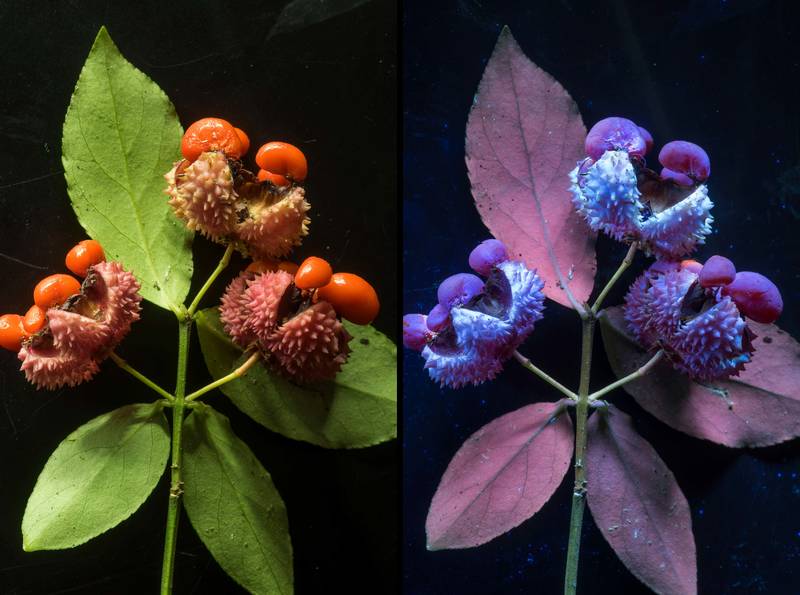

Strawberry-bush (Euonymus americanus) when exposed to regular daylight as well as when illuminated by a 365 nm ultraviolet (UV-A) blacklight taken from North Wilderness Trail of Little Lake Creek Wilderness in Sam Houston National Forest north from Montgomery. Texas


Album 3639: College Station, Texas, November 4 - 8, 2024
The image presents a comparative analysis of the strawberry-bush plant's appearance under regular daylight and ultraviolet (UV-A) blacklight illumination.
**Key Features:**
* The left-hand photograph captures the strawberry-bush plant under regular daylight conditions.
* The right-hand photograph shows the same plant illuminated by a 365 nm UV-A blacklight, highlighting its unique characteristics in response to UV light.
**Plant Characteristics:**
* Under daylight, the strawberry-bush appears as a typical plant with green leaves and red berries.
* When exposed to UV-A blacklight, however, it reveals striking changes:
+ Its pinkish-red coloration becomes more vibrant and intense.
+ The red berries turn bright orange or yellow.
**Conclusion:**
The image effectively demonstrates the effects of UV light on the strawberry-bush plant, showcasing its ability to absorb and reflect different wavelengths of light. This phenomenon is likely due to the presence of specific pigments in the plant's cells that respond to UV radiation by altering their coloration. The image provides valuable insights into the intricate relationships between plants and light, highlighting the importance of considering multiple factors when studying plant biology.
**Final Answer:** The final answer is: The strawberry-bush plant exhibits a unique response to ultraviolet (UV-A) blacklight illumination, transforming its appearance from green with red berries under daylight conditions to pinkish-red with bright orange or yellow berries. – AI vision
🇪🇸 Descripción en español / Spanish Description
La planta de arbusto de fresa (Euonymus americanus) cuando está expuesta a la luz diurna regular, así como cuando se ilumina con una lámpara negra ultravioleta (UV-A) de 365 nm tomada del North Wilderness Trail of Little Lake Creek Wilderness en Sam Houston National Forest al norte de Montgomery. Texas, el 7 de noviembre de 2024. La imagen presenta un análisis comparativo del aspecto de la planta de arbusto de fresa bajo la luz diurna y la iluminación ultravioleta (UV-A). **Características clave:** * La fotografía de la izquierda captura la planta de arbusto de fresa en condiciones de luz diurna normal. * La fotografía de la derecha muestra la misma planta iluminada por una lámpara negra ultravioleta de 365 nm, lo que destaca sus características únicas en respuesta a la radiación UV. **Características de la planta:** * Bajo la luz diurna, el arbusto de fresa aparece como una planta típica con hojas verdes y bayas rojas. * Cuando se expone a la lámpara negra ultravioleta (UV-A), sin embargo, revela cambios sorprendentes: + Su coloración rosada se vuelve más vibrante e intensa. + Las bayas rojas se tornan naranja brillante o amarillo. **Conclusión:** La imagen demuestra efectivamente los efectos de la luz ultravioleta en la planta del arbusto de fresa, mostrando su capacidad para absorber y reflejar diferentes longitudes de onda de luz. Este fenómeno se debe probablemente a la presencia de pigmentos específicos en las células de la planta que responden a la radiación UV alterando su coloración. La imagen proporciona información valiosa sobre las intrincadas relaciones entre las plantas y la luz, destacando la importancia de considerar múltiples factores al estudiar la biología vegetal. **Respuesta final:** La planta del arbusto de fresa exhibe una respuesta única a la iluminación ultravioleta (UV-A) negra, transformando su aspecto de verde con bayas rojas bajo luz diurna normal a rosado intenso con bayas naranja brillante o amarillo. – Spanish translation