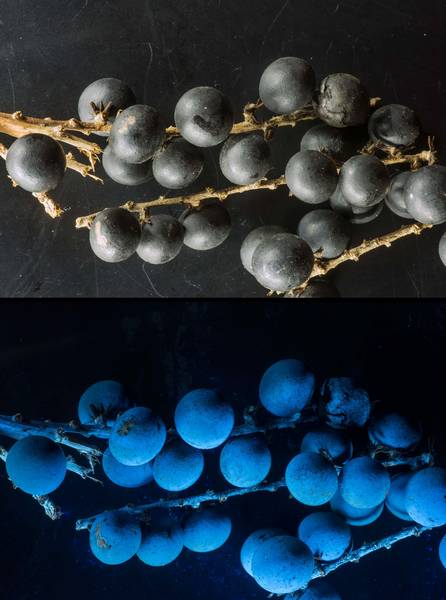

Berries of saw palmetto when exposed to regular daylight as well as when illuminated by a 365 nm ultraviolet (UV-A) blacklight taken from North Wilderness Trail of Little Lake Creek Wilderness in Sam Houston National Forest north from Montgomery. Texas


Album 3639: College Station, Texas, November 4 - 8, 2024
The image presents two photographs of saw palmetto berries, showcasing their appearance under regular daylight and when illuminated by a blacklight emitting ultraviolet (UV-A) light with a wavelength of 365 nm.
**Top Image: Daylight**
* The top photograph depicts a cluster of dark purple to nearly black berries on branches.
* The berries appear relatively uniform in size and color, with some exhibiting slight variations in tone or texture.
* Overall, the berries are depicted as being slightly smaller than a dime in diameter.
**Bottom Image: Blacklight Illumination**
In contrast, the bottom photograph reveals the same cluster of saw palmetto berries when illuminated by UV-A light from a blacklight. Under these conditions, the berries take on an even more intense and uniform blue coloration, while the branches remain relatively unchanged in appearance. This striking transformation highlights the unique properties of saw palmetto berries, which exhibit a notable fluorescence under UV-A illumination.
**Comparison and Conclusion**
The two photographs demonstrate the distinct differences in how saw palmetto berries appear when exposed to regular daylight versus UV-A light from a blacklight. While the berries remain relatively consistent in color and size under normal lighting conditions, they undergo a dramatic transformation under UV-A illumination, taking on an intense blue hue that is not visible with the naked eye under standard lighting conditions. This phenomenon underscores the importance of considering multiple lighting sources when evaluating plant characteristics or conducting research on their properties. – AI vision
🇪🇸 Descripción en español / Spanish Description
Bayas de serrato cuando se exponen a la luz diurna regular y también cuando se iluminan con una luz negra ultravioleta (UV-A) de 365 nm tomada en North Wilderness Trail of Little Lake Creek Wilderness en Sam Houston National Forest al norte de Montgomery, Texas, el 7 de noviembre de 2024. La imagen presenta dos fotografías de bayas de serrato, que muestran su aspecto bajo luz diurna y cuando se iluminan con una luz negra que emite luz ultravioleta (UV-A) con una longitud de onda de 365 nm. **Imagen superior: Luz diurna** *La fotografía superior representa un grupo de bayas moradas oscuras a casi negras en ramas. *Las bayas parecen uniformes en tamaño y color, mostrando algunas ligeras variaciones de tono o textura. *En general, las bayas se muestran como ligeramente más pequeñas que un centavo en diámetro. **Imagen inferior: Iluminación con luz negra** En contraste, la fotografía inferior revela el mismo grupo de bayas de serrato cuando se ilumina con luz UV-A desde una linterna negra. En estas condiciones, las bayas adquieren una coloración azul aún más intensa y uniforme, mientras que las ramas permanecen relativamente inalteradas en su apariencia. Esta transformación sorprendente destaca las propiedades únicas de las bayas de serrato, que muestran una notable fluorescencia bajo iluminación UV-A. **Comparación y conclusión** Las dos fotografías demuestran las distintas diferencias en cómo aparecen las bayas de serrato cuando se exponen a la luz diurna regular frente a la luz UV-A de una linterna negra. Aunque las bayas permanecen relativamente consistentes en color y tamaño bajo condiciones normales de iluminación, sufren un cambio drástico bajo iluminación UV-A, adoptando un tono azul intenso que no es visible a simple vista bajo condiciones estándar de iluminación. Este fenómeno subraya la importancia de considerar múltiples fuentes de luz al evaluar las características de las plantas o realizar investigaciones sobre sus propiedades. – Spanish translation