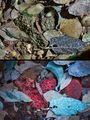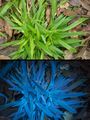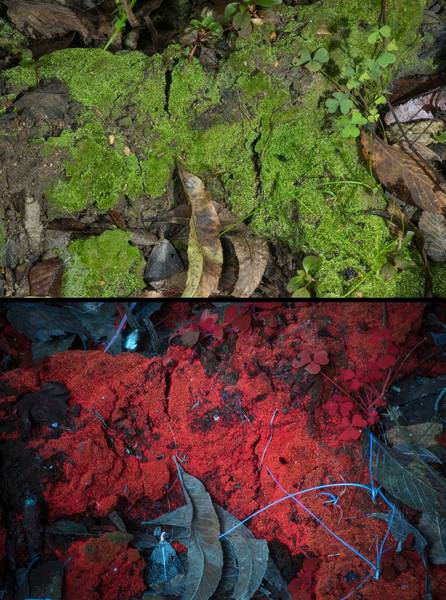

Algae on muddy soil in wet area when exposed to regular daylight as well as when illuminated by a 365 nm ultraviolet (UV-A) blacklight on Racoon Run Trail in Lick Creek ParkLick Creek: Background Notes. College Station, Texas


Album 3642: College Station, Texas, November 14 - 15, 2024
The image presents a striking comparison between two photographs of algae-covered muddy soil, taken under different lighting conditions. The top photograph is exposed to regular daylight, while the bottom one is illuminated by a 365 nm ultraviolet (UV-A) blacklight.
**Top Photograph: Daylight Exposure**
* The top photograph shows the algae-covered muddy soil in its natural state, with vibrant green patches of algae visible on the surface.
* The surrounding area appears dry and cracked, indicating that this section of the trail may have been exposed to sunlight or other environmental factors for some time.
**Bottom Photograph: UV-A Blacklight Illumination**
* In contrast, the bottom photograph is taken using a 365 nm ultraviolet (UV-A) blacklight, which reveals a different aspect of the algae's appearance.
* The algae now appears bright red and fluorescent under the UV-A light, indicating that it contains pigments that absorb in the ultraviolet range.
* This effect is likely due to the presence of chlorophyll or other photosynthetic pigments within the algae cells.
**Comparison of Photographs**
* A visual comparison between the two photographs highlights the dramatic difference in coloration caused by the UV-A light.
* The bright red and fluorescent appearance of the algae under UV-A illumination stands out against its greenish hue when exposed to regular daylight.
* This contrast suggests that the algae has a unique property that allows it to absorb or reflect ultraviolet radiation, making it visible only under certain lighting conditions.
**Conclusion**
In conclusion, this image showcases the fascinating phenomenon of bioluminescence in algae, where the organism's pigments respond differently to various wavelengths of light. By comparing the two photographs taken under different lighting conditions, we gain insight into the complex interactions between living organisms and their environment. This observation has implications for our understanding of ecological processes and the importance of considering multiple perspectives when studying natural phenomena. – AI vision
🇪🇸 Descripción en español / Spanish Description
Las algas del suelo lúdico en una zona húmeda cuando se exponen a la luz diurna regular, así como cuando se iluminan con una luz negra ultravioleta (UV-A) de 365 nm en el sendero Racoon Run en el parque Lick Creek. College Station, Texas, 15 de noviembre de 2024. La imagen presenta una comparación sorprendente entre dos fotografías de suelo fangoso cubierto de algas, tomadas en diferentes condiciones de iluminación. La fotografía superior está expuesta a la luz diurna regular, mientras que la inferior se ilumina con una luz negra ultravioleta (UV-A) de 365 nm.
**Fotografía superior: Exposición a la luz del día** * La fotografía superior muestra el suelo fangoso cubierto de algas en su estado natural, con parches verdes vibrantes de algas visibles en la superficie. * El área circundante parece seca y agrietada, lo que indica que esta sección del sendero puede haber estado expuesta a la luz solar u otros factores ambientales durante algún tiempo.
**Fotografía inferior: Iluminación con luz negra UV-A** * En contraste, la fotografía inferior se toma usando una luz negra ultravioleta (UV-A) de 365 nm, que revela un aspecto diferente del aspecto de las algas. * Ahora, las algas parecen rojo brillante y fluorescente bajo la luz UV-A, lo que indica que contienen pigmentos que absorben en el rango ultravioleta. * Este efecto se debe probablemente a la presencia de clorofila u otros pigmentos fotosintéticos dentro de las células de algas.
**Comparación de fotografías** * Una comparación visual entre las dos fotografías destaca la diferencia drástica en la coloración causada por la luz UV-A. * El aspecto rojo brillante y fluorescente de las algas bajo iluminación UV-A contrasta con su matiz verdoso cuando se expone a la luz diurna regular. * Este contraste sugiere que las algas tienen una propiedad única que les permite absorber o reflejar radiación ultravioleta, haciéndolas visibles solo bajo ciertas condiciones de iluminación.
**Conclusión** En conclusión, esta imagen muestra el fascinante fenómeno de la bioluminiscencia en algas, donde los pigmentos del organismo responden de forma diferente a diversas longitudes de onda de luz. Al comparar las dos fotografías tomadas bajo diferentes condiciones de iluminación, obtenemos información sobre las interacciones complejas entre los organismos vivos y su entorno. Este hecho tiene implicaciones para nuestra comprensión de procesos ecológicos y la importancia de considerar múltiples perspectivas al estudiar fenómenos naturales. – Spanish translation