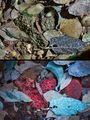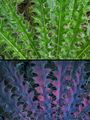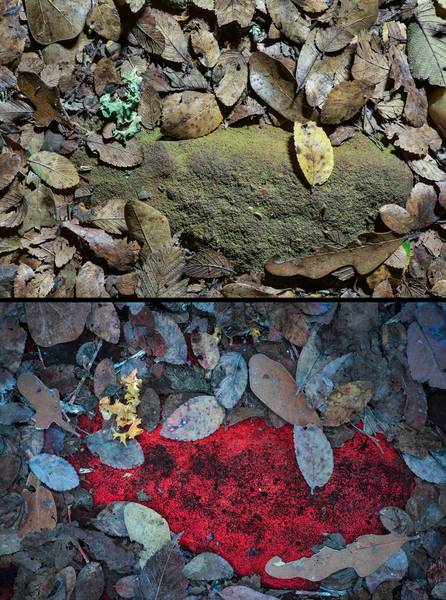

Dry oak and elm leaves and sandstone with algae on a path when exposed to regular daylight as well as when illuminated by a 365 nm ultraviolet (UV-A) blacklight in Lick Creek ParkLick Creek: Background Notes. College Station, Texas


Album 3639: College Station, Texas, November 4 - 8, 2024
The top half of the image presents an unlit scene, displaying various dry oak and elm leaves scattered on a path. Additionally, there is a large sandstone boulder covered with algae. The bottom half of the image reveals the same area under ultraviolet (UV-A) blacklight illumination.
Upon exposure to UV light, the colors change significantly. The leaves appear in shades of blue, while the sandstone boulder becomes green due to its algae growth. Furthermore, a small patch of red is visible on the path, which was previously indistinguishable from the surrounding area. This red coloration suggests the presence of lichen or fungi that emit fluorescence when exposed to UV light.
The photograph effectively showcases how different organisms respond to various forms of illumination. The use of UV-A blacklight highlights the unique characteristics of these organisms and their ability to absorb and reflect specific wavelengths of light, resulting in vibrant colors that would otherwise be invisible under regular daylight conditions. – AI vision
🇪🇸 Descripción en español / Spanish Description
Las hojas secas de roble y olmo y el piedra arenisca con algas en un camino cuando se expone a la luz diurna regular, así como cuando se ilumina con una luz ultravioleta negra (UV-A) de 365 nm en Lick Creek Park. College Station, Texas, 8 de noviembre de 2024. La mitad superior de la imagen presenta una escena sin luz, que muestra varias hojas secas de roble y olmo dispersas en un camino. Además, hay un gran boulder de piedra arenisca cubierto de algas. La mitad inferior de la imagen revela la misma área bajo iluminación ultravioleta (UV-A) negra. Tras la exposición a la luz UV, los colores cambian significativamente. Las hojas aparecen en tonos azules, mientras que el boulder de piedra arenisca se vuelve verde debido al crecimiento de algas. Además, es visible un pequeño parche rojo en el camino, que previamente era indistinguible del área circundante. Este color rojo sugiere la presencia de líquenes u hongos que emiten fluorescencia cuando se exponen a luz ultravioleta. La fotografía muestra efectivamente cómo diferentes organismos responden a diversas formas de iluminación. El uso de luz negra UV-A destaca las características únicas de estos organismos y su capacidad para absorber y reflejar longitudes de onda específicas de la luz, lo que resulta en colores vibrantes que de otra forma serían invisibles bajo condiciones de luz diurna regular. – Spanish translation