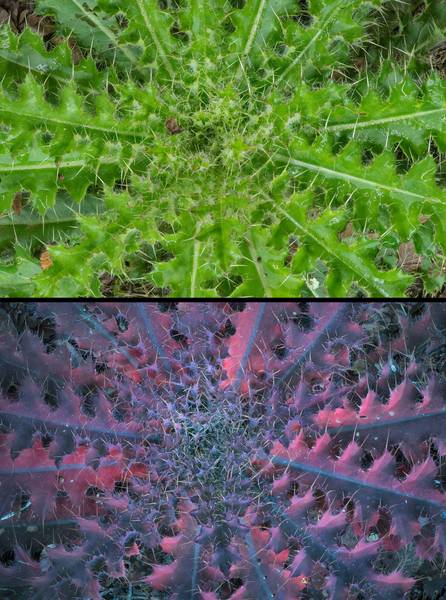

Smaller rosette of basal leaves of bull thistle (Cirsium horridulum) when exposed to regular daylight as well as when illuminated by a 365 nm ultraviolet (UV-A) blacklight on a sewage line right of way in Lick Creek ParkLick Creek: Background Notes. College Station, Texas


Album 3642: College Station, Texas, November 14 - 15, 2024
The image shows two photographs of bull thistle plants, one exposed to regular daylight and the other illuminated by a 365 nm ultraviolet (UV-A) blacklight.
**Daylight Exposure**
* The top photograph features a green rosette of basal leaves.
* The plant appears healthy with no visible signs of damage or stress.
**Ultraviolet Exposure**
* The bottom photograph shows the same plant, but this time illuminated by a 365 nm ultraviolet (UV-A) blacklight on a sewage line right of way in Lick Creek Park.
* The thistle's leaves have turned pinkish-purple and appear to be glowing under the UV light.
* The color change is due to the absorption of UV radiation by the plant, causing the chlorophyll to break down and reveal other pigments.
**Overall**
The image highlights the unique response of bull thistle plants to different types of lighting. While they appear healthy in regular daylight, they respond dramatically to UV light, changing their color and potentially altering their behavior or physiology. This phenomenon is likely an adaptation that helps them survive in environments with high levels of UV radiation. – AI vision
🇪🇸 Descripción en español / Spanish Description
Una roseta más pequeña de hojas basales de cardo torcido (Cirsium horridulum) cuando se expone a la luz del día normal, así como también cuando se ilumina con una lámpara negra de ultravioleta (UV-A) de 365 nm en un camino de alcantarillado cerca de Lick Creek Park. College Station, Texas, 15 de noviembre de 2024. La imagen muestra dos fotografías de plantas de cardo torcido, una expuesta a la luz del día normal y la otra iluminada con una lámpara negra de ultravioleta (UV-A) de 365 nm.
**Exposición a la luz del día** *La fotografía superior muestra una roseta verde de hojas basales. *La planta parece saludable sin signos visibles de daño o estrés. **Exposición ultravioleta** *En la fotografía inferior se ve la misma planta, pero esta vez iluminada con una lámpara negra de ultravioleta (UV-A) de 365 nm en un camino de alcantarillado cerca de Lick Creek Park. *Las hojas del cardo se han vuelto rosadas y parecen iluminarse bajo la luz UV. *El cambio de color es debido a la absorción de radiación UV por la planta, lo que hace que la clorofila se descomponga y revelen otros pigmentos. **Resumen** La imagen destaca la respuesta única de las plantas de cardo torcido a diferentes tipos de iluminación. Mientras que aparecen saludables en la luz del día normal, responden drásticamente a la luz UV, cambiando su color y alterando potencialmente su comportamiento o fisiología. Este fenómeno es probablemente una adaptación que los ayuda a sobrevivir en entornos con altos niveles de radiación UV. – Spanish translation