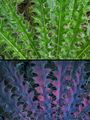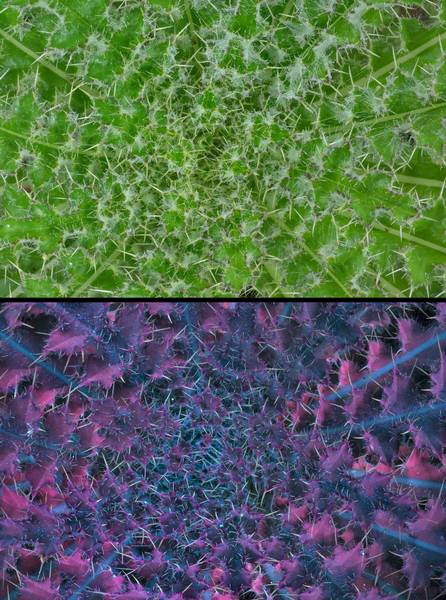

Winter rosette of bull thistle (Cirsium horridulum) when exposed to regular daylight as well as when illuminated by a 365 nm ultraviolet (UV-A) blacklight on a sewage line right of way in Lick Creek ParkLick Creek: Background Notes. College Station, Texas


Album 3642: College Station, Texas, November 14 - 15, 2024
The image showcases the intricate details of a bull thistle rosette from two distinct perspectives:
* **Top Image:** The plant's leaves are exposed to regular daylight, resulting in their typical green coloration.
* **Bottom Image:** In contrast, when illuminated by a 365 nm ultraviolet (UV-A) blacklight, the same plant exhibits vibrant pink and blue hues.
**Key Observations:**
* The use of UV light accentuates the fine hairs on the leaves, giving them an almost luminescent appearance.
* This phenomenon is likely due to the presence of flavonoids, which are responsible for absorbing ultraviolet radiation and causing a shift in color from green to pink or blue.
**Implications:**
* The image highlights the importance of considering environmental factors when studying plant biology.
* By exposing plants to different wavelengths of light, researchers can gain valuable insights into their behavior and physiology.
**Conclusion:**
The image provides a fascinating glimpse into the world of plant biology, showcasing the unique effects of UV light on the bull thistle's appearance. The use of UV light not only reveals the intricate details of the plant's structure but also demonstrates its potential as a tool for studying plant development and ecology. – AI vision
🇪🇸 Descripción en español / Spanish Description
Roseta de invierno del cardo bueyero (Cirsium horridulum) cuando se expone a la luz diurna regular, así como también cuando es iluminada por una luz negra ultravioleta (UV-A) de 365 nm en una alcantarilla abierta a la derecha del camino en el Parque Lick Creek. College Station, Texas, 15 de noviembre de 2024. La imagen muestra los detalles intrincados de una roseta de cardo bueyero desde dos perspectivas diferentes: * **Imagen superior:** Las hojas de la planta están expuestas a la luz diurna regular, lo que resulta en su típica coloración verde. * **Imagen inferior:** En contraste, cuando es iluminada por una luz negra ultravioleta (UV-A) de 365 nm, la misma planta muestra tonos rosa y azules vibrantes. **Observaciones clave:** * El uso de luz UV acentúa los pelillos finos en las hojas, dándoles un aspecto casi luminiscente. * Es probable que este fenómeno se deba a la presencia de flavonoides, responsables de absorber radiación ultravioleta y causar un cambio de color del verde al rosa o azul. **Implicaciones:** * La imagen resalta la importancia de considerar los factores ambientales cuando se estudia la biología vegetal. * Al exponer las plantas a diferentes longitudes de onda de luz, los investigadores pueden obtener información valiosa sobre su comportamiento y fisiología. **Conclusión:** La imagen proporciona un fascinante vistazo al mundo de la biología vegetal, mostrando los efectos únicos de la luz ultravioleta en el aspecto del cardo bueyero. El uso de luz UV no solo revela los detalles intrincados de la estructura de la planta, sino que también demuestra su potencial como herramienta para estudiar el desarrollo y la ecología de las plantas. – Spanish translation