
Entangled cypress roots growing over river boulders in Pedernales Falls State Park. Johnson City, Texas, January 12, 2013

Boulder field near Devil s Cave near northern entrance of John Witherspoon Woods park. Princeton, New Jersey, April 28, 2007

Morning mist on boulder field near Stuart Road entrance of John Witherspoon Woods park. Princeton, New Jersey, April 28, 2007

A creek on boulder field in John Witherspoon Woods park. Princeton, New Jersey, April 27, 2007


Skunk cabbage on boulder field in John Witherspoon Woods park. Princeton, New Jersey, April 27, 2007

Large boulders near Monrepo (Mon Repos) Park. Vyborg, north from Saint Petersburg, Russia, October 7, 2016

Stone head made from a boulder in Sergievka Park. Old Peterhof, west from Saint Petersburg, Russia, April 10, 2017

A creek on boulder field in John Witherspoon Woods park. Princeton, New Jersey, April 28, 2007

A creek crossing on boulder field in John Witherspoon Woods park. Princeton, New Jersey, April 27, 2007

Lichen and boulders near Goat Hill Trail in Blackstone River and Canal Heritage State Park. Uxbridge, Massachusetts, October 30, 2004

Boulders in Atlantic Ocean at the Knubble in Acoaxet at evening. Massachusetts, September 30, 2004

Pile of boulders in a village of Al Mashrab in area of Ras Laffan Farms. Northern Qatar, October 18, 2014

Weathered white boulder in area of Cypress Pool in Pedernales Falls State Park. Johnson City, Texas, January 12, 2013

Deeply divided umbrella-like young leaf of May apple near Boulder Field in John Witherspoon Woods park. Princeton, New Jersey, April 26, 2007

Wet granite boulders on a beach in Alexandria Park in Peterhof, west from Saint Petersburg. Russia, September 28, 2015

Bridge with boulders of Krystatelka River near Leykhtenbergsky Palace in Sergievka Park. Old Peterhof, west from Saint Petersburg, Russia, October 11, 2016

Boulders in Gulf of Finland in Alexandria Park in Peterhof, west from Saint Petersburg. Russia, May 22, 2015


Giant boulder in Pedernales Falls State Park. Johnson City, Texas, January 12, 2013

Boulders in Atlantic Ocean after sunset at the end of River Road west from Acoaxet. Westport, Massachusetts, October 26, 2004

Umbrella-like May apple leaves near boulder field in John Witherspoon Woods park. Princeton, New Jersey, April 27, 2007

Skunk cabbage on boulder field in John Witherspoon Woods park. Princeton, New Jersey, April 28, 2007

Cypress roots enveloping a river boulder in Pedernales Falls State Park. Johnson City, Texas, January 12, 2013

A boulder of tidal flat at the end of River Road west from Acoaxet. Westport, Massachusetts, October 26, 2004

Leaves of skunk cabbage near boulder field in John Witherspoon Woods park. Princeton, New Jersey, April 28, 2007


Leaves of skunk cabbage at morning near boulder field in John Witherspoon Woods park. Princeton, New Jersey, April 28, 2007

Granite boulders in Monrepo (Mon Repos) Park near Malaya Vodyanaya Street. Vyborg, Russia, September 14, 2013


Granite boulders on a beach in Alexandria Park in Peterhof, west from Saint Petersburg. Russia, September 28, 2015

Wet boulders on a beach in Alexandria Park in Peterhof, west from Saint Petersburg. Russia, September 28, 2015

Boulders in Monrepo (Mon Repos) Park. Vyborg, Russia, September 10, 2016

Boulders in Gulf of Finland in Alexandria Park. Peterhof, a suburb of Saint Petersburg, Russia, September 27, 2016

Stone head made from a boulder in Sergievka Park. Old Peterhof, west from Saint Petersburg, Russia, October 11, 2016

Stone head made from a boulder with a spring in Sergievka Park. Old Peterhof, west from Saint Petersburg, Russia, April 10, 2017

Boulders on a beach of Gulf of Finland in Tarkhovka Park near Sestroretsk, west from Saint Petersburg. Russia, September 22, 2017

Rock foam lichen (Stereocaulon saxatile)(?) on a boulder in Zakhodskoe (Lounatjoki), 50 miles north from Saint Petersburg. Russia, May 9, 2019

Lichen Lecidea lapicida(?) on a boulder in a forest in Zakhodskoe (Lounatjoki), 50 miles north from Saint Petersburg. Russia, May 9, 2019

Forest road with boulders near Zakhodskoe (Lounatjoki), 50 miles north from Saint Petersburg. Russia, August 31, 2018

Buellia(?) lichen on a boulder in a forest in Kannelyarvi, 45 miles north from Saint Petersburg. Russia, May 25, 2019

Rock foam lichen (Stereocaulon saxatile)(?) on a boulder in a forest in Kannelyarvi, 45 miles north from Saint Petersburg. Russia, May 25, 2019

Peppered rock tripe lichen (Umbilicaria deusta) on a boulder in Kannelyarvi, 45 miles north from Saint Petersburg. Russia, May 25, 2019

Map lichen Rhizocarpon petraeum on a granite boulder in Zakhodskoe (Lounatjoki), 50 miles north from Saint Petersburg. Russia, May 22, 2021

Boulders and rapids in Roshchinka River in Lindulovskaya Reserve near Roshchino, 30 miles north-west from Saint Petersburg. Russia, May 28, 2021

Boulders and whitewater in Roshchinka River in Lindulovskaya Reserve near Roshchino, 30 miles north-west from Saint Petersburg. Russia, May 28, 2021

Rapid flow of water around boulders in Roshchinka River in Lindulovskaya Reserve near Roshchino, 30 miles north-west from Saint Petersburg. Russia, May 28, 2021

Yellow map lichen (Rhizocarpon geographicum) on a granite boulder on shore of Gvardeysky Island. Vyborg, Russia, July 20, 2024

Grey crustose lichen Aspicilia on a granite boulder on shore of Gvardeysky Island. Vyborg, Russia, July 20, 2024

Elegant sunburst lichen Rusavskia elegans (formerly Xanthoria elegans) on a granite boulder on shore of Gvardeysky Island. Vyborg, Russia, July 20, 2024

Close-up of elegant sunburst lichen Rusavskia elegans (formerly Xanthoria elegans) on a granite boulder on shore of Gvardeysky Island. Vyborg, Russia, July 20, 2024

Rosette of crustose lichen Lecanora muralis (Protoparmeliopsis muralis) on a granite boulder on shore of Gvardeysky Island. Vyborg, Russia, July 20, 2024

Close-up of crustose lichen Lecanora muralis (Protoparmeliopsis muralis) on a granite boulder on shore of Gvardeysky Island. Vyborg, Russia, July 20, 2024

Physcia lichen on a granite boulder on shore of Gvardeysky Island. Vyborg, Russia, July 20, 2024

Growth of yellow map lichen (Rhizocarpon geographicum) on a granite boulder on shore of Gvardeysky Island. Vyborg, Russia, July 20, 2024

Yellow map lichen (Rhizocarpon geographicum) and another crustose yellow lichen on a granite boulder on shore of Gvardeysky Island. Vyborg, Russia, July 20, 2024

Rock shield lichen (Xanthoparmelia) on a granite boulder on shore of Gvardeysky Island. Vyborg, Russia, July 20, 2024

Rosette of yellow map lichen (Rhizocarpon geographicum) on a granite boulder on shore of Gvardeysky Island. Vyborg, Russia, July 20, 2024

Circular round patch of yellow map lichen (Rhizocarpon geographicum) on a granite boulder on shore of Gvardeysky Island. Vyborg, Russia, July 20, 2024

Granite boulders in Vyborg Bay near Stony Trail (Kamenistaya Tropa) in Kivi Park south from Chulkovo, west from Vyborg. Russia, July 27, 2024

Large granite boulders in Vyborg Bay near Stony Trail (Kamenistaya Tropa) in Kivi Park south from Chulkovo, west from Vyborg. Russia, July 27, 2024

Rapid flow of water around boulders in Roshchinka River in Lindulovskaya Larch Grove near Roshchino, 30 miles north-west from Saint Petersburg. Russia, August 4, 2024

Boulders in Roshchinka River in Lindulovskaya Larch Grove, near Roshchino, 30 miles north-west from Saint Petersburg. Russia, September 30, 2025

Glacial erratic (a large granite boulder) left behind by the retreating Scandinavian Ice Sheet over 11,000 years ago. The inscription ":041d:0415:0422 :0412:041e:0419:041d:0415" (pronounced Net Voyne), meaning "NO TO THE WAR," is a direct political protest against the ongoing Russian invasion of Ukraine. Activists often paint this slogan in forests, on snow, on frozen rivers, or in elevators to avoid CCTV cameras and police patrols found in city centers. This stone serves as a quiet but firm artifact of internal resistance, standing in the silent forest just kilometers from the station and the dacha community. Kannelyarvi, north from Saint Petersburg, Russia, October 1, 2025

Gulf of Finland coastline, with shallow waters and glacial boulders. Behind the rocky beach, there is a zone of Common Reed (Phragmites australis), which is ubiquitous along the Neva Bay coast. The trees include Scots Pine (Pinus sylvestris)--the tall conifer with orange bark on the right--and Black Alder or Birch, which are typical for these damp, sandy soils. The pines here are often twisted by the strong westerly winds. Tarkhovka Park near Sestroretsk, west from Saint Petersburg. Russia, October 3, 2025

Scattered, moss-covered remains of the pontoon bridge mechanism or its anchoring system. The massive granite boulders with embedded iron loops are likely anchors for a floating structure, or remnants of the pontoon system itself that was once used or stored near the Visconti Bridge. Before the stone Visconti Bridge was built in 1803, a floating bridge existed in this location. It is possible these are historical remnants from that era or parts of the hydraulic system used to manage the floating pontoons or secure boats near the dam. Pavlovsk, a suburb of Saint Petersburg, Russia, October 6, 2025

View towards Repino from the Laskovy Beach area in Solnechnoe highlighting a transition in the coastal landscape of the Gulf of Finland, marked by rugged natural textures and distinct geological features typical of the Karelian Isthmus shoreline. Unlike the wide, smooth sandy expanses of the main Laskovy Beach, the stretch towards Repino is characterized by a "stony belt" of glacial boulders and pebbles. The rocks visible in the shallow water and on the sand--primarily rapakivi granite and gneiss--are glacial erratics left behind by retreating ice sheets. Their reddish and grey hues (wet from the waves) contrast sharply with the rust-colored sand. Several hooded crows (Corvus cornix) are visible foraging along the shoreline. Saint Petersburg, Russia, October 9, 2025

Hydraulic engineering and bank reinforcement works at Upper Ponds in Catherine Park. The piles of large fieldstones (boulders) and gravel, along with the heavy machinery (an excavator is visible in the background), indicate major landscaping and structural repairs. The area near the Upper Ponds has historically required maintenance to its complex system of dams, sluices, and cascades. Pushkin (former Tsarskoe Selo) near Saint Petersburg, Russia, October 10, 2025

Rocky riverbed of Karasta River, with moss-covered boulders visible in the shallow water. Oranienbaum palace-and-park ensemble in Lomonosov (a suburb of St. Petersburg), Russia, October 13, 2025

Autumn in Upper Park. The large glacial boulder (erratic block) on the side of the path is a typical element of 19th-century romantic park design, intended to add a sense of antiquity and natural wildness. Oranienbaum palace-and-park ensemble in Lomonosov (a suburb of St. Petersburg), Russia, October 13, 2025

Rustic, three-arched stone bridge (often referred to as the Ruin Bridge or simply the stone arch bridge) in the "Russian Switzerland" area in Oranienbaum s Upper Park. Built from rough-hewn boulders to mimic a natural or ancient ruin, it harmonizes perfectly with the wild, rugged aesthetic of the Karasta River valley. The bridge spans a small ravine or tributary, surrounded by a golden forest of birch and maple trees that soften the stone s heavy appearance with delicate autumn foliage. Oranienbaum palace-and-park ensemble in Lomonosov (a suburb of St. Petersburg), Russia, October 13, 2025

Close-up view of the Karasta River cascade in Oranienbaum Park. The water tumbles over tiered, man-made steps (part of the Lower Bridge dam system), transforming into a silky, smooth sheet of water that suggests a long-exposure photograph. Moss-covered boulders at the base add a rugged, naturalistic touch, breaking the uniform flow into frothy white streams that contrast with the dark, wet stone walls. Oranienbaum palace-and-park ensemble in Lomonosov (a suburb of St. Petersburg), Russia, October 13, 2025

Stone bridge in Oranienbaum Park in the "Russian Switzerland" section of the Upper Park. The bridge is built from rough, unpolished granite boulders, giving it a deliberately archaic, "ruin-like" appearance that blends seamlessly into the natural landscape, typical of the romantic style popular in the 19th century. It spans a bend in the Karasta River, connecting a gravel path that winds through rolling green hills, which were artificially shaped to mimic an alpine valley. Oranienbaum palace-and-park ensemble in Lomonosov (a suburb of St. Petersburg), Russia, October 13, 2025

Upper Park s "Russian Switzerland". A majestic, deep green spruce tree in the foreground provides a striking vertical anchor, contrasting sharply with the soft, hazy backdrop of golden maples and oaks that line the riverbanks. The shallow, rocky riverbed is visible through the clear, dark water, with scattered boulders breaking the surface, enhancing the "mountain stream" illusion intended by the landscape architects. Oranienbaum palace-and-park ensemble in Lomonosov (a suburb of St. Petersburg), Russia, October 13, 2025

The "Stone Head" (also known as "The Old Man" or "Adam s Head") which is Sergievka Park s most famous and mysterious landmark. Carved from a massive granite boulder in situ, its origins are unclear. Most researchers date it to around 1800, attributing it to an unknown master, possibly based on a design by Franz Brouer. The sculpture appears to be sinking into the earth, with its eyes wide open, gazing up from the bottom of a ravine near the manor house, surrounded by fallen autumn leaves. Sergievka Park, Old Peterhof, west from Saint Petersburg, Russia, October 13, 2025

The "Adam s Head" (or Golova-valun:feff) sculpture presents a striking profile view, revealing its deep-set eye and prominent nose emerging from the earth. Bright yellow maple leaves carpeting the ground and contrasting with the grey granite. A small spring flows near the base of the sculpture (visible in the foreground as a trickle), adding to the mystical atmosphere that reportedly inspired Lewis Carroll during his visit in 1867. This angle emphasizes the massive scale of the boulder relative to the path, showing how the face was carved directly into the natural granite contours. Sergievka Park, Old Peterhof, west from Saint Petersburg, Russia, October 13, 2025

This stone bridge serves as a picturesque crossing over the Kristatelka River ravine, situated at the foot of the slope directly beneath the Leuchtenberg Palace. As part of the 19th-century Sergievka ensemble, this bridge links the wilder, lower ravine paths (near the "Adam s Head" boulder) with the landscaped grounds surrounding the palace on the upper terrace. It features a solid masonry arch topped with simple iron railings, designed to provide a functional yet scenic vantage point for viewing the deep ravine that defines the estate s geography. Sergievka Park, Old Peterhof, west from Saint Petersburg, Russia, October 13, 2025

A stone arch bridge of the Kristatelka River situated downstream from the "Adam s Head" sculpture. The bridge features a solid, polished masonry arch topped with a simple, functional black iron railing. Spanning a cascade of moss-covered boulders and small waterfalls, the bridge sits deep within the ravine, creating a secluded atmosphere amplified by the dense canopy of trees. Sergievka Park, Old Peterhof, west from Saint Petersburg, Russia, October 13, 2025

Close-up of the "Adam s Head" (or "The Old Man") revealing the intricate craftsmanship carved directly into the granite boulder, highlighting its weathered texture and mysterious expression. The close view emphasizes the deeply carved eyes with distinct eyelids and pupils, gazing upward in a look of eternal surprise or contemplation. The nose is prominent and well-defined. The sculpture s rough granite surface is speckled with wet, yellow maple leaves, which contrast with the dark grey stone and emphasize its seamless, "sunken" placement within the forest floor. Sergievka Park, Old Peterhof, west from Saint Petersburg, Russia, October 13, 2025
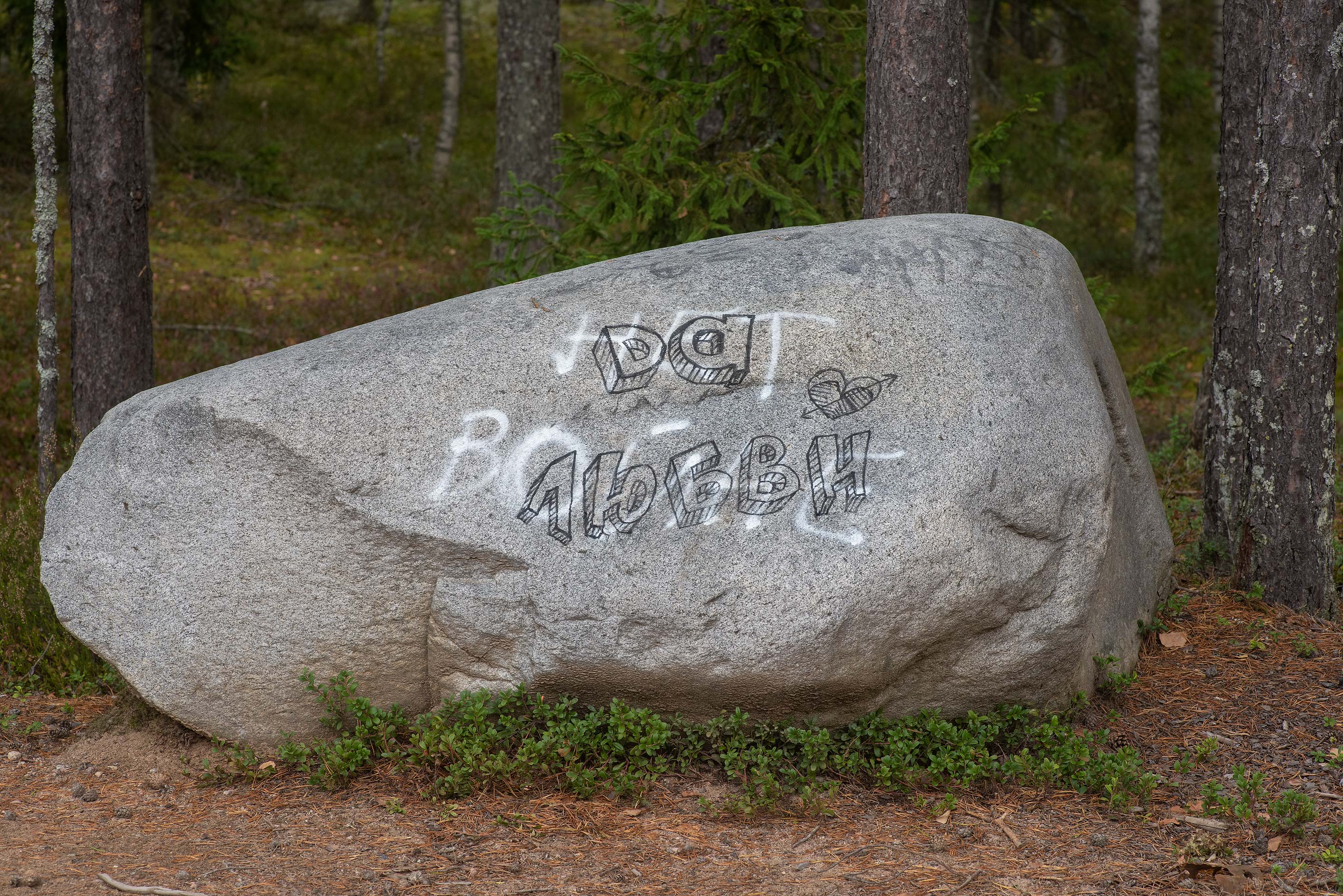
A large granite boulder in a forest bears the inscription [OpenCurlyDoubleQuote]:041d:0415:0422 :0412:041e:0419:041d:0415 / :0414:0430 :043b:044e:0431:0432:0438[CloseCurlyDoubleQuote]--[OpenCurlyDoubleQuote]NO TO WAR / YES TO LOVE[CloseCurlyDoubleQuote] - and a small heart pierced by an arrow. In contemporary Russia, the wording can be read as a quiet act of resistance to Russia[CloseCurlyQuote]s invasion of Ukraine, contrasting military violence with love and human solidarity. Kannelyarvi, north from Saint Petersburg, Russia, September 9, 2026
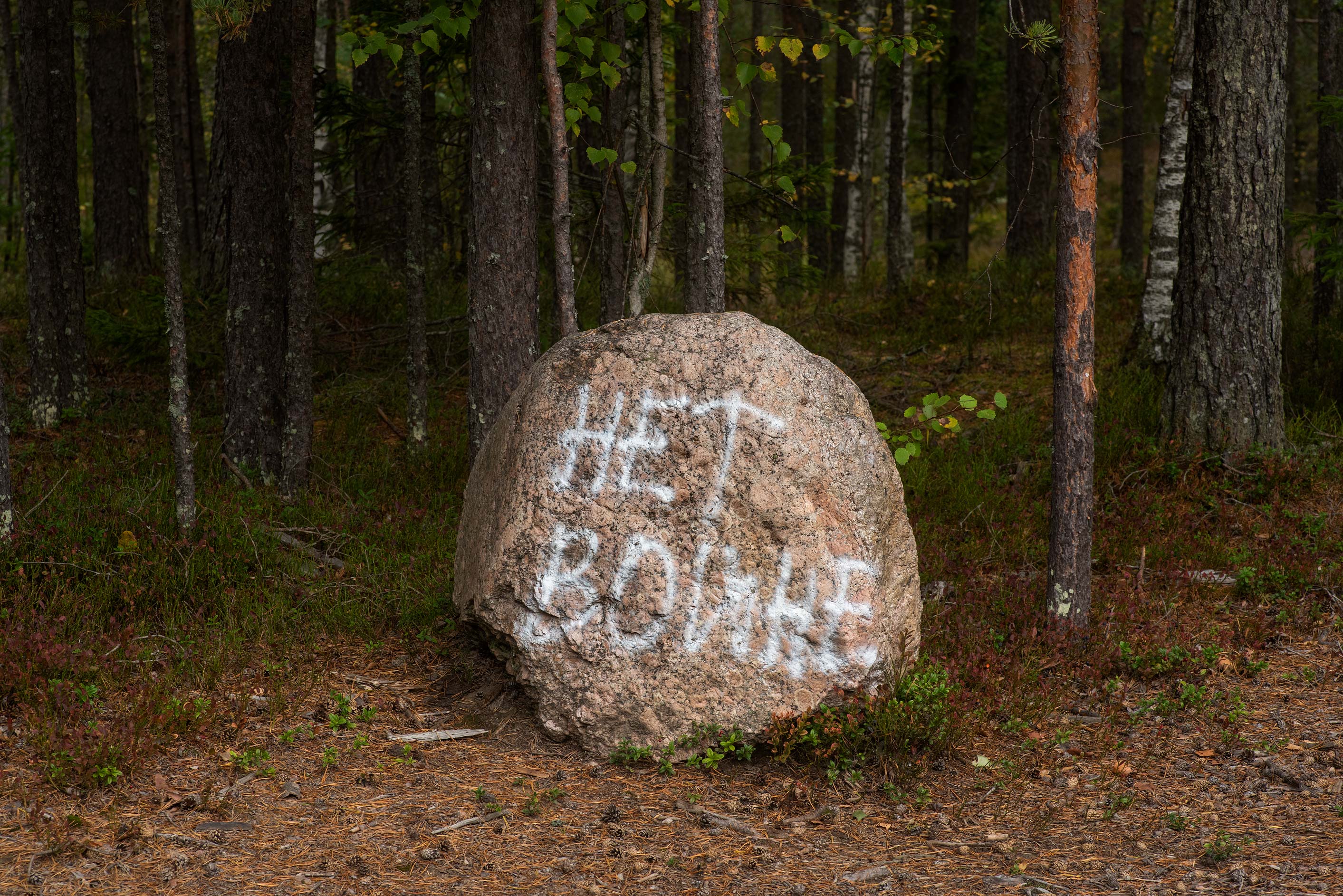
Inscription "NO TO THE WAR" on a granite boulder in a forest. Kannelyarvi, north from Saint Petersburg, Russia, September 9, 2026
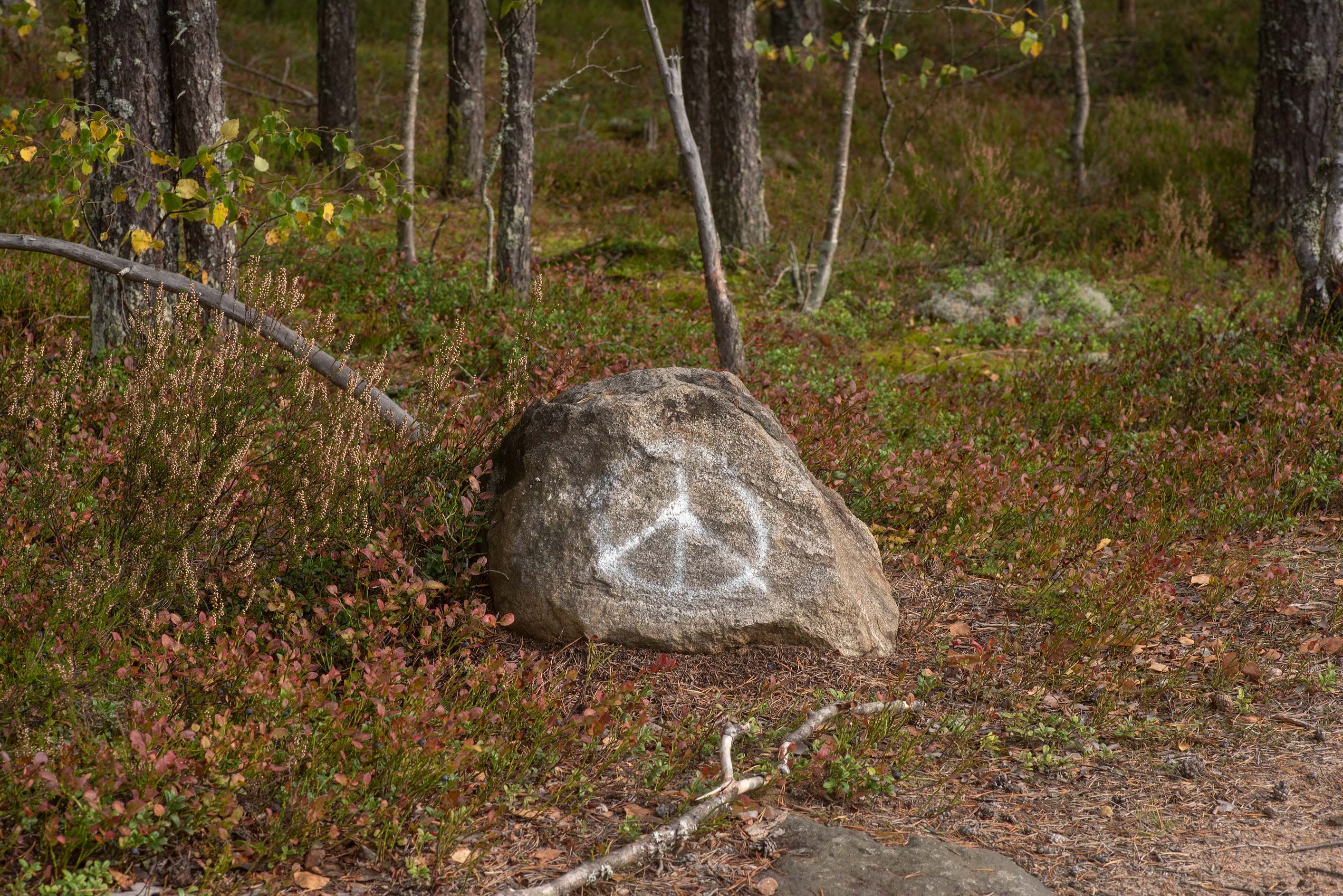
A white peace symbol painted on a forest boulder offers a quiet anti-war message amid autumn vegetation. In the context of Russia[CloseCurlyQuote]s invasion of Ukraine, it may express dissent, though its author and intended meaning are unknown. Kannelyarvi, north from Saint Petersburg, Russia, September 9, 2026
