
Room of Italian Art of the 13th to Early 15th Century in Hermitage Museum. Saint Petersburg, Russia, June 10, 2009

Group of early spring pinkgill mushrooms Entoloma vernum in sandy firebreak ditch in Dibuny, near Saint Petersburg. Russia, May 18, 2017

Wrinkled thimble-cap mushrooms (early morel, Verpa bohemica) at Road 41K-064 south from Mys Moryin Nos, east from Saint Petersburg. Russia, May 26, 2017

Church of Savior on Blood at early morning. Saint Petersburg, Russia, August 7, 2004

Early Weigela (Weigela praecox) in Botanic Gardens of Komarov Botanical Institute. Saint Petersburg, Russia, May 26, 2014

Early snowfall over summer houses of a mining city Beriozovsk in Siberia, near Kemerovo. Russia, September 15, 2002

Early fruit of wild strawberry (Russian name Zemlianika) east from Kuzmolovo, 7 miles north from Saint Petersburg. Russia, June 22, 2011

Early spring pinkgill mushrooms Entoloma vernum in sandy firebreak ditch in Dibuny, near Saint Petersburg. Russia, May 18, 2017

Engineers (Mikhailovsky) Castle at early morning. Saint Petersburg, Russia, August 7, 2004

Sculpted head and torso of the Red Army soldier marking the grave of Mikhail Abramovich Fishman (1890-1935) on the Communist Section of the Alexander Nevsky Lavra. Rendered in early Socialist Realist style, the portrait captures a determined, stoic gaze, a firm jawline, and the textured wool collar of a military greatcoat. Crowning the figure is a summer-pattern budenovka (cloth helmet) with a visor, buttoned earflaps, and an incised five-pointed Red Army star at the front. Rain-slicked dark patination, traces of moss, and weathered crevices in the cast metal highlight the sculptural fidelity of this iconic revolutionary sentinel standing directly before Holy Trinity Cathedral. Saint Petersburg, Russia, May 29, 2014

Early snowfall over summer houses of a mining city Beriozovsk in Siberia, near Kemerovo. Russia, September 15, 2002

Early spring brittlestem mushrooms Psathyrella spadiceogrisea in Sosnovka Park. Saint Petersburg, Russia, May 27, 2017

This constructivist funerary sculpture on the Communist Section of the Alexander Nevsky Lavra marks the 1921 grave of Nikolay Vasilyevich Bakhvalov, remembered in Petrograd lore as one of the pioneer automobile drivers and motor mechanics of early revolutionary Russia. In the chaotic aftermath of the Civil War, professional chauffeurs and mechanics formed an indispensable technical corps operating transport trucks and armored vehicles, prompting local authorities to allocate Bakhvalov a burial site within the monastery s inner courtyard. Eschewing stone stelae and traditional Orthodox funerary emblems, the memorial was fabricated by fellow workers from authentic mechanical components representing the deceased s trade. The structure rests on a concrete plinth anchored by paired cast-iron spoked wheels, surmounted by horizontal spur gears and transmission rings. Heavy roller drive chains--the type utilized in early chain-driven motorcars and industrial machinery--extend upward in a triangular pyramid to meet a central vertical shaft and finial that originally displayed a metal nameplate. Created during the War Communism era, the monument represents a rare surviving specimen of early Soviet Productivist and Proletkult memorial art. By assembling discarded industrial hardware into an emblem of proletarian labor and mechanized modernization directly opposite baroque monastic architecture, the work embodied the early Bolshevik effort to replace religious mourning traditions with a secular cult of the machine. Saint Petersburg, Russia, May 25, 2011

Ivory Madonna (Virgin and Child, France, early 13th century) on display in Hermitage Museum. Saint Petersburg, Russia, June 3, 2011

Early snowfall at Barzas River near a mining city Beriozovsk in Siberia, near Kemerovo. Russia, September 15, 2002

Decoration with voting(?) saints on ivory plaque (book cover, Italy, early 12th century) in Hermitage Museum. Saint Petersburg, Russia, July 1, 2010

This detailed bas-relief portrait on the Communist Section of the Alexander Nevsky Lavra depicts Alexander Alexeyevich Kapteltsev (1895-1933), chief of Leningrad s Criminal Investigation Department (:0423:0433:043e:043b:043e:0432:043d:044b:0439 :0440:043e:0437:044b:0441:043a) under the OGPU . The sculpted relief captures his heavy features, fleshy neck, and closely cropped hair, wearing an early 1930s service tunic (gymnastyorka) with a turn-down collar . The collar tabs display four geometric insignia insignia along the gold trim--representing the 1928-1931 positional category insignia for senior militia and criminal investigation commanders prior to the reintroduction of personal military ranks. Weathered surface pitting, dark soot deposits in the carved folds, and traces of moisture accent the stark realism of the early Soviet security chief s funerary monument. Saint Petersburg, Russia, May 29, 2014

Early snowfall near a mining city Beriozovsk in Siberia, near Kemerovo. Russia, September 15, 2002

This grave marker on the Communist Section of the Alexander Nevsky Lavra commemorates Pyotr Petrovich Petrov (1883-1925), an early Bolshevik revolutionary and Soviet worker-cadre buried during the First Five-Year Plan s formative years. Like many party functionaries interred along the courtyard s central avenues, Petrov died in the mid-1920s during the arduous post-Civil War reconstruction of Petrograd . The memorial consists of a weathered concrete and stone stele characteristic of the modest, egalitarian funerary aesthetic favored for early Soviet party members . Flanked by iron railings and spring greenery, the unadorned headstone preserves an austere, secular tribute to an early Soviet activist laid to rest within the historic monastery courtyard. Saint Petersburg, Russia, May 29, 2014

Early snowfall near a mining city Beriozovsk in Siberia, near Kemerovo. Russia, September 15, 2002

Rose-pink flowers of early Weigela (Weigela praecox) in Botanic Gardens of Komarov Botanical Institute. Saint Petersburg, Russia, May 28, 2011

This monument in the inner courtyard of the Alexander Nevsky Lavra in Saint Petersburg marks the grave of Alexander Alexeyevich Kapteltsev (1895-1933), who headed Leningrad[CloseCurlyQuote]s Criminal Investigation Department (:0423:0433:043e:043b:043e:0432:043d:044b:0439 :0440:043e:0437:044b:0441:043a) under the OGPU from 1929 until his death. The burial site belongs to the historic Communist Section (:041a:043e:043c:043c:0443:043d:0438:0441:0442:0438:0447:0435:0441:043a:0430:044f :043f:043b:043e:0449:0430:0434:043a:0430), a cemetery created in 1917-1919 directly before Holy Trinity Cathedral that Bolshevik authorities repurposed into an elite pantheon for prominent revolutionaries, secret police officials, military commanders, and Soviet intellectuals within the grounds of an Orthodox monastery . The obelisk of dark polished stone features an inset bas-relief portrait in lighter composite showing Kapteltsev in an early Soviet service tunic (gymnastyorka) bearing the badge of an Honorary Worker of the VChK-OGPU on his chest. Beneath it sits a light stone nameplate where the word :041f:043e:043b:043a:043e:0432:043d:0438:043a (Colonel) appears faintly above his surname--a later addition or informal epitaph, given that personal military ranks were not formally restored in the Soviet Union until 1935, two years after his demise. Decades of northern weathering and moisture have streaked the dark stone and partially eroded the painted lettering of the plaque. The subject[CloseCurlyQuote]s striking resemblance to North Korean leader Kim Jong Un is purely accidental, resulting from natural facial physiognomy combined with period aesthetics. Kapteltsev s full features, prominent double chin, close-cropped military haircut, and buttoned high-collar collar uniform closely echo the contemporary silhouette, tailored dress, and iconic grooming associated with North Korea s supreme leadership. Russia, November 25, 2016

Pink flowers of early Weigela (Weigela praecox) in Botanic Gardens of Komarov Botanical Institute. Saint Petersburg, Russia, May 26, 2014

Early birch bolete mushroom (Leccinum scabrum(?), Podberiozovik) near Sobachye Lake in Sosnovka Park. Saint Petersburg, Russia, June 24, 2014

This monument marks Mass Grave No. 7 of three power workers - Sergey Yakovlevich Vasilyev, Sergey Ivanovich Vshivtsev, and Alexander Mikhailovich Babanov . As recorded on the marble epitaph plaque mounted on the concrete base, the men perished on July 24, 1935, in a fatal industrial electrical accident at Leningrad s 5th State District Power Plant (:0413:042d:0421-5, later Krasny Oktyabr) during the First and Second Five-Year Plans aggressive electrification drive . Enclosed by black looped-iron railings against golden foliage, the memorial features a painted steel scale replica of a high-voltage transmission pylon (:043e:043f:043e:0440:0430 :041b:042d:041f) with crossarms and ceramic suspension insulators . The constructivist design reflects early Soviet funerary culture, which substituted traditional crosses with the industrial artifacts of a worker[CloseCurlyQuote]s vocation, transforming state electrification and technological sacrifice into sacred proletarian memory within the monastery courtyard. Communist section of Alexander Nevsky Lavra, Saint Petersburg, Russia, October 18, 2016

This steel monument in the inner courtyard of the Alexander Nevsky Lavra marks Mass Grave No. 7 on the historic Communist Section, commemorating three Soviet electrical workers - Sergey Yakovlevich Vasilyev, Sergey Ivanovich Vshivtsev, and Alexander Mikhailovich Babanov. The three men died together on July 24, 1935, in a severe industrial electrical accident at Leningrad[CloseCurlyQuote]s 5th State District Power Plant (:0413:042d:0421-5, later known as Krasny Oktyabr). Celebrated as fallen martyrs of the nation s rapid electrification drive, they were granted an elite collective burial on the monastery grounds alongside revolutionaries, military commanders, and prominent party cadres. The grave is crowned by a detailed miniature replica of an electrical transmission pylon (:043e:043f:043e:0440:0430 :041b:042d:041f), complete with riveted steel lattice bracing, crossarms, and hanging ceramic insulator bells. The monument reflects early Soviet constructivist mourning aesthetics, which systematically purged Orthodox crosses in favor of industrial tools, machine gears, and technological artifacts that symbolized a worker[CloseCurlyQuote]s vocation and contribution to socialist development. The presence of a high-voltage transmission tower directly before Holy Trinity Cathedral stands as one of the most eccentric visual contradictions of early Soviet material culture . Reflecting Vladimir Lenin s defining decree that communism equated to Soviet power plus national electrification, the utilitarian pylon transformed sacred monastic space into a monument honoring Soviet modernization and the sacrifices of its industrial labor force. Saint Petersburg, Russia, November 25, 2016

This modest headstone in the Communist Section of the Alexander Nevsky Lavra commemorates P. S. Fedotov (1900-1931), a 31-year-old Bolshevik party member who was killed in the line of duty. The weathered inscription reads :0427:041b. :0412:041a:041f(:0431) - denoting his membership in the All-Union Communist Party of Bolsheviks--and records his death with the Soviet administrative formula :043f:043e:0433:0438:0431 :043f:0440:0438 :0441:043b:0443:0436:0435:0431. :043e:0431:044f:0437. (short for :043f:043e:0433:0438:0431 :043f:0440:0438 :0438:0441:043f:043e:043b:043d:0435:043d:0438:0438 :0441:043b:0443:0436:0435:0431:043d:044b:0445 :043e:0431:044f:0437:0430:043d:043d:043e:0441:0442:0435:0439) on October 31, 1931 (notated as 31/X). In Leningrad during this era, such formal recognition alongside burial in an elite pantheon typically honored law enforcement operatives, OGPU security officers, or industrial managers who perished in violent confrontations with armed criminal gangs, counter-revolutionary elements, or fatal workplace emergencies. In sharp contrast to the monumental granite obelisks and constructivist steel sculptures of senior officials nearby, Fedotov[CloseCurlyQuote]s marker exemplifies the austere egalitarianism of early Soviet funerary culture. Proletarian ethics of the First Five-Year Plan discouraged bourgeois tomb ostentation, favoring minimal, unadorned markers that commemorated political dedication over personal grandeur. The memorial consists of a rough stone slab set into a concrete footing, punctuated by machine-drilled holes along the lower edge that reveal its origin as salvaged pre-revolutionary masonry or industrial scrap - a resourceful repurposing common during the construction shortages of early 1930s Leningrad. Covered in moss and decades of urban weathering, the stone preserves the hand-chiseled epitaph of a rank-and-file Soviet cadre buried on the grounds of an Orthodox monastery. Saint Petersburg, Russia, November 25, 2016

This sculptural niche on the Communist Section of the Alexander Nevsky Lavra shelters the memorial urn of Professor Ivan Ivanovich Grekov (1867-1934), one of Russia s foremost clinical surgeons and chief physician of Leningrad s historic Obukhov Hospital. Renowned for pioneering complex abdominal and cardiovascular procedures--including an early successful direct suture of a penetrating cardiac wound--Grekov was named an Honored Scientist of the RSFSR in 1932. His sudden death in 1934 prompted the municipal authorities to grant him a resting place in the monastery courtyard, which served as an elite civic pantheon for pre-revolutionary academic luminaries alongside Bolshevik cadres. The monument departs from the constructivist steel pylons and industrial iconography common to neighboring graves, adopting traditional neoclassical funerary forms. Recessed within a vaulted masonry alcove sits a fluted stone urn draped in a sculpted mourning shroud and accented with beaded molding, adorned with a profile medallion that captures Grekov[CloseCurlyQuote]s features with academic realism. Commissioned by his medical colleagues, the design reflects the enduring humanistic traditions of the imperial-trained intelligentsia in early Soviet Leningrad. Saint Petersburg, Russia, November 25, 2016

Early season pinkgill mushrooms Entoloma vernum in Dibuny, near Saint Petersburg. Russia, May 18, 2017

Early spring pinkgill mushrooms Entoloma vernum in firebreak in Dibuny, near Saint Petersburg. Russia, May 18, 2017

Gills of early spring pinkgill mushrooms Entoloma vernum in Dibuny, near Saint Petersburg. Russia, May 18, 2017

Wrinkled thimble-cap mushroom (early morel, Verpa bohemica) at Road 41K-064 south from Mys Moryin Nos, east from Saint Petersburg. Russia, May 26, 2017

Wrinkled thimble-cap mushrooms (early morel, Verpa bohemica) on mushroom show in Botanic Gardens of Komarov Botanical Institute. Saint Petersburg, Russia, May 27, 2017

Gills of early spring pinkgill mushrooms Entoloma vernum near a road in a spruce forest in Tarkhovka near Sestroretsk. West from Saint Petersburg, Russia, May 13, 2019

Group of early spring pinkgill mushrooms Entoloma vernum under pines in Tarkhovka near Sestroretsk. West from Saint Petersburg, Russia, May 13, 2019

Early spring pinkgill mushrooms Entoloma vernum near Road 41K-064 south from Mys Moryin Nos near Ladoga Lake, east from Saint Petersburg. Russia, May 14, 2019

Wrinkled thimble-cap mushrooms (early morel, Verpa bohemica) in aspen forest at Road 41K-064 south from Mys Moryin Nos, east from Saint Petersburg. Russia, May 26, 2017

Close up of wrinkled thimble-cap mushroom (early morel, Verpa bohemica) at Road 41K-064 south from Mys Moryin Nos, east from Saint Petersburg. Russia, May 26, 2017

Early Weigela (Weigela praecox) in Botanic Gardens of Komarov Botanical Institute. Saint Petersburg, Russia, June 9, 2017

Early autumn in Blizhnie Dubki area near Lisiy Nos, west from Saint Petersburg. Russia, September 26, 2017

Early spring pinkgill mushrooms Entoloma vernum in Tarkhovka near Sestroretsk. West from Saint Petersburg, Russia, May 13, 2019

Early spring pinkgill mushrooms Entoloma vernum near a road in a spruce forest in Tarkhovka near Sestroretsk. West from Saint Petersburg, Russia, May 13, 2019

Group of early spring pinkgill mushrooms Entoloma vernum near a road in a spruce forest in Tarkhovka near Sestroretsk. West from Saint Petersburg, Russia, May 13, 2019

Early spring pinkgill mushrooms Entoloma vernum on a small opening in a spruce forest in Tarkhovka near Sestroretsk. West from Saint Petersburg, Russia, May 13, 2019

Early spring pinkgill mushrooms Entoloma vernum under pines in Tarkhovka near Sestroretsk. West from Saint Petersburg, Russia, May 13, 2019

Serene autumn scene at Laskovy Beach (Russian: Laskovyy Plyazh) in the settlement of Solnechnoe, located on the shore of the Gulf of Finland, approximately 40 kilometers northwest of Saint Petersburg. Laskovy Beach is one of the most popular beaches in the Kurortny District of Saint Petersburg. The name "Laskovy" translates to "Affectionate" or "Tender," while the settlement name, Solnechnoe, means "Sunny". This area has a rich history as a summer resort destination; formerly known as the Finnish village of Ollila, it became a hub for St. Petersburg s intelligentsia and dacha owners in the late 19th and early 20th centuries. The image shows a trio of birch trees with vibrant yellow and orange leaves, which is characteristic of the "Golden Autumn" season in the Leningrad Region during early-to-mid October. The golden leaves contrast strikingly with the blue sky and the dark blue waters of the Gulf. The large white concrete sphere on the sand is a landscaping feature. Russia, October 9, 2025

Rebuilding of the Forest Building (Russian: Lesnoy Korpus) in a major reconstruction project at the historic Sestroretsk Resort (Sestroretsky Kurort). The original Sestroretsk Resort was a famous health spa complex founded in 1898 by engineer Peter Avenarius. It featured several grand wooden structures, including a massive Kursaal (concert hall), a mud bath facility, and the Forest Building. The resort was a hub for St. Petersburg s elite and intelligentsia in the early 20th century. The original Forest Building was a beautiful wooden hotel and sanatorium building constructed in the early 1900s. It was a key part of the ensemble but was destroyed during World War II. The new structure faithfully replicates the "Northern Art Nouveau" style of the original resort architecture, characterized by its complex roofline, spires, towers, and wooden detailing that harmonizes with the surrounding pine forest and dunes. The exterior appears nearly complete, showing the elaborate wooden facade, the large central dome, and the corner towers with their needle-like spires. The scaffolding indicates that finishing work is still in progress. Saint Petersburg, Russia, October 9, 2025

Upper Bath Pavilion reflected perfectly in the Mirror Pond in Catherine Park. Built in 1777-1779 by the architects Ilya and Vasily Neelov, this pavilion is a fine example of Early Classicism. The building features a modest yet elegant yellow facade with a central arched entrance and circular windows (oculi) adorned with garlands. Pushkin (former Tsarskoe Selo) near Saint Petersburg, Russia, October 10, 2025

Big Lamsky Pond (Bolshoy Lamskoy Prud), part of a system of ponds originally dug in the early 19th century to drain the park s marshy terrain. Aleksandrovsky (Alexander) Park in Pushkin (former Tsarskoe Selo) near Saint Petersburg, Russia, October 10, 2025

Small Lamsky Bridge (Maly Lamskoy Bridge), built in the early 20th century (around 1900) to replace an earlier wooden crossing. Aleksandrovsky (Alexander) Park in Pushkin (former Tsarskoe Selo) near Saint Petersburg, Russia, October 10, 2025

Part of the Maze (or Labyrinth) located in the Lower Garden. The area features a classic French formal garden layout with geometrically trimmed hedges and gravel paths, characteristic of the early 18th-century design commissioned by Alexander Menshikov. Oranienbaum palace-and-park ensemble in Lomonosov (a suburb of St. Petersburg), Russia, October 13, 2025

Katalnaya Gorka Pavilion (Sliding Hill Pavilion), a masterpiece of 18th-century architecture located in the Upper Park of Oranienbaum. Designed by Antonio Rinaldi, this 33-meter-high pavilion is a striking blend of Baroque and early Classicism. Its festive, light-blue and white facade, tiered "wedding-cake" shape, and crowning bell-shaped dome make it resemble a lighthouse rising above the park s trees. Oranienbaum palace-and-park ensemble in Lomonosov (a suburb of St. Petersburg), Russia, October 13, 2025

A view from a window near Svetlanovsky Prospekt that offers an intimate look into a typical residential courtyard (dvor) of the Vyborgsky District. The beige brick buildings framing the scene are classic examples of brick Khrushchev-era apartments (or early Brezhnev-era), likely built in the 1960s. The 5-story height was standard to avoid the mandatory installation of elevators, which was required for buildings of 6 stories or more. This layout reflects the Soviet microdistrict concept, where residential blocks were arranged around green, communal courtyards to provide light, air, and recreation space away from the main roads. Saint Petersburg, Russia, October 14, 2025

Allegorical statue of Peace, sculpted by the Venetian artist Pietro Baratta in the early 18th century in Pavlovsk Park. Pavlovsk, a suburb of Saint Petersburg, Russia, October 15, 2025
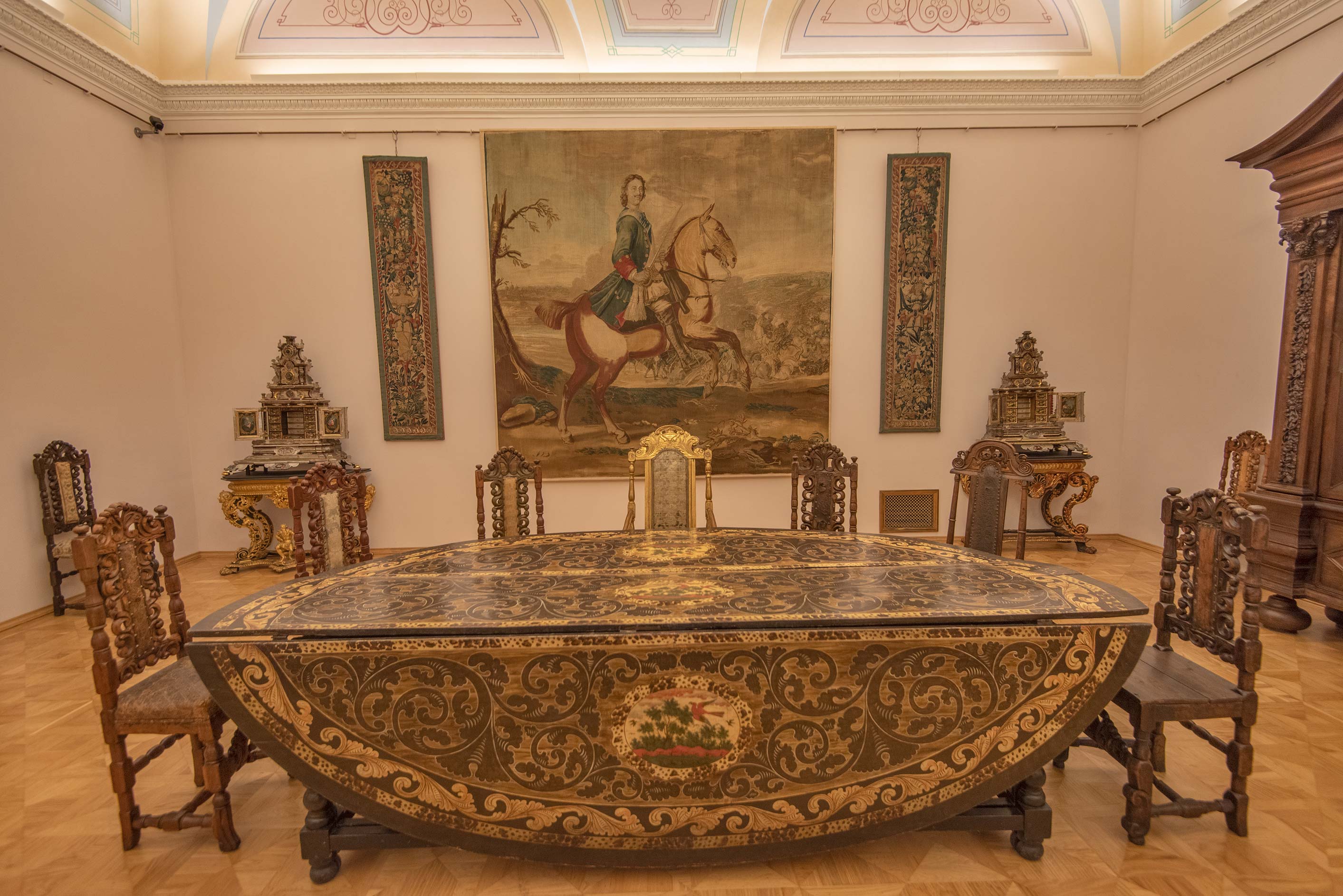
Centered in one of the halls of the Gallery of Peter the Great in the Winter Palace, a large early 18th-century oval gateleg table--intricately inlaid with floral marquetry and a central landscape medallion--stands surrounded by high-backed carved wooden chairs and a gilded armchair on a herringbone parquet floor. On the wall behind it, a monumental woven tapestry depicting Peter the Great on horseback at the Battle of Poltava is flanked by vertical floral tapestry borders, two miniature architectural cabinets on gilded console tables, and a massive carved wooden wardrobe in the State Hermitage Museum in Saint Petersburg, Russia, September 10, 2026
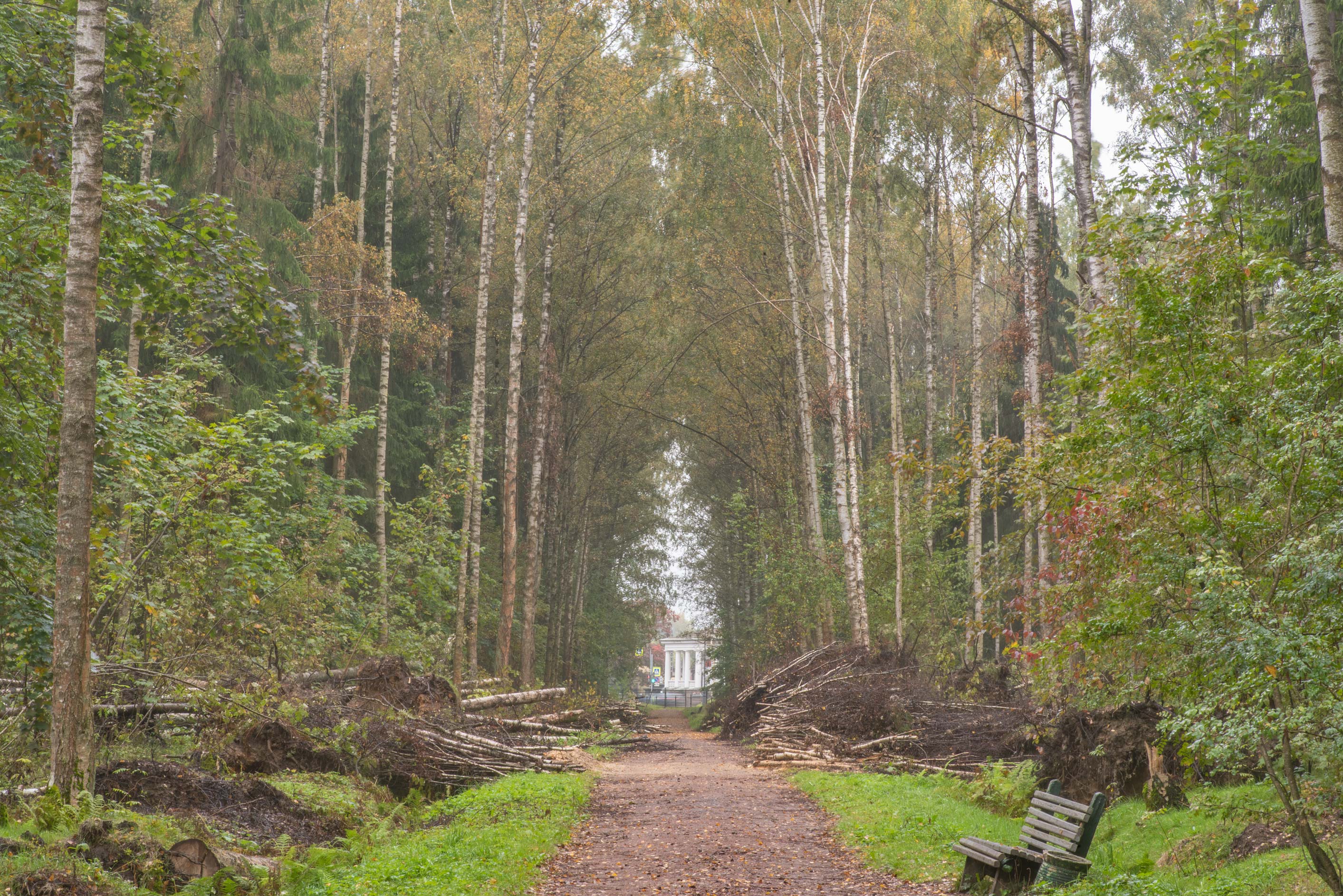
Flanked by tall silver birches and conifers with early autumn foliage, a leaf-strewn dirt avenue--Alleya Krasnogo Bugra (Red Hillock Alley)--is lined on both sides with massive upturned root plates and stacked brushwood cleared after the July 11, 2026 hurricane-force windstorm. In the foreground on the right, an empty wooden park bench with a small green trash bin sits beside the cleared grassy verge, while the white classical colonnade of the Pavlovsk Railway Station appears at the far end of the vista in Pavlovsk Park. Pavlovsk, suburb of Saint Petersburg, Russia, September 13, 2026
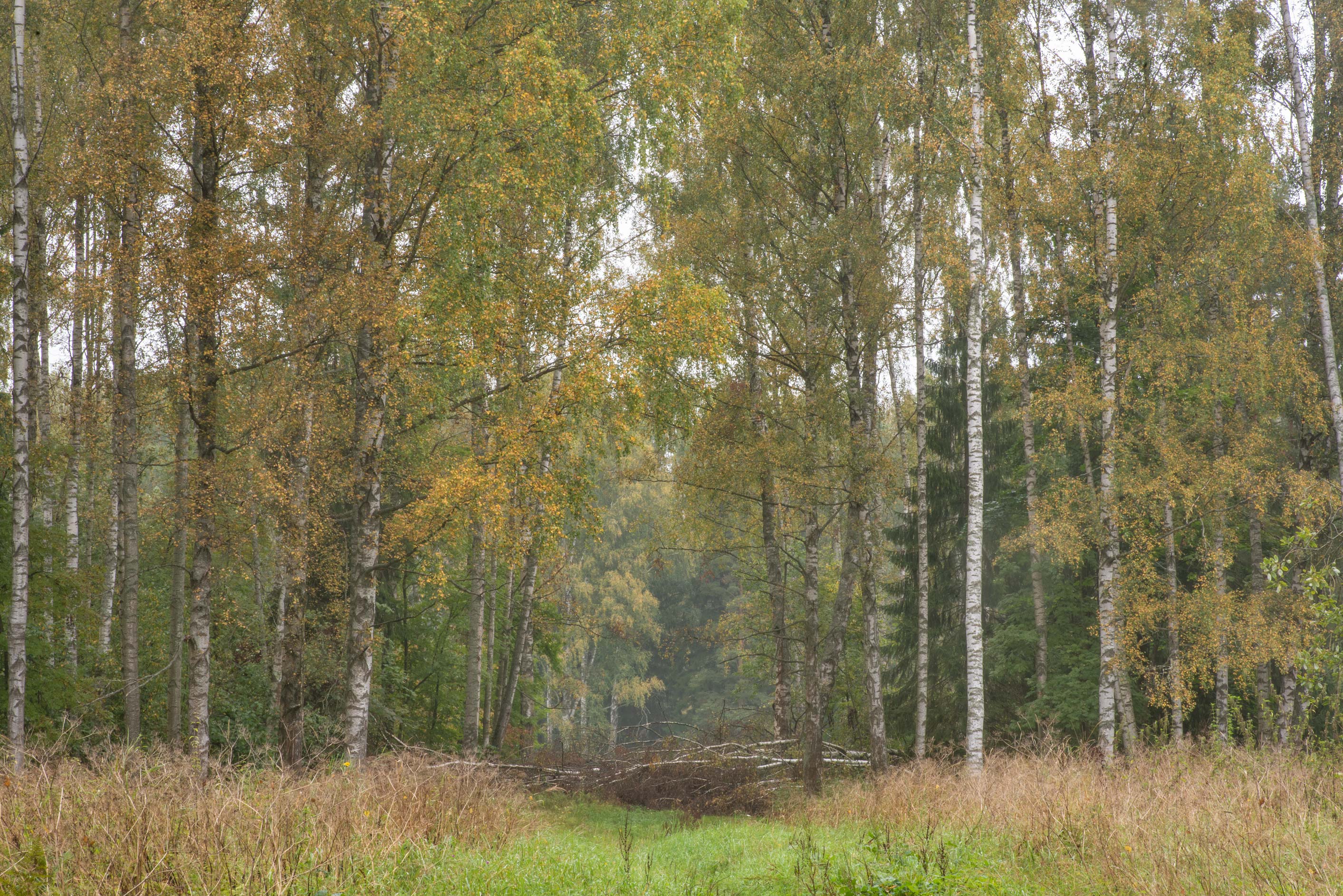
Framed by tall silver birches turning yellow-green in early autumn and dark evergreen spruces, a narrow grassy forest clearing--bordered by tall, dry golden-brown meadow grasses--is blocked across its middle by fallen birch trunks and tangled branches brought down by the July 11, 2026 hurricane-force windstorm. Beyond the barrier of downed trees, the wooded vista recedes into misty, muted foliage in Pavlovsk Park. Pavlovsk, suburb of Saint Petersburg, Russia, September 13, 2026
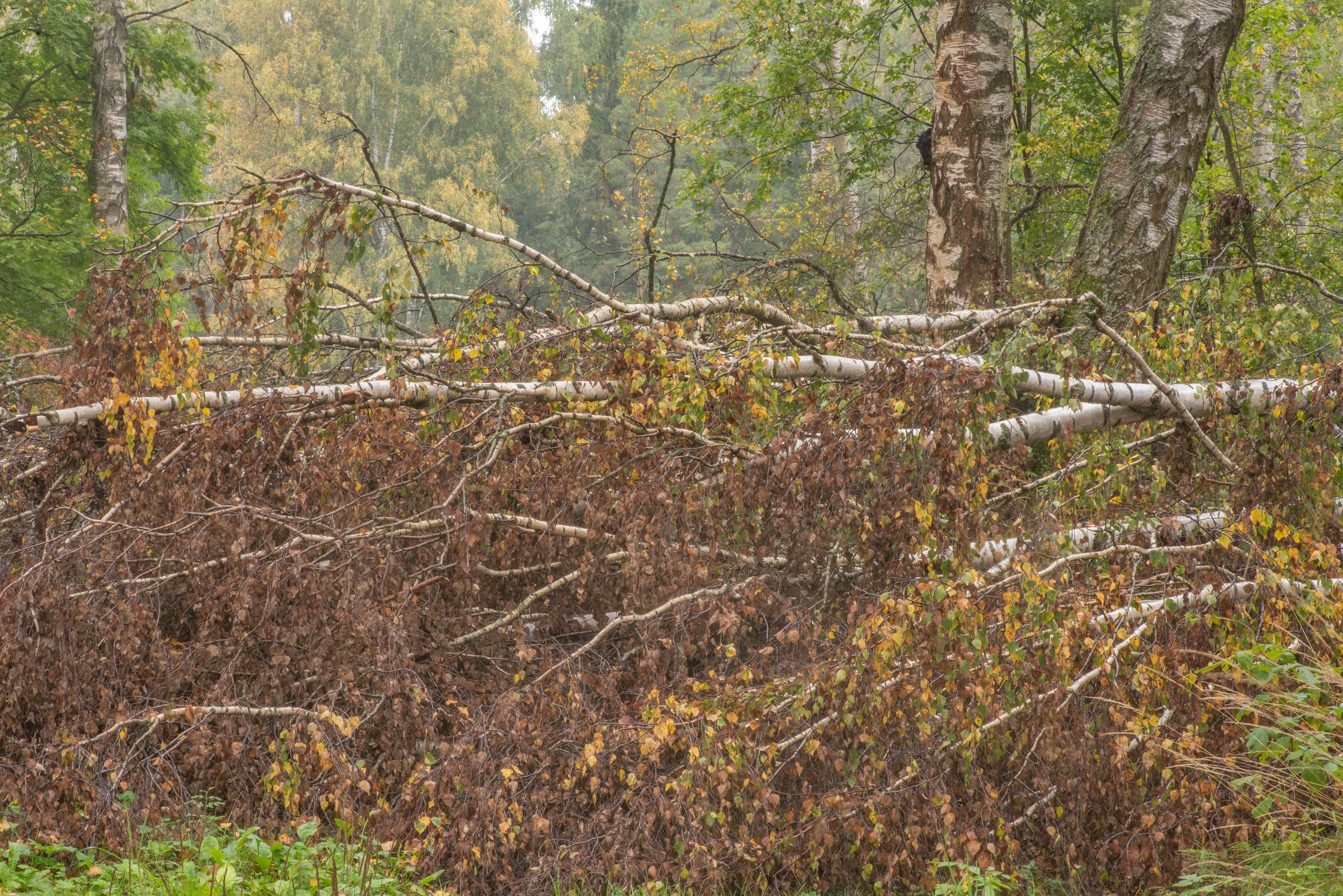
Seen at close range, the tangled crowns and white-barked limbs of several silver birches (Betula pendula) toppled by the July 11, 2026 hurricane-force windstorm form a dense, horizontal wall of dry brown twigs and withered yellow-brown leaves across the forest floor. Behind the fallen canopy, the rough-barked trunks of surviving birches and soft, early autumn woodland foliage rise into the misty background in Pavlovsk Park. Pavlovsk, suburb of Saint Petersburg, Russia, September 13, 2026
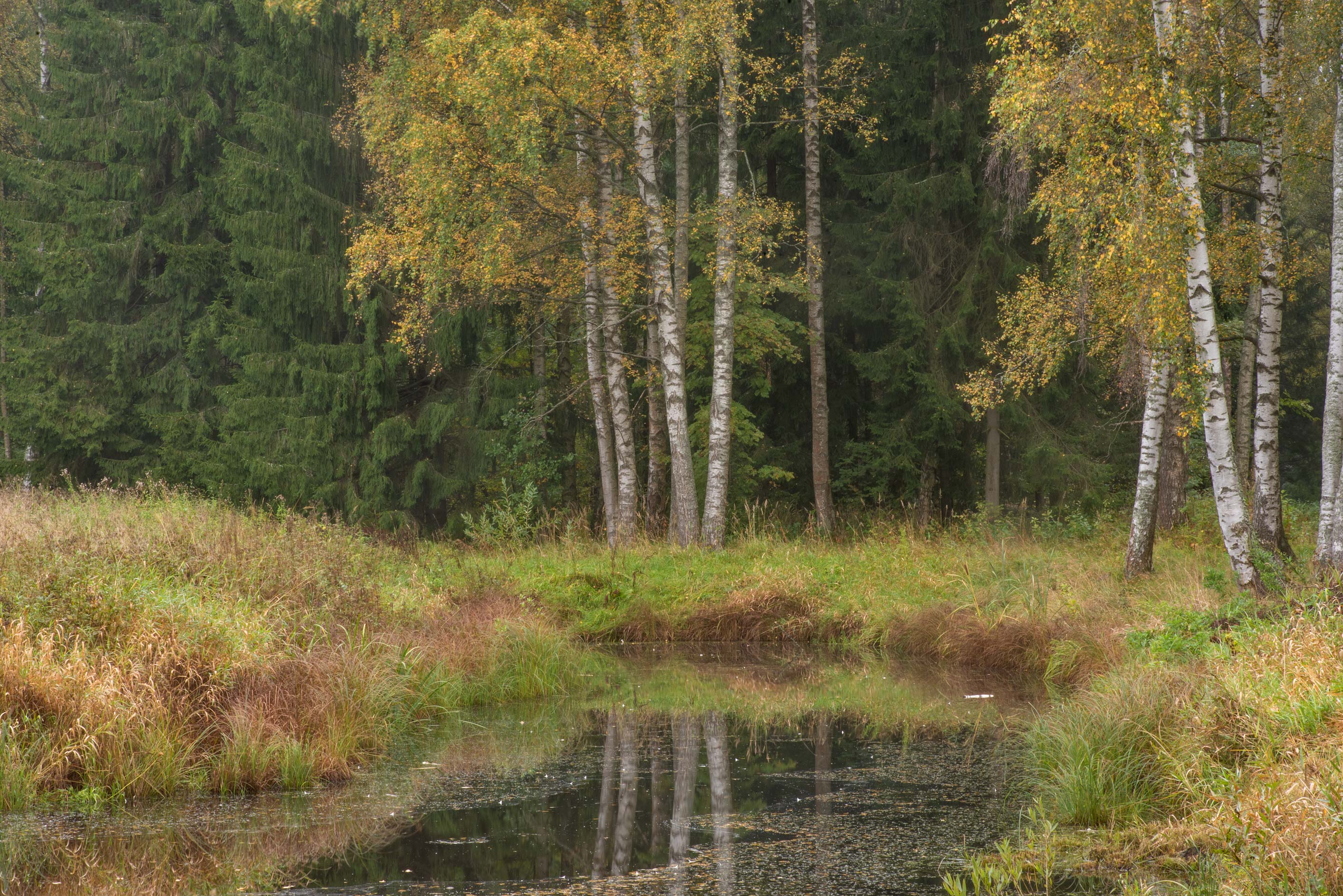
Surrounded by tall, russet-and-green sedges and meadow grasses along its marshy banks, the still, leaf-flecked water of one of the Kruglozalnye Ponds (Kruglozalnye Prudy, or Round Hall Ponds) reflects the slender white trunks of silver birches (Betula pendula) turning golden-yellow in early autumn. Behind the cluster of birches on the far shore, a dense wall of dark green Norway spruces (Picea abies) rises against the overcast sky in Pavlovsk Park. Pavlovsk, suburb of Saint Petersburg, Russia, September 13, 2026
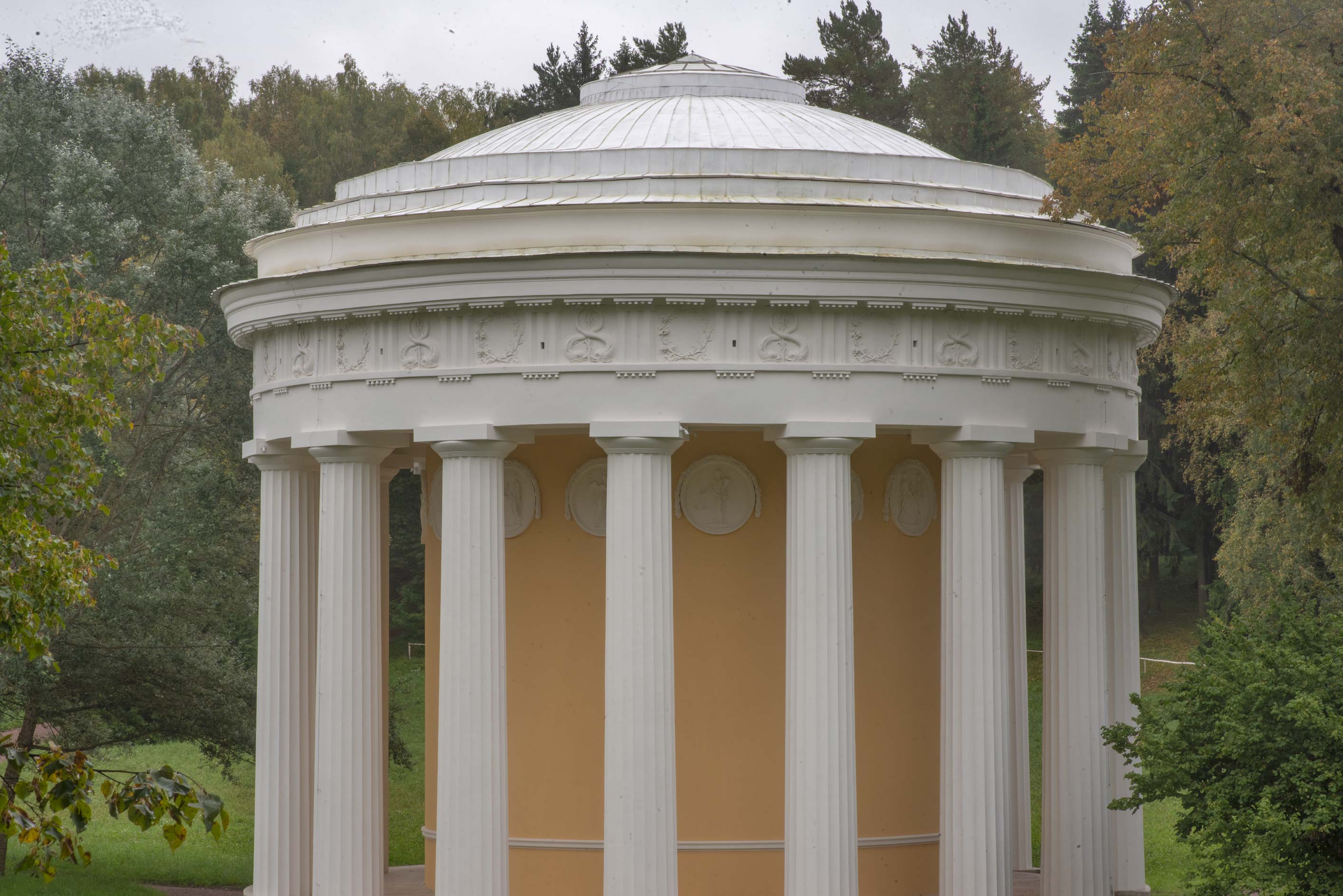
Designed by Scottish architect Charles Cameron in 1780-1782 as a gift of gratitude from Grand Duke Paul and Maria Feodorovna to Empress Catherine the Great (and comprehensively restored in 2024-2026), the neoclassical Temple of Friendship (Khram Druzhby) features a circular ochre-yellow rotunda encircled by sixteen white fluted Greek Doric columns. Topped by a shallow ribbed dome and an entablature frieze sculpted with wreaths and dolphins, the pavilion s upper exterior wall displays allegorical bas-relief medallions by Jacques-Dominique Rachette against a backdrop of early autumn trees in Pavlovsk Park. Pavlovsk, suburb of Saint Petersburg, Russia, September 13, 2026
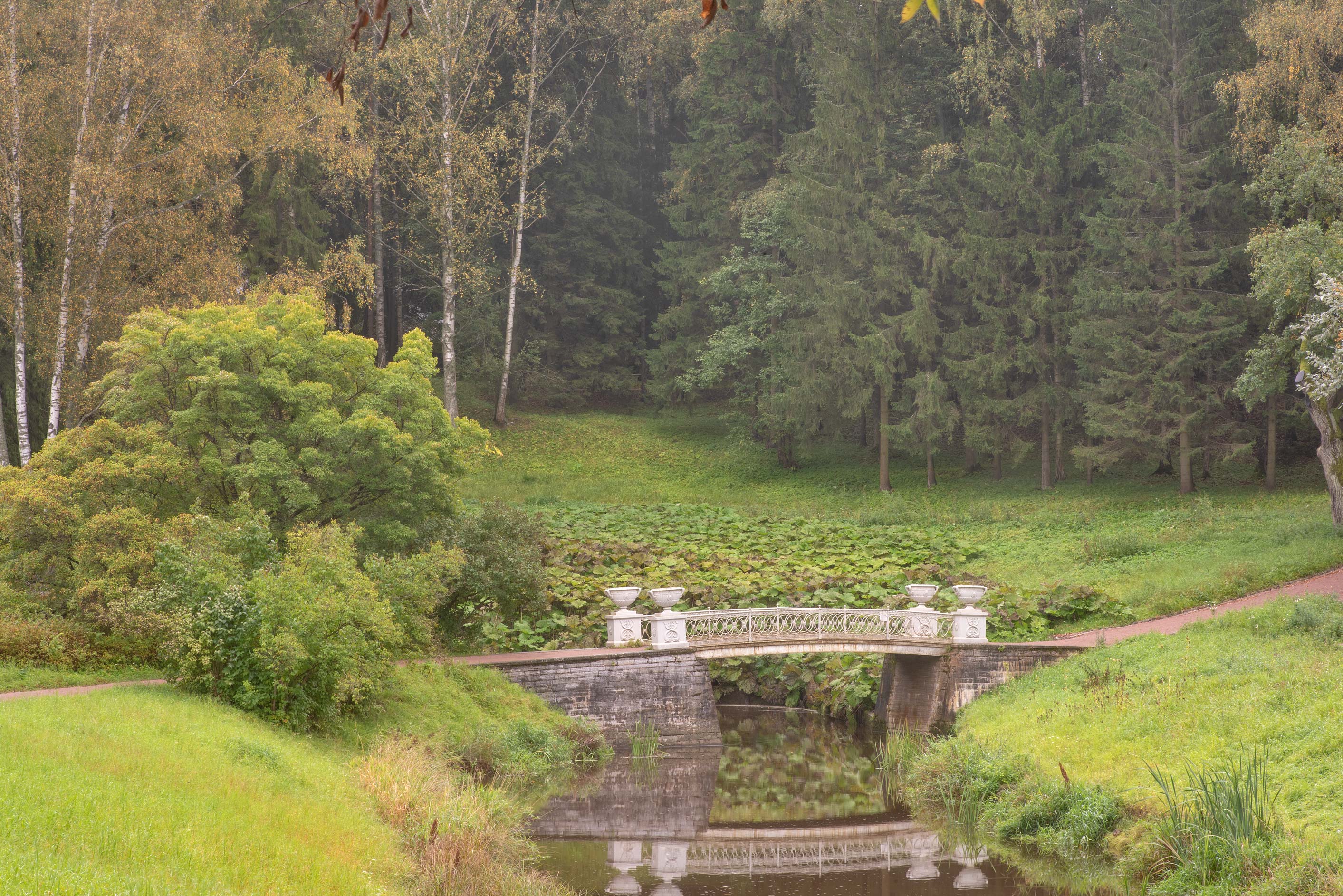
Spanning the calm Slavyanka River near the Temple of Friendship, the Cast Iron Bridge (Chugunny Most, built in 1823 to a design by architect Carlo Rossi) pairs rough-hewn stone abutments with a gently arched white-painted cast-iron span featuring an ornate openwork lattice railing and four classical urns atop square pedestals. Reflected clearly in the still water below, the bridge connects a winding reddish-gravel footpath across grassy banks framed by large-leaved butterbur plants, early autumn birches, and tall spruces in Pavlovsk Park. Pavlovsk, suburb of Saint Petersburg, Russia, September 13, 2026
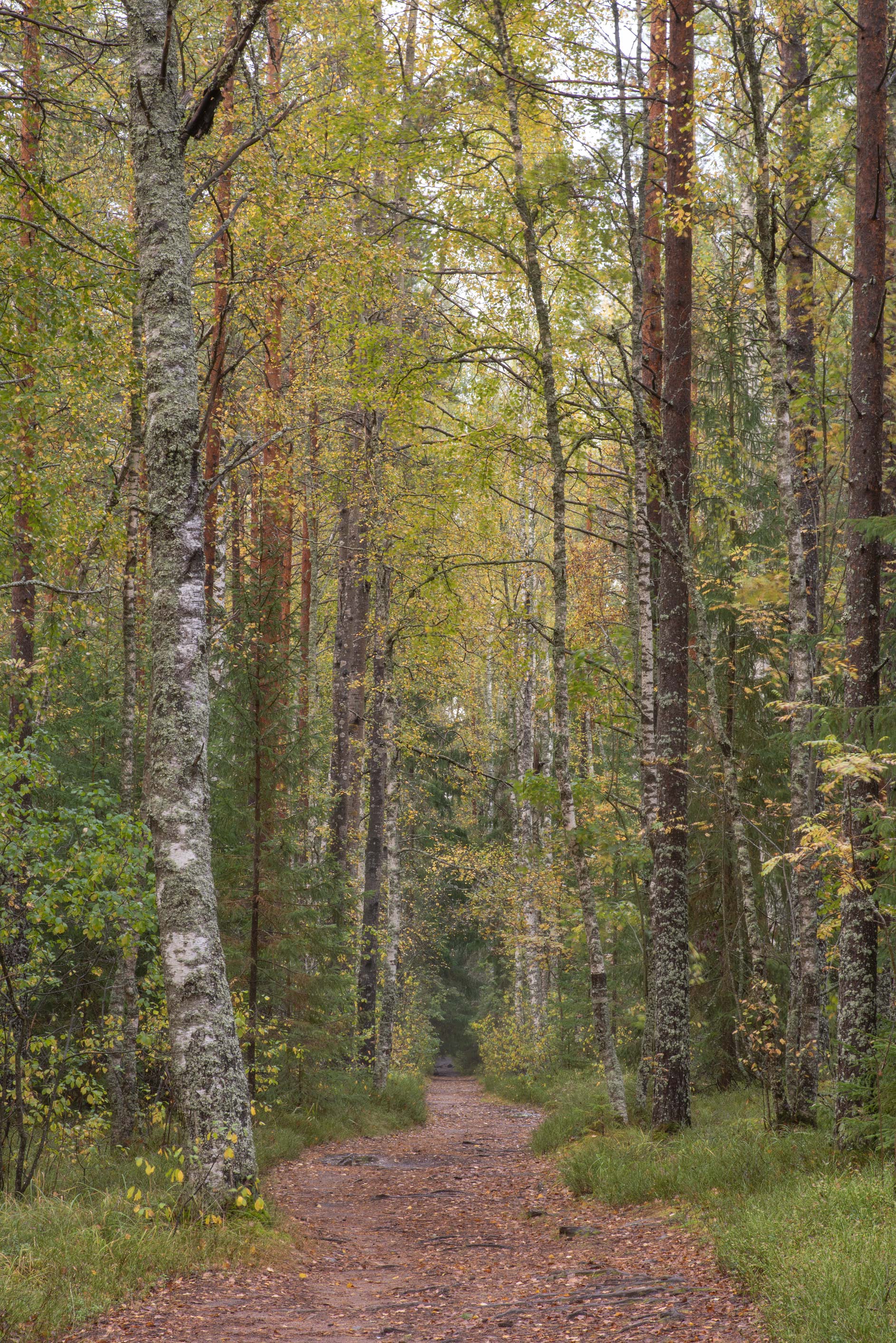
Prospekt Knyazya Trubetskogo (Prince Trubetskoy Avenue), a straight forest road from the station to Bolshoye Krasnoperskoye Lake. It was laid out in the early 1900s for a steam tram of the lost Leovilla dacha colony and is now lined with birches, pines and spruces. Zakhodskoe (Lounatjoki), 50 miles north from Saint Petersburg. Russia, September 19, 2026

The Upper Bathhouse pavilion, built in 1777-1779 by architects Vasily and Ilya Neyelov in the early Classical style, stands beside the rectangular Mirror Pond. Framed by white wrought-iron benches along the gravel terrace, the yellow-stuccoed pavilion emerges through dense autumn fog in Ekaterininsky (Catherine) Park of Pushkin (former Tsarskoe Selo), a suburb of Saint Petersburg. Russia, September 22, 2026

A solitary mallard duck swims across the Mirror Pond, sending concentric ripples through the faint reflection of the Upper Bathhouse pavilion. Designed in the early Classical style in the late 1770s, the yellow-stuccoed building stands beyond the stone-lined embankment amid dense autumn fog in Ekaterininsky (Catherine) Park of Pushkin (former Tsarskoe Selo), a suburb of Saint Petersburg. Russia, September 22, 2026

A wide red-gravel alley lined with mature oak and linden trees stretches into dense autumn fog at the foot of the Sloping Walk. Overarching branches tinged with early yellow and russet leaves canopy the quiet pathway and bordering lawns in Ekaterininsky (Catherine) Park of Pushkin (former Tsarskoe Selo), a suburb of Saint Petersburg. Russia, September 22, 2026

A long, straight red-gravel avenue of Ramp Alley stretches beneath an overarching canopy of mature oaks turning yellow-green in early autumn. Flanked by white wrought-iron benches along the grassy borders, the mist-filled path recedes toward a lone distant figure in Ekaterininsky (Catherine) Park of Pushkin (former Tsarskoe Selo), a suburb of Saint Petersburg. Russia, September 22, 2026

The Monument to Alexander Lanskoi (also known as the Marble Pedestal in Honor of Virtue and Merits), designed in 1773 by architect Antonio Rinaldi, stands atop a grassy slope overlooking a pond in the landscape section of the park. Crafted from grey and pink marble, the rectangular pedestal features a carved bas-relief panel and is crowned by an urn with a flame finial amid early autumn foliage and fog in Ekaterininsky (Catherine) Park of Pushkin (former Tsarskoe Selo), a suburb of Saint Petersburg. Russia, September 22, 2026

A grassy peninsula carpeted with fallen leaves extends into the Swan Ponds (Lebyazhyi Prudki), crowned by deciduous trees turning yellow and orange in early autumn. Across the narrow channel, tall spruces rise along the opposite bank beneath light morning fog, while fallen leaves float on the calm water in Ekaterininsky (Catherine) Park of Pushkin (former Tsarskoe Selo), a suburb of Saint Petersburg. Russia, September 22, 2026

The Pyramid Pavilion, originally built in 1770-1772 by Vasily Neyelov and rebuilt in 1782-1783 to designs by Charles Cameron, stands in a wooded clearing near the Swan Ponds. Constructed of brick faced with trimmed granite blocks and flanked by four reconstructed grey Ural marble columns on pink marble pedestals, the pavilion once housed Catherine the Great s collection of antique urns and vases amid trees turning yellow and green in early autumn in Ekaterininsky (Catherine) Park of Pushkin (former Tsarskoe Selo), a suburb of Saint Petersburg. Russia, September 22, 2026

The octagonal Chinoiserie gazebo crowning the Krestovy (Cross) Bridge, built in 1776-1779 by architects Vasily and Ilya Neyelov across the Krestovy Canal. Framed by maples turning bright orange and yellow in early autumn, the pavilion features glazed brickwork, yellow-trimmed lancet windows, and a curved roof topped by a gilded spire with spheres above the brick archways and granite steps in Aleksandrovsky (Alexander) Park of Pushkin (former Tsarskoe Selo), a suburb of Saint Petersburg. Russia, September 22, 2026

Full view of the Krestovy (Cross) Bridge, built in 1776-1779 by architects Vasily and Ilya Neyelov across the Krestovy Canal, showcasing its four intersecting red-brick arches, central pendentive vault, and octagonal Chinoiserie gazebo. Surrounded by grassy banks and mature maples turning vivid orange and yellow in early autumn, the bridge reflects in the calm canal water in Aleksandrovsky (Alexander) Park of Pushkin (former Tsarskoe Selo), a suburb of Saint Petersburg. Russia, September 22, 2026

One of the Small Chinese Bridges spanning the Krestovy Canal toward the Chinese Village, originally designed in wood by Charles Cameron in 1781 and recast in iron at the Sestroretsk Arms Factory in 1786 under architect Karl Speckle. Framed by mature oaks turning yellow-green in early autumn, the bridge features decorative iron lattice railings and paired column porticoes crowned with sheet-iron pagoda roofs, dragon volutes, and Chinese umbrellas in Aleksandrovsky (Alexander) Park of Pushkin (former Tsarskoe Selo), a suburb of Saint Petersburg. Russia, September 22, 2026

Side elevation of one of the Small Chinese Bridges (1786, after designs by Charles Cameron) spanning the Krestovy Canal, highlighting its painted cast-iron arch spandrels adorned with winged dragons, lattice railings with coral-branch motifs, and paired Chinoiserie column porticoes. Framed beneath overhanging oak branches turning yellow and orange in early autumn, the Krestovy (Cross) Bridge and its octagonal gazebo appear down the canal in the background in Aleksandrovsky (Alexander) Park of Pushkin (former Tsarskoe Selo), a suburb of Saint Petersburg. Russia, September 22, 2026

A multi-stemmed maple with bright orange and golden-yellow foliage stands on a grassy clearing beside a straight row of white-barked silver birches turning yellow-green in early autumn. The tranquil meadow and birch-lined border were photographed on an overcast morning in Aleksandrovsky (Alexander) Park of Pushkin (former Tsarskoe Selo), a suburb of Saint Petersburg. Russia, September 22, 2026

Closer view of the Feodorovsky Gorodok (Feodorovsky Town), built in 1913-1918 in the Neo-Russian style to designs by architect Stepan Krichinsky, showing the green-roofed corner tower, the intricately carved entrance gatehouse (White Chamber), and the crenellated Yellow Chamber rising behind them. Framed by an oak tree turning golden-yellow in early autumn beneath fluffy white clouds and a blue sky, the complex stands behind temporary metal fencing in Pushkin (former Tsarskoe Selo), a suburb of Saint Petersburg. Russia, September 22, 2026

The bronze Monument to Vasily Dokuchaev, unveiled in 1962 to designs by sculptor Igor Krestovsky and architect Mikhail Serebrovsky in honor of the founder of Russian soil science, stands atop a cylindrical pink granite pedestal. Surrounded by blooming hydrangeas and maples turning bright orange and yellow in early autumn, the statue rises before the weathered Neo-Russian entrance gatehouse of the former Imperial Convoy Barracks--now Academic Building No. 2 of the Saint Petersburg State Agrarian University, scheduled for heritage restoration--in Pushkin (former Tsarskoe Selo), a suburb of Saint Petersburg. Russia, September 22, 2026
