
Field in Urochishche Teterevskoe open space, between Orekhovo and Lembolovo, north from Saint Petersburg. Russia, June 30, 2010

Entrance space in prayer hall (musallah) of State Mosque (Sheikh Imam Muhammad Ibn Abdul Wahhab Mosque). Doha, Qatar, November 27, 2013

Entrance space in prayer hall (musallah) in State Mosque (Sheikh Muhammad Ibn Abdul Wahhab Mosque). Doha, Qatar, April 4, 2013

Field road in Urochishche Teterevskoe open space, between Orekhovo and Lembolovo, north from Saint Petersburg. Russia, June 30, 2010

Guts of Saturn Rocket in NASA Space Center Museum. Houston, Texas, February 16, 2008

An air-space institute(?) and a silos(?) tower of former sovkhoz Ruchyi near crossing of Svetlanovskiy and Tikhoretskiy Prospect. Saint Petersburg, Russia, September 2, 2002

Junk rocket in NASA Space Center Museum. Houston, Texas, February 16, 2008

Tubes and wires of Saturn Rocket in NASA Space Center Museum. Houston, Texas, February 16, 2008

Stones in Urochishche Teterevskoe open space, between Orekhovo and Lembolovo, north from Saint Petersburg. Russia, June 30, 2010

Wires of Saturn Rocket in NASA Space Center Museum. Houston, Texas, February 16, 2008

Saturn Rocket in junk rocket park of NASA Space Center Museum. Houston, Texas, February 16, 2008

A pond in eastern Sosnovka Park, with an air space institute on background. Saint Petersburg, Russia, August 26, 2001

Field scabiosa in Urochishche Teterevskoe open space, between Orekhovo and Lembolovo, north from Saint Petersburg. Russia, June 30, 2010

Engine of Saturn rocket in NASA Space Center Museum. Houston, Texas, February 16, 2008

West Bay towers from an empty space behind City Center Mall. Doha, Qatar, January 23, 2012

Mycena chloroxantha var. appalachienensis (Mycena sect. Sacchariferae) and a small marasmoid mushroom with widely spaced gills on Caney Creek section of Lone Star Hiking Trail in Sam Houston National Forest near Huntsville, Texas, May 5, 2018

Visitor s walk in current Mission Control Center in NASA Space Center Museum. Houston, Texas, February 16, 2008

Bed space for Muslims at Al Maymoun Street. Doha, Qatar, February 22, 2013

Historic Mission Control Center in NASA Space Center Museum. Houston, Texas, February 16, 2008


Hotels in West Bay, view from a space between Somerset and Kempinski hotels. Doha, Qatar, January 19, 2012

West Bay from empty space south from Al Sham Street. Doha, Qatar, January 31, 2012

Closed space of an old yard near Liteyny Prospect. Saint Petersburg, Russia, January 7, 2006

Tightly spaced houses near Fontanka River. Saint Petersburg, Russia, January 7, 2006

Yachts grounded on parking space of North Roadway Street at West End near Lake Pontchartrain. New Orleans, Louisiana, March 4, 2006

Current Mission Control Center in NASA Space Center Museum. Houston, Texas, February 16, 2008

Kids Place in NASA Space Center Museum. Houston, Texas, February 16, 2008

A pond in Sosnovka Park near crossing of Svetlanovskiy and Tikhoretskiy Prospect, with an air-space institute(?) at background. Saint Petersburg, Russia, September 2, 2002

Al Qassar, Ezdan Hotel, and Olympic Tower from empty space south from Al Sham Street. Doha, Qatar, January 31, 2012

Narrow yard space on Liteyny Prospect. Saint Petersburg, Russia, February 2, 2013


Young tightly spaced leaves of Sago palm (cikas) in prehistoric garden in Zilker Botanical Gardens. Austin, Texas, May 10, 2009

Field violet (Viola tricolor, Russian name Fialka) in Urochishche Teterevskoe open space, between Orekhovo and Lembolovo, north from Saint Petersburg. Russia, June 30, 2010

Mysterious buttons in Historic Mission Control Center in NASA Space Center Museum. Houston, Texas, February 16, 2008

Bed space "Only for Nepalese" at Al Jassasiya Street, Musheirib area. Doha, Qatar, June 28, 2013

Apparatus in current Mission Control Center in NASA Space Center Museum. Houston, Texas, February 16, 2008

View to the south from empty space south from Al Sham Street in West Bay. Doha, Qatar, January 31, 2012

This steel monument in the inner courtyard of the Alexander Nevsky Lavra marks Mass Grave No. 7 on the historic Communist Section, commemorating three Soviet electrical workers - Sergey Yakovlevich Vasilyev, Sergey Ivanovich Vshivtsev, and Alexander Mikhailovich Babanov. The three men died together on July 24, 1935, in a severe industrial electrical accident at Leningrad[CloseCurlyQuote]s 5th State District Power Plant (:0413:042d:0421-5, later known as Krasny Oktyabr). Celebrated as fallen martyrs of the nation s rapid electrification drive, they were granted an elite collective burial on the monastery grounds alongside revolutionaries, military commanders, and prominent party cadres. The grave is crowned by a detailed miniature replica of an electrical transmission pylon (:043e:043f:043e:0440:0430 :041b:042d:041f), complete with riveted steel lattice bracing, crossarms, and hanging ceramic insulator bells. The monument reflects early Soviet constructivist mourning aesthetics, which systematically purged Orthodox crosses in favor of industrial tools, machine gears, and technological artifacts that symbolized a worker[CloseCurlyQuote]s vocation and contribution to socialist development. The presence of a high-voltage transmission tower directly before Holy Trinity Cathedral stands as one of the most eccentric visual contradictions of early Soviet material culture . Reflecting Vladimir Lenin s defining decree that communism equated to Soviet power plus national electrification, the utilitarian pylon transformed sacred monastic space into a monument honoring Soviet modernization and the sacrifices of its industrial labor force. Saint Petersburg, Russia, November 25, 2016

Xyanikiayze Urochishche (open space) in Kuzmolovo, north from Saint Petersburg. Russia, May 16, 2017

Field road in Xyanikiayze Urochishche (open space) in Kuzmolovo, north from Saint Petersburg. Russia, May 16, 2017

Earthfan mushrooms (Thelephora terrestris) on roadside in an open space near Lembolovo, north from Saint Petersburg. Russia, August 24, 2018

Figure of a sitting woman "Messenger from Space" in Erarta Museum of Contemporary Art. Saint Petersburg, Russia, May 29, 2019

Closely spaced stalked bonfire cup (Geopyxis carbonaria) and violet cup mushrooms (Peziza violacea, also known as P. subviolacea, P. tenacella) in a burned spruce forest in Zakhodskoe (Lounatjoki), 50 miles north from Saint Petersburg. Russia, May 15, 2021

Closely spaced stalked bonfire cup mushrooms (Geopyxis carbonaria) on burned forest floor with fallen spruce needles in Zakhodskoe (Lounatjoki), 50 miles north from Saint Petersburg. Russia, May 22, 2021

Puffball mushrooms Calvatia cyathiformis on open space near a former pond in Washington-on-the-Brazos State Historic Site. Washington, Texas, September 5, 2022

Hollow space inside a cap of greyling mushrooms Tephrocybe anthracophila on Caney Creek Trail (Little Lake Creek Loop Trail) in Sam Houston National Forest north from Montgomery. Texas, November 18, 2023

The diverse visual language of mourning in the "Alley of Heroes," showing a mix of permanent granite monuments and temporary graves decorated with flags, including the Russian Imperial black-yellow-white tricolor and a Soviet red banner. In the foreground, the polished black headstone of Ivan Vladimirovich Semenov (1995-2024) features a color portrait of the 28-year-old soldier, while nearby, two women stand amidst the graves, highlighting the cemetery as an active site of personal grief. The scene captures the juxtaposition of varied ideological symbols--imperial, communist, and modern state--united within the shared space of military sacrifice. Cemetery of the Victims of January 9, St. Petersburg, Russia, October 4, 2025

Church of the Tikhvin Icon of the Mother of God near the train station in Sestroretsk. The huge icon of Jesus and the rocket models is part of a distinct chapel and memorial complex dedicated to the Royal Martyrs (Tsar Nicholas II and his family) and the spiritual protection of Russia. The Rockets: The models of space rockets (one clearly marked "VOSTOK") are part of a unique, patriotic, and somewhat eclectic display. The local spiritual community, led by Father Gavriil (Gabriel), is known for combining intense Orthodox devotion with Soviet/Russian patriotic symbols, viewing the country s history (including the space age) through a spiritual lens. This particular "installation" links the idea of "spiritual ascent" with the physical ascent of space exploration, a quirky but sincere local expression of faith. The "Clock Tower": The transparent model tower with clocks is a stylized representation of the Spasskaya Tower of the Moscow Kremlin. The Kremlin is often associated with state power, and its inclusion here reinforces the church s focus on the spiritual destiny of the Russian state. This is one of the most idiosyncratic religious sites in the St. Petersburg region--a place where Tsarist martyrdom, Orthodox mysticism, and Soviet space achievements are all visually blended together. Russia, October 9, 2025

Naturalistic style of the English landscape garden, which dominates the areas surrounding the formal canals, with rich textural contrast between the golden maples and dark evergreen firs, creating a painterly composition typical of 19th-century Russian park design. The untamed, wilder growth of the underbrush and tall grasses contrasts with the manicured lawns found elsewhere, evoking a sense of romantic melancholy suited to the "golden autumn" season. The dense, layered foliage creates an intimate, enclosed space that feels removed from the grand palace architecture, focusing entirely on the mood of the forest. Aleksandrovsky (Alexander) Park in Pushkin (former Tsarskoe Selo) near Saint Petersburg, Russia, October 10, 2025

A view from a window near Svetlanovsky Prospekt that offers an intimate look into a typical residential courtyard (dvor) of the Vyborgsky District. The beige brick buildings framing the scene are classic examples of brick Khrushchev-era apartments (or early Brezhnev-era), likely built in the 1960s. The 5-story height was standard to avoid the mandatory installation of elevators, which was required for buildings of 6 stories or more. This layout reflects the Soviet microdistrict concept, where residential blocks were arranged around green, communal courtyards to provide light, air, and recreation space away from the main roads. Saint Petersburg, Russia, October 14, 2025

Looking south from the Friendship Bridge, this view captures the recreational and spiritual side of the city, contrasting with the military fortifications seen on the other side. The prominent spire in the distance belongs to the Narva Alexander s Cathedral, an Evangelical Lutheran church built in the late 19th century. Its distinct octagonal tower is a major city landmark that survived severe damage during WWII. Along the riverbank, one see the modern architecture of the Joaorg Beach Building (the low, tiered structure nestled in the trees). This area serves as a popular public space with a swimming beach, gym, and promenade, offering locals a place to relax by the river. Estonia, October 16, 2025

This perspective looks further up Pikk Street as it gently curves uphill towards the Pikk Jalg gate and Toompea Hill. On the left, the building housing the Veta knitwear shop is a notable example of Tallinn s layered architecture. The structure itself dates back to the 14th century and survived WWII largely intact, making it one of the city s authentic medieval gems. The bay window with its decorative woodwork on the upper floor adds a touch of elegance to the facade. The right side of the street features handsome brick and plaster facades, typical of the prosperous merchant dwellings that line this historic trade route. The blue sign for Fitness Formula marks a modern business occupying one of these centuries-old spaces. Estonia, October 16, 2025

This panoramic view from the tower of St. Nicholas Church looks south-west towards Toompea Hill, capturing the dense layering of Tallinn s medieval and religious history. The striking structure with black onion domes is the Alexander Nevsky Cathedral, an Orthodox cathedral built in 1900 in the Russian Revival style. Its imposing presence on Toompea Hill contrasts sharply with the surrounding red-tiled roofs, symbolizing the complex history of the Russian era in Estonia. In the foreground and middle distance, you can see key parts of the city s defensive network: The square tower with the tall red roof in the foreground is the Maiden Tower, a 14th-century defensive structure that now houses a cafe. Just behind and slightly to the left of the Maiden Tower (partially obscured) is the massive Kiek in de Ko"k artillery tower, whose Low German name ("Peep into the Kitchen") referred to the guards ability to see into nearby homes. Connective sections of the medieval city wall run between these towers, marking the boundary between the lower town and the upper citadel. The green space visible near the base of the wall is the Danish King s Garden (Taani kuninga aed). According to legend, this is where the Danish flag (Dannebrog) fell from the sky during a battle in 1219, turning the tide in favor of the Danes. The garden sits on the slope directly facing St. Nicholas Church. Estonia, October 16, 2025

This view from the tower of St. Nicholas Church offers a fascinating contrast between medieval history, post-war reconstruction, and modern urban growth, looking east towards the city center. The most prominent building in the immediate foreground is the large, grey, L-shaped structure known as the Writers House (Kirjanike Maja) on Harju Street. Built in 1963 on the ruins of buildings destroyed during the 1944 Soviet bombing of Tallinn, this modernist structure is a significant cultural landmark. It houses the Estonian Writers Union, a well-known bookstore, and the famous Cafe Pegasus, serving as a hub for the country s literary scene. The street running along the left side of the Writers House is Harju Street, historically one of the city s main commercial arteries. The open green space visible nearby (part of the Harju Street green area) was also created following the wartime destruction, serving as a memorial and recreational space before partial reconstruction debates in recent years. In the background, the view opens up to Tallinn s modern business district. The cluster of high-rise glass buildings, including the distinct wedge-shaped Swisso^tel and the SEB Bank headquarters, illustrates the city s rapid economic development and stands in stark contrast to the red-tiled roofs of the Old Town below. Estonia, October 16, 2025

This is the No~elasilma ("Eye of the Needle") Gate, a reconstructed section of the medieval urban fabric located at the end of Niguliste Street. Originally, this area was a densely built-up part of the Old Town, near the historic Harju Gate. However, the neighborhood was largely destroyed during the March 1944 Soviet bombing, which leveled about 20% of Tallinn s buildings, particularly in the Harju and Niguliste street areas. The ruins stood for decades before the area was cleared and later redeveloped as a green space and memorial. The No~elasilma Gate itself was reconstructed in 2006-2007 as part of an effort to restore the medieval street network and mark the historical boundary of the former churchyard. The structure consists of two limestone walls with arched openings, mimicking the narrow passageways typical of the medieval city. Looking through the gate, you see the cobblestones of Niguliste Street. In the background stands a distinct corner tower with a red tiled roof, part of the residential block that survived or was restored after the war. The modern apartment buildings on the left (Harju Street area) are post-war constructions, filling the void left by the bombing. The gate now serves as a poignant reminder of the city s lost layers and its resilience. Estonia, October 16, 2025

This perspective on Harju Street captures a striking mix of Soviet-era modernism and medieval heritage in the heart of Tallinn s Old Town. The prominent grey building on the right is the Writers House (Kirjanike Maja), located at Harju 1. Designed by architects August Volberg and Heili Volberg and completed in 1963, it is a prime example of post-war modernist architecture in Estonia. The foreground reveals traces of the area s turbulent history. The open green space on the left (Harju Street Park) occupies the site of buildings destroyed during the March 1944 Soviet bombing. For decades, these ruins were a painful scar, but the area has since been redeveloped into a recreational space that memorializes the lost urban fabric while providing a breathing room in the dense Old Town. The blue truck cabin visible in the foreground of the Harju Street photo is a GAZ-51, a legendary Soviet-era truck that was a common sight in Estonia for decades. Estonia, October 16, 2025

Masters Courtyard (Meistrite Hoov), located at Vene 6. The courtyard is a dedicated space for master artisans and craftsmen. It houses various workshops and boutiques selling handmade jewelry, ceramics, textiles, and woodcrafts. The mission of the non-profit organization that manages it is to preserve and revive ancient handicraft traditions. The property has a rich history dating back to 1371. Over the centuries, the buildings surrounding the yard have served many purposes and undergone various reconstructions, but the area retains its historic architectural character. Tallinn, Estonia, October 16, 2025

Interior of St. Peter and St. Paul s Cathedral (Peeter-Pauli katedraal), located at Vene 18. This is the main cathedral for the Roman Catholic Diocese of Tallinn and one of the few Catholic churches in a predominantly Protestant and secular country. The church was built between 1841 and 1844 on the walls of the former refectory (dining hall) of the medieval St. Catherine s Monastery. The Neoclassical fac,ade and twin towers were added later in the 1920s by architects Erich Jacoby and Franz de Vries. The space is characterized by its high vaulted ceilings and light, airy atmosphere. Tallinn, Estonia, October 16, 2025

A view of Pikk Street (Pikk ta"nav) in Tallinn s Old Town, specifically looking towards the iconic House of the Brotherhood of Blackheads. The yellow building on the right foreground is Pikk 33. It is a historic property, formerly a merchant s house, that has been renovated into apartments and commercial space. In your photo, the ground floor features a shop with a green, white, and red flag display, likely an Italian restaurant or boutique. Further down the street on the right (at Pikk 26, though partially obscured in this angle) is the famous House of the Brotherhood of Blackheads (Mustpeade maja). This building is renowned for its Renaissance fac,ade, the only one of its kind preserved in Tallinn. It historically served as the headquarters for the guild of unmarried merchants and shipowners. Pikk means "Long," and this street is one of the oldest and most significant in the city. In medieval times, it was the main artery connecting the harbor to the Upper Town (Toompea), lined with the homes of wealthy merchants and powerful guild halls. The street showcases a rich mix of architectural styles, including the Gothic gabled houses seen on the left and the later Renaissance and Baroque facades. The building on the left with the stepped gable is a classic example of Hanseatic merchant architecture. Tallinn, Estonia, October 16, 2025

A temporary protest installation located directly in front of the Russian Embassy at Pikk 19 in Tallinn s Old Town. The barricades and posters are situated along the sidewalk of Pikk Street, facing the embassy building. This narrow, historic street has become a focal point for public demonstrations since the beginning of the full-scale invasion of Ukraine in February 2022. The installation serves as a persistent protest against the Russian invasion of Ukraine. It features Ukrainian flags, anti-war messages, graphic images of war damage (such as destroyed buildings in Ukrainian cities), and tributes to figures like Alexei Navalny. The display transforms a section of the picturesque Old Town into a politically charged space, forcing diplomats and passersby to confront the realities of the conflict. The protest materials are often updated by activists and local residents to reflect ongoing events. The sign "If they decide to kill me, it means we are incredibly strong - Navalny" references the late Russian opposition leader Alexei Navalny, whose death in prison in February 2024 sparked renewed gatherings and memorials at this exact spot. Tallinn, Estonia, October 16, 2025

Evening view that provides a dramatic, upward-looking perspective of St. Olaf s Church (Oleviste kirik) from the street level (near Lai 48), emphasizing the towering scale of its west facade. The image is dominated by the massive limestone tower of St. Olaf s. The perspective highlights the transition from the square base to the octagonal upper stages, a typical feature of Gothic architecture in the Hanseatic region. The long, narrow window with its pointed arch (lancet window) is a defining Gothic element, allowing light into the nave. To the right, you can see the upper stories of the adjacent building (likely Lai 48 or 50). Its simple, plastered facade and regularly spaced windows provide a domestic scale that contrasts with the monumental church. The distinctive rain gutter (downspout) on the left foreground acts as a framing element, drawing the eye upward. This view underscores why St. Olaf s was once the tallest building in the world (1549-1625). The sheer verticality visible here was originally intended to serve as a landmark for trading ships approaching Tallinn s harbor. Tallinn, Estonia, October 16, 2025

Fac,ade of Pikk 18, arguably the most famous Art Nouveau building in Tallinn, known as the Dragon Gallery (Draakoni Galerii). Designed by the renowned Baltic German architect Jacques Rosenbaum and completed in 1910, this building is a prime example of late Art Nouveau (Jugendstil) architecture. The two massive, sculpted dragons flanking the ground-floor window are the building s namesake and most iconic feature. They were created by the sculptor August Volz. Above the dragons, the fac,ade features two stern female figures with Egyptian headdresses projecting from the pilasters. These, along with sphinxes and other exotic ornaments on the upper levels, reflect the eclectic and fantastical influences typical of Rosenbaum s style. The large, horseshoe-shaped window on the ground floor and the undulating gable at the top create a sense of movement and fluidity that contrasts sharply with the rigid lines of the adjacent classical and medieval buildings. Originally built as an apartment house for the merchant Reinhold Reichmann, the ground floor has housed the Draakoni Gallery since 1983, an exhibition space managed by the Estonian Artists Association. The green light visible in the window belongs to a fashion boutique or exhibition currently occupying the space. Tallinn, Estonia, October 16, 2025

A striking architectural contrast on Sauna Street (Sauna ta"nav), near the intersection with Va"ike-Karja Street. On the left, a modern glass-and-steel building features large display windows and industrial-style staircases, illuminated by neon lights. This building is part of the Helios Hall complex (formerly the Helios Cinema), which has been repurposed as an event venue and art space. The transparent facade allows a view into the contemporary interior, contrasting sharply with the solid, historic walls of the Old Town. On the right, the corner of an older, plastered building (Sauna 12) is covered in colorful, abstract graffiti. This gritty, urban element acts as a foil to the clean lines and slick surfaces of the modern building opposite it, highlighting the eclectic mix of styles in this part of the city. Tallinn, Estonia, October 16, 2025

Looking down Mu"u"rivahe Street (Mu"u"rivahe ta"nav), running alongside the medieval city wall of Tallinn. The dominant feature is the massive, 14th-century limestone defensive wall on the right. What stands out in this specific section (near Mu"u"rivahe 52) are the large concrete buttresses supporting the wall. Unlike the original medieval masonry, these are modern reinforcements added during the Soviet era (specifically in the late 1960s or 70s) to stabilize this section of the wall, which was in danger of collapsing. While effective, they are often noted for their distinct, brutalist contrast with the historic stonework. Further down the wall, you can see the red-tiled roof of the defensive walkway (chemin de ronde) and the towers (Hellemann Tower is nearby) that made Tallinn one of the best-fortified cities in Northern Europe. At the base of the wall, the original pointed arches (niches) are illuminated, highlighting the texture of the rough-hewn limestone. These niches historically housed workshops or stalls. The street name "Mu"u"rivahe" literally means "the gap between the walls," referring to the space between the main city wall and the lower defensive earthworks that once existed here. Tallinn, Estonia, October 16, 2025

This aerial view, captured on the approach to Helsinki (arriving from the west/southwest towards Helsinki-Vantaa Airport), showcases the stunningly fragmented coastline of the Finnish capital. The Archipelago: The image perfectly illustrates why Helsinki is known as the "Daughter of the Baltic." The coastline is a complex maze of peninsulas, bays, and islands. Western Suburbs: The dense urban areas visible are likely the western districts of Espoo (Finland s second-largest city, part of the capital region) and western Helsinki. Specifically, the large island connected by bridges in the center-left is likely Lauttasaari (Drumso), a major residential island district. To its left, the distinctive curved coastline of Keilaniemi and West Harbour (La"nsisatama) areas might be visible. The landscape is dotted with significant green spaces and forested islands, characteristic of the Helsinki metropolitan area where nature is never far from the urban core. View from a window of an airplane from Tallinn to Helsinki, Finland, October 17, 2025

This aerial view captures the Tapiola district in Espoo, Finland, just west of Helsinki. Known as a "garden city," Tapiola is famous for its unique urban planning that blends modern architecture with extensive green spaces. Central Basin (Keskusallas): The large body of water in the left-center is the artificial pool or basin at the heart of Tapiola s center. It is surrounded by key landmarks like the Espoo Cultural Centre and the iconic Tapiola Garden Hotel. The image clearly shows the "garden city" concept in action: high-rise apartment blocks (typically white) are scattered amongst dense patches of forest and parks, rather than being packed into tight grids. In the foreground (bottom left), the coastline features marinas and residential areas, likely parts of the affluent Westend or Haukilahti neighborhoods, known for their seaside location. The major road running horizontally through the upper middle is likely La"nsiva"yla" (Western Highway), the main artery connecting Espoo to Helsinki city center (which would be to the right/east). View from a window of an airplane from Tallinn to Helsinki, Finland, October 17, 2025

This aerial view shows the suburban landscape of Coppell, Texas, where State Highway 121 merges with the Sam Rayburn Tollway, just north-northwest of DFW International Airport. The prominent highway is the confluence of SH 121 and the Sam Rayburn Tollway, a critical artery connecting the northern Dallas suburbs. The complex interchange and heavy traffic are characteristic of the DFW metroplex s extensive highway system. The natural waterway winding through the scene is Denton Creek. The creek and the surrounding ponds create a greenbelt that offers a natural buffer between the highway and residential areas . These water features are integral to the master-planned communities in Coppell, providing both drainage and recreational space. The dense, master-planned neighborhoods with their distinctive gray roofs are typical of Coppell. On the right, the development is part of the Riverchase area, while the homes in the upper left are also part of Coppell s extensive suburban grid. The large white buildings in the lower-left are warehouses and logistics centers, strategically located near DFW Airport and the major highway interchange for easy distribution. View from a window of an airplane from Helsinki to Dallas, Greenland, October 17, 2025

A playful piece of garden art utilizing an antique wrought-iron bed frame, creating a literal "flower bed". The dark, heavily rusted metal frame features a classic design with curved corners and vertical iron spindles on both the headboard and footboard. Rather than holding a mattress, the space between the head and foot of the bed is completely filled with densely growing, low-profile green vegetation, pruned flat to mimic the shape and height of a mattress. This living "mattress" blends seamlessly into the surrounding garden landscape, with various other plants, shrubs, and spring-blooming bulbs growing freely around the base of the rusty metal legs and intertwined through the iron bars. Antique Rose Emporium. Independence, Texas, March 5, 2026

Farther along Viru Street, the view narrows between closely spaced buildings, with the Town Hall tower rising above the rooftops ahead. Pastel plaster fac,ades, stone-faced ground floors, and tall shop windows line the cobbled roadway; souvenir shops on the left and an antiques and gold-buying sign on the right show the street[CloseCurlyQuote]s continuing commercial use. The Estonian word [OpenCurlyDoubleQuote]suveniirid[CloseCurlyDoubleQuote] appears alongside its English translation on the shop signs. Tallinn, Estonia, August 26, 2026

A row of adjoining houses faces Raekoja plats, Tallinn[CloseCurlyQuote]s Town Hall Square, a marketplace and centre of civic life since the Middle Ages. Their contrasting fac,ades show how the square[CloseCurlyQuote]s buildings were altered over time while retaining narrow plots and varied rooflines. The red house has a steep gable with curled sides, while its pale-green neighbour retains an upper loading door beneath a projecting hoisting beam, evidence of storage space under the roof. The wider yellow building presents a more regular fac,ade, with decorative window cornices and a pediment bearing a three-lion coat of arms. Weather vanes stand above the gables, and outdoor terraces occupy the cobbled square below. Tallinn, Estonia, August 26, 2026

A closer view of the houses on Raekoja plats shows three contrasting roof forms: a broad tiled roof with a shuttered dormer on the left, a low parapet above the central yellow fac,ade, and a steep, scroll-edged gable on the right. The yellow building has four regularly spaced window bays, moulded window surrounds, and projecting cornices supported by small decorative brackets. A three-lion shield framed by ornamental scrollwork crowns its fac,ade, while a green metal canopy with patterned iron supports shelters the entrance. The neighbouring red house retains a narrower frontage and a small arched opening high in its gable. Tallinn, Estonia, August 26, 2026

An informal protest memorial outside the Russian Embassy on Pikk Street combines Ukrainian flags, photographs of war damage, anti-war messages, and portraits of victims of political repression. The embassy has been a gathering place for protests against Russia[CloseCurlyQuote]s full-scale invasion of Ukraine since February 2022; tributes to Alexei Navalny were added following his death in prison on February 16, 2024. A large portrait of Navalny carries the accusation [OpenCurlyDoubleQuote]Putin killed Navalny,[CloseCurlyDoubleQuote] while nearby posters call for freedom for political prisoners and warn against threats to Ukraine and the Baltic states. Flowers, candles, ribbons, and handwritten notes placed along the metal barriers turn the pavement beside the pink, arched-window fac,ade into a shared space for mourning and political dissent. Tallinn, Estonia, August 26, 2026

The building facing the junction is Hotel Barons, a former bank completed in 1912. Its Art Nouveau design represents the early twentieth-century commercial architecture added to Tallinn[CloseCurlyQuote]s older street network. Tall pilasters divide the symmetrical fac,ade into three main bays, with carved masks and scroll-like capitals beneath the cornice. A stone-faced ground floor with broad arched windows supports the lighter upper storeys, while a steep red-tiled mansard roof contains three dormers and a small copper-clad cupola. The central balcony and entrance establish a formal axis facing the cobbled junction, contrasting with the lower, closely spaced houses along the adjoining streets. Tallinn, Estonia, August 26, 2026

The stone-faced building at Harju 9 combines rough limestone masonry with finely carved architectural ornament. A high, stepped gable edged with scrolls rises above grouped attic windows, while smooth stone surrounds and shallow relieving arches distinguish the larger windows below. The contrast between rugged wall surfaces and elaborate detailing gives the fac,ade its character. The round-arched entrance is framed by fluted pilasters with Ionic-style capitals and carved heads around the arch. Floral relief panels decorate the spaces beneath the windows, and a small stone balcony projects from the left-hand side on sculpted brackets. These Renaissance-inspired details distinguish the building from the simpler plastered fac,ades adjoining it. Tallinn, Estonia, August 26, 2026

Small gilled mushrooms, tentatively identified as Hydropus marginellus, arranged on decaying wood with most caps turned underside upward, revealing whitish, moderately spaced gills with shorter intermediate gills and subtly brown-edged margins. Slender, curved, finely powdery tan stems meet the broadly attached gills, while the overturned cap at right exposes a pale ochre-brown surface with a finely textured, slightly translucent margin. Splintered reddish-brown wood beneath the mushrooms carries patches of white, cottony fungal growth and a finely porous crust in Sosnovka Park. Saint Petersburg, Russia, August 28, 2026
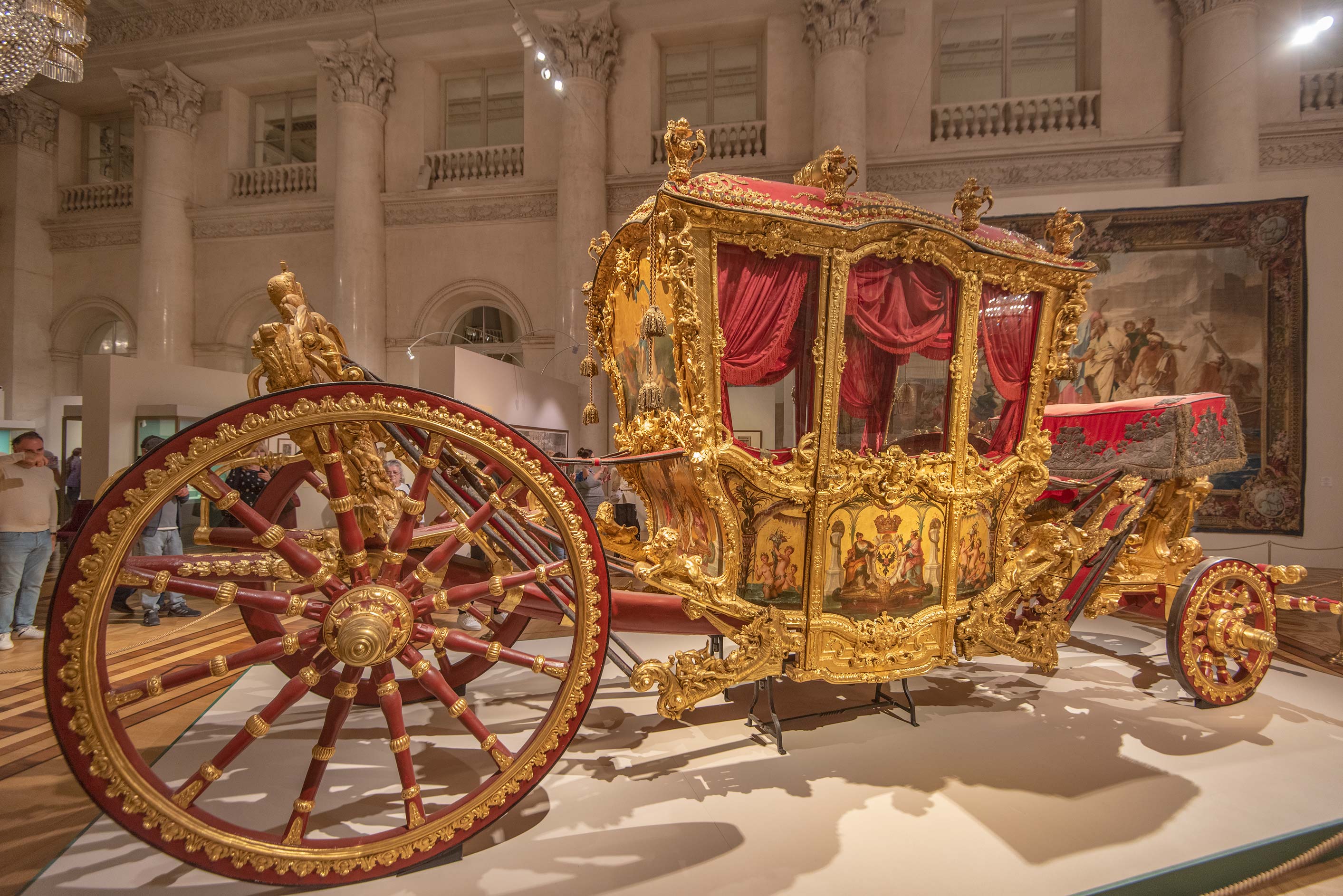
Displayed on a raised white platform in the Field Marshals Hall of the Winter Palace, the 18th-century Grand Coronation Carriage (commissioned in Paris by Peter the Great for Catherine I and later used by Catherine the Great) features gilded wood carvings, painted allegorical panels, crimson velvet curtains, and large red-spoked wheels. Behind the coach, neoclassical Corinthian columns, an upper gallery balustrade, and a large woven tapestry frame the exhibition space in the State Hermitage Museum in Saint Petersburg, Russia, September 10, 2026
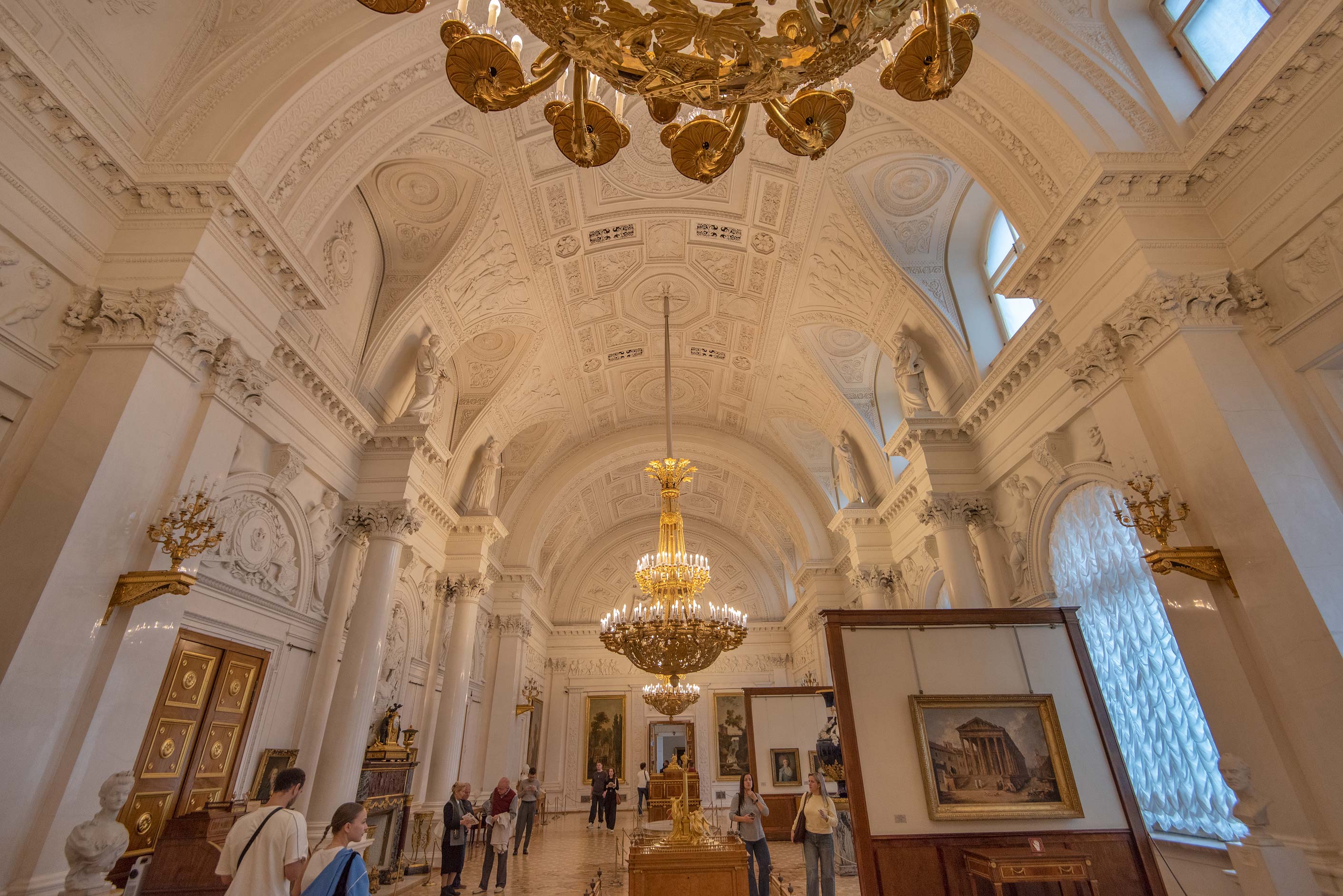
Designed by architect Alexander Briullov in 1841, the neoclassical White Hall (Room 289) of the Winter Palace features a coffered barrel-vaulted ceiling with white stucco reliefs, Corinthian columns topped with classical statues, and tiered gilt-bronze chandeliers. Gilded wall sconces, carved wooden doors, marble busts, and freestanding exhibition partitions displaying 19th-century European paintings fill the grand space in the State Hermitage Museum, September 10, 2026
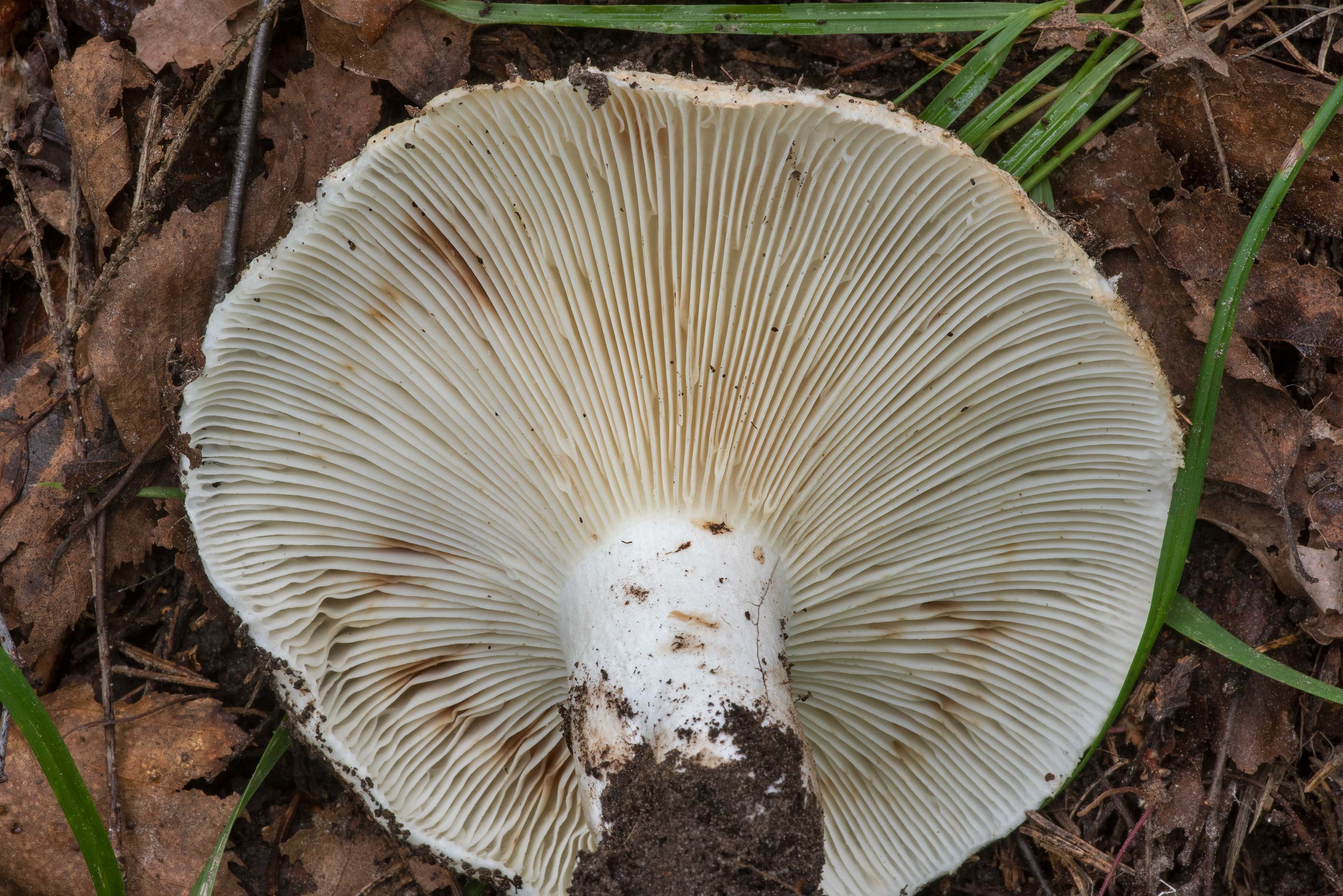
Viewed from beneath amidst damp brown leaf litter and green grass blades on the forest floor, the upturned fruiting body of the milk-white brittlegill mushroom (Russula delica) displays radiating, moderately spaced, creamy-white decurrent gills interspersed with shorter lamellulae and marked by occasional rusty-brown bruised stains. Extending from the center of the slightly inrolled, soil-rimmed cap margin, the short, stout, white stipe tapers slightly toward a dark humus-covered base in Pavlovsk Park. Pavlovsk, suburb of Saint Petersburg, Russia, September 13, 2026
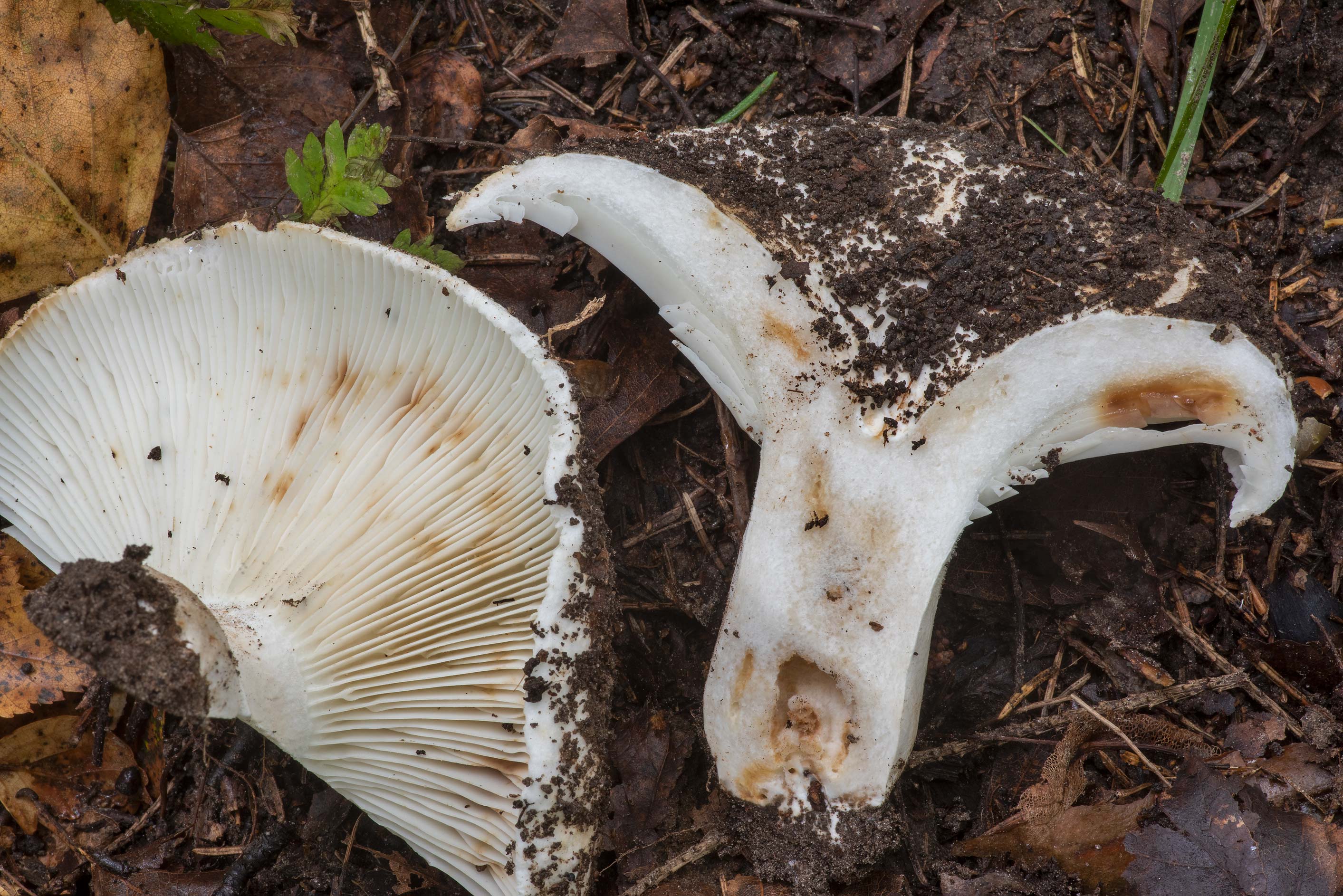
Seen in longitudinal cross-section alongside its overturned counterpart amidst dark forest litter and fallen leaves, a halved fruiting body of the milk-white brittlegill mushroom (Russula delica) displays thick, firm, milky-white flesh devoid of latex, with a deeply funnel-shaped cap covered in dark humus and a small cavity near the base of the short, stout stipe. To the left, the upturned half reveals moderately spaced, creamy-white decurrent gills marked by rusty-brown bruised stains beneath an inrolled, soil-rimmed margin in Pavlovsk Park. Pavlovsk, suburb of Saint Petersburg, Russia, September 13, 2026
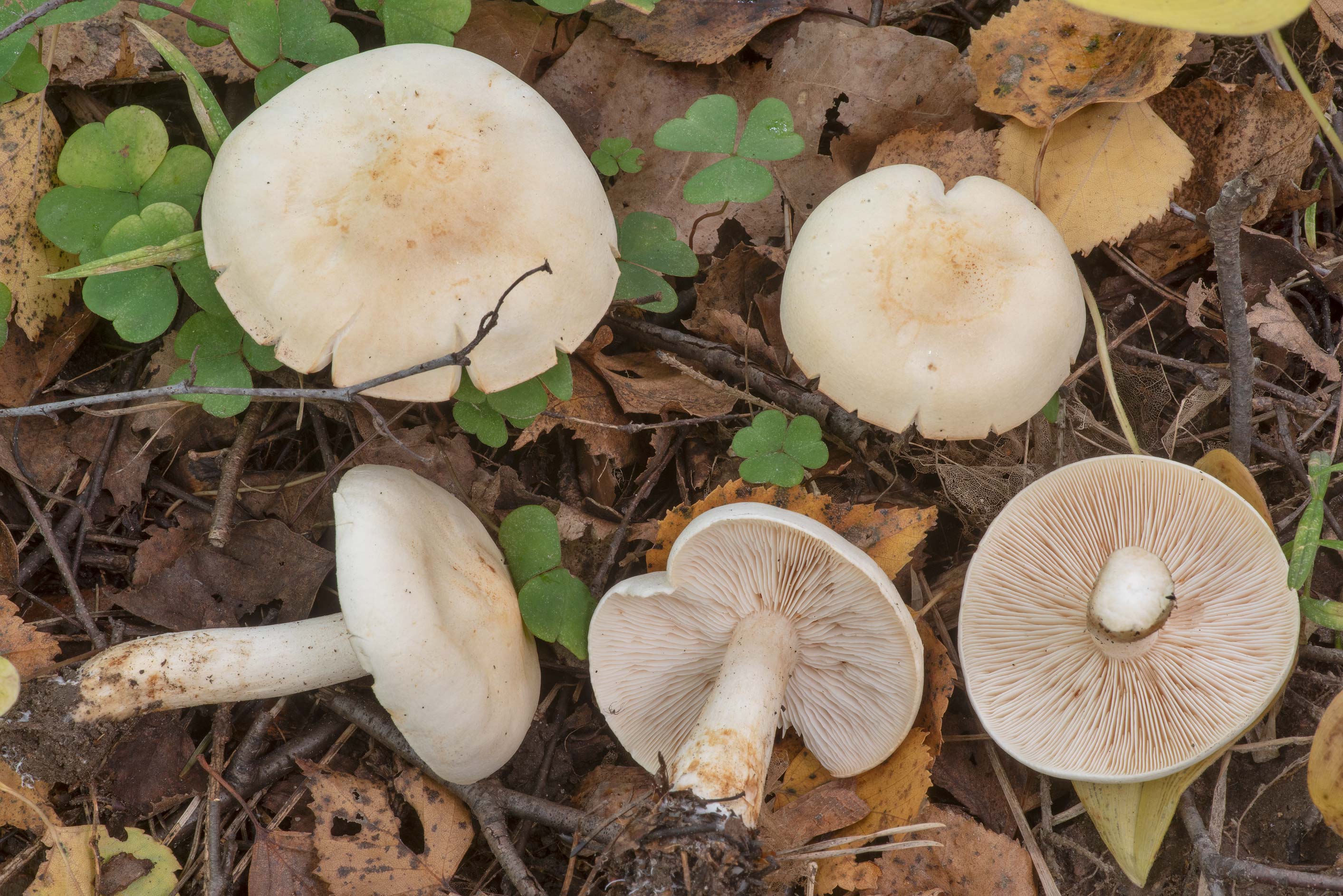
Viewed from directly above amidst fallen brown and yellow birch leaves, twigs, and green wood sorrel (Oxalis acetosella) leaflets in the Sylvia area, five fruiting bodies of the birch knight mushrooms (Tricholoma stiparophyllum) display convex, ivory-to-cream caps with faintly ochre-buff centers and slightly cracked margins. Arranged across the lower half in profile and overturned views, three specimens reveal closely spaced, pale cream emarginate gills and sturdy, cylindrical whitish stems stained ochre-brown toward the soil-clinging bases in Pavlovsk Park. Pavlovsk, suburb of Saint Petersburg, Russia, September 13, 2026
