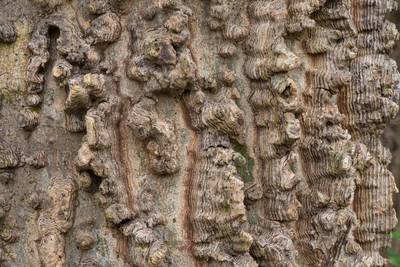
Warty texture with corky ridges of bark of hackberry (Celtis laevigata) in Washington-on-the-Brazos State Historic Site. Washington, Texas, January 3, 2010.  Young leaves of hackberry tree. The deeply impressed venation creates a quilted, highly textured surface on the more mature, larger leaves at the top of the cluster. Looking closely at the leaf margins, particularly on the prominent leaf on the left, one can clearly see the asymmetric bases and the sharp, forward-pointing serrations along the edges, both classic field marks for this genus. Bee Creek Park. College Station, Texas, March 26, 2026  Corky ridges of bark of hackberry (Celtis laevigata) in Washington-on-the-Brazos State Historic Site. Washington, Texas, May 16, 2010  Corky ridges of bark of hackberry (Celtis laevigata) in Washington-on-the-Brazos State Historic Site. Washington, Texas, December 30, 2010  Warty texture of bark of hackberry (Celtis laevigata) on Racoon Run Trail in Lick Creek Park. College Station, Texas, December 17, 2008  Corky bark of hackberry tree near Racoon Run Trail in Lick Creek Park. College Station, Texas, January 4, 2011  Warty texture of bark of hackberry (Celtis laevigata) with ice on a golf course on campus of Texas A and M University. College Station, Texas, February 14, 2021  Sugarberry (hackberry, Celtis laevigata) tree bark on Racoon Run Trail in Lick Creek Park. College Station, Texas, July 17, 2013  Corky bark of hackberry (Celtis laevigata) in Washington-on-the-Brazos State Historic Site. Washington, Texas, December 30, 2010  Focusing closer, the photograph reveals the intricate, densely packed structure of the cursed buttercup (Ranunculus sceleratus) as it colonizes the dried mud. The plants exhibit a vibrant, fleshy appearance, characterized by deeply lobed, shiny green leaves that vaguely resemble flat-leaf parsley or young celery--giving the plant its alternate name, the celery-leaved buttercup. In this dense thicket, the stout, hollow stems branch frequently, creating a tangled, multi-layered canopy. Tiny, five-petaled pale yellow flowers dot the upper stems, standing out brightly against the dark backdrop of the soil and the deeper green foliage below. Flag Pond near Nails Creek Unit of Somerville Lake State Park. Texas, March 14, 2026  Close up of bark sulphur-firedot lichen (Gyalolechia flavorubescens, Caloplaca flavorubescens) on a hackberry tree in Lick Creek Park. College Station, Texas, February 3, 2019  Sapsucker holes in warty bark of hackberry near Racoon Run Trail in Lick Creek Park. College Station, Texas, January 14, 2011  Dynamic display of autumn color and texture in Upper Park. The image highlights a grove of white-barked trees--likely birch or aspen--whose bright trunks are textured with patches of green moss and lichen. These vertical lines contrast beautifully with the chaotic, horizontal spread of the crimson undergrowth (likely wild shrubs like dogwood). Oranienbaum palace-and-park ensemble in Lomonosov (a suburb of St. Petersburg), Russia, October 13, 2025  Warty bark of hackberry (Celtis laevigata) in Washington-on-the-Brazos State Historic Site. Washington, Texas, November 3, 2020  Warty texture of bark of hackberry (Celtis laevigata) in Washington-on-the-Brazos State Historic Site. Washington, Texas, November 17, 2012  Old holes bored by sapsuckers in warty bark of hackberry (Celtis laevigata) in Washington-on-the-Brazos State Historic Site. Washington, Texas, December 30, 2010  Bark of hackberry (Celtis laevigata) with ice on a golf course on campus of Texas A and M University. College Station, Texas, February 14, 2021  Frostweed (Verbesina virginica) after hard freeze on sewer line right of way in Lick Creek Park. Layers of ice are formed into exquisite patterns that curl into "petals" that resemble flowers. College Station, Texas, January 9, 2010  Frostweed (Verbesina virginica) after hard freeze on sewer line right of way in Lick Creek Park. Thin layers of ice are often formed into exquisite patterns that curl into "petals" that resemble flowers. College Station, Texas, January 9, 2010  Corky bark in Lick Creek Park. College Station, Texas, November 30, 2012 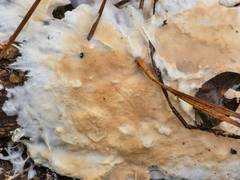 Corticioid fungus Trechispora polyporoidea (also currently known as Phlyctibasidium polyporoideum or Ramaricium polyporoideum) under a hardwood log. The close-up photo clearly shows the thick, membranous to leathery texture with a grayish-yellow fertile area. on South Wilderness Loop Trail at Little Lake Creek Wilderness in Sam Houston National Forest. Montgomery County, Texas, May 2, 2026  Bark sulphur-firedot lichen (Gyalolechia flavorubescens, Caloplaca flavorubescens) on a hackberry tree in Lick Creek Park. College Station, Texas, February 3, 2019  Bark sulphur-firedot lichen (Gyalolechia flavorubescens, Caloplaca flavorubescens) on bark of hackberry tree in Lick Creek Park. College Station, Texas, January 1, 2019  Texture of bark sulphur-firedot lichen (Gyalolechia flavorubescens, Caloplaca flavorubescens) on a hackberry tree in Lick Creek Park. College Station, Texas, February 3, 2019  Hackberry (Celtis laevigata)(?) in Lick Creek Park. College Station, Texas, March 22, 2019  Pattern of bark sulphur-firedot lichen (Gyalolechia flavorubescens, Caloplaca flavorubescens) on bark of hackberry tree in Lick Creek Park. College Station, Texas, January 1, 2019  Texture of bark sulphur-firedot lichen (Gyalolechia flavorubescens, Caloplaca flavorubescens) on bark of hackberry tree in Lick Creek Park. College Station, Texas, January 1, 2019 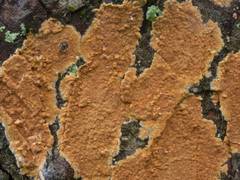 Close-up of thin corticioid fungus Hymenochaete cinnamomea (H. fuliginosa complex) on bark of a living tree of farkleberry (Vaccinium) in Lick Creek Park. College Station, Texas, June 3, 2026  Orange apothecia of bark sulphur-firedot lichen (Gyalolechia flavorubescens, Caloplaca flavorubescens) on bark of hackberry tree in Lick Creek Park. College Station, Texas, January 1, 2019  Spider on shoot of hackberry (Celtis laevigatus) in Lick Creek Park. College Station, Texas, March 23, 2023  Shoots of hackberry (sugarberry, Celtis laevigata) in Lick Creek Park. College Station, Texas, March 7, 2023  Bark of hackberry tree near Racoon Run Trail in Lick Creek Park. College Station, Texas, January 4, 2011  Graffiti series, located on the concrete retaining wall separating the beach from the promenade along the Gulf of Finland (near the Sestroretsk Resort or "Kurort" area) which is a fanciful and nostalgic mural composition featuring whimsical animals and nature motifs. This segment shows a yellow-orange cat perched comfortably on a tree branch. The surrounding trees are depicted with vertical, textured strokes, suggesting a dense birch or pine forest typical of the Karelian Isthmus. Saint Petersburg, Russia, October 9, 2025  Spider on young leaves of hackberry (Celtis laevigatus) in Lick Creek Park. College Station, Texas, March 23, 2023  Back lit leaves of hackberry (sugarberry, Celtis laevigata) in Lick Creek Park. College Station, Texas, March 7, 2023  Young leaves of hackberry (sugarberry, Celtis laevigata) in Lick Creek Park. College Station, Texas, March 7, 2023  Close-up of black dots of Sordariomycetes fungi on bark of a fallen tree in wet area in Lick Creek Park. College Station, Texas, February 23, 2024  Close-up of corticioid mushroom Dendrothele macrodens on bark of a recently fallen large hackberry in Lick Creek Park. College Station, Texas, January 9, 2023  Warty lichen (Pertusaria) on a tree in Lick Creek Park. College Station, Texas, February 3, 2019  On the dry bottom of Flag Pond, the exposed basin was covered with an almost continuous green-and-yellow carpet of cursed buttercup (Ranunculus sceleratus), turning what is usually open water into a bright spring sheet of bloom. The plants spread densely across the dark, uneven mud, with only a few bare patches and scattered taller shoots breaking the surface of the low, fine-textured vegetation.The broad open expanse, distant tree line, and heavy gray clouds make the scene feel both striking and a little surreal, as if the pond has briefly become a flowering meadow. Near Nails Creek Unit of Somerville Lake State Park. Texas, March 14, 2026  Close-up of texture of lichens on bark of hackberry (Celtis laevigata) in Washington-on-the-Brazos State Historic Site. Washington, Texas, November 3, 2020  This scene showcases a sophisticated understanding of color layering in landscape design, using native species to create depth. The distinct red-purple haze of the Red-barked dogwood (Cornus alba or Swida alba) in the foreground acts as a grounding base, contrasting sharply with the luminous yellow of the maples and the vertical white lines of the birch trunks behind it. The dogwood s dense, fine twig structure (which turns vibrant blood-red in winter) adds a chaotic, bushy texture that complements the more open, airy canopy of the deciduous forest. This composition highlights the transition of seasons; while the canopy glows with "golden autumn," the understory dogwood is already revealing the red bark that will provide visual interest throughout the snowy Russian winter. Aleksandrovsky (Alexander) Park in Pushkin (former Tsarskoe Selo) near Saint Petersburg, Russia, October 10, 2025  Patterns of bark of dead oak on Racoon Run Trail in Lick Creek Park. College Station, Texas, July 17, 2013  Close-up of young oyster mushroom (Pleurotus ostreatus) on a large fallen elm(?) tree in Lick Creek Park. College Station, Texas, February 11, 2026  Irregular surface of brown corticioid (crust) fungus Dichostereum effuscatum on bark of a fallen oak branch at Lake Somerville Trailway near Birch Creek Unit of Somerville Lake State Park. Texas, January 1, 2023  Rich textures of the "Golden Autumn" in the Upper Park s romantic landscape. A prominent feature is the large tree trunk (likely a Linden/Lime tree, Tilia) displaying dense epicormic growth--small green sprouts at its base--which creates a "skirt" of fresh green that stands out against the darker, rugged bark and the autumn colors surrounding it. Oranienbaum palace-and-park ensemble in Lomonosov (a suburb of St. Petersburg), Russia, October 13, 2025  Speckled blister lichen Trypethelium tropicum (Nigrovothelium tropicum) on bark of hackberry tree in Lick Creek Park. College Station, Texas, January 1, 2019  Small ant on bark of a hackberry tree in Bee Creek Park. College Station, Texas, April 9, 2021  Speckled blister lichen Trypethelium tropicum (Nigrovothelium tropicum) with black perithecia on bark of hackberry tree in Lick Creek Park. College Station, Texas, January 1, 2019  Spores shaped as viruses or blood clots of corticioid mushroom Dendrothele macrodens from bark of a recently fallen big hackberry tree, collected a day before in Lick Creek Park. College Station, Texas, January 10, 2023  Irregular surface of white resupinate polypore mushroom "boring poria" (Oxyporus corticola)(?) on a fallen tree without bark near Dibuny, north-west from Saint Petersburg, Russia, May 5, 2021  Shoot of hackberry tree in Bee Creek Park. College Station, Texas, March 26, 2026 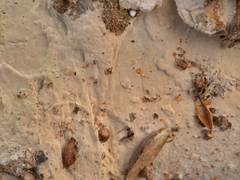 Close-up of brown corticioid fungus Dichostereum effuscatum(?) on a log in Lick Creek Park. College Station, Texas, May 14, 2026  Close-up of corticioid brown fungus on bark of a fallen oak branch in Lick Creek Park. College Station, Texas, June 4, 2021  Brown tree bark on Racoon Run Trail in Lick Creek Park. College Station, Texas, July 28, 2013  This composite image documents four stems of Hedeoma hispida (Rough False Pennyroyal) demonstrating the plant s appearance under two different lighting conditions against a dark background. The top panel shows the specimens under standard white light. The stems feature opposite, linear leaves and are covered in fine, bristly hairs, giving the plant its "rough" descriptor. Clusters of tiny, tubular, purplish-blue flowers emerge from the leaf axils along the upper portions of the stems, nestled within spiky, bristly calyces. The overall coloration is a vibrant, natural green with delicate violet floral accents. The bottom panel reveals the same four specimens illuminated by a 365 nm ultraviolet (UV-A) blacklight. Under UV excitation, the plant exhibits striking fluorescence. The previously purplish-blue flowers fluoresce a brilliant, vivid pinkish-red, while the green stems, leaves, and bristly hairs emit a cool, icy blue-white glow. This stark contrast highlights the complex photochemical properties of the plant tissues, transforming the subtle daytime appearance into a dramatic, high-contrast display. College Station, Texas, April 30, 2026 Blooming Rough False Pennyroyal (Hedeoma hispida) both in natural light and under 365 nm ultraviolet (UV-A) blacklight collected on a lawn at crossing of Holleman Drive and Dartmouth Street. College Station, Texas, April 30, 2026  Close-up of fleshy, grayish yellow, fan-shaped caps of black-staining polypore mushrooms Meripilus sumstinei at the base of dry Mexican plum in Lick Creek Park. College Station, Texas, August 18, 2021  Close-up of bark of lacebark elm tree (Ulmus parvifolia) in Wolf Pen Creek Park. College Station, Texas, February 22, 2024  Young leaves of hackberry (Celtis laevigata) in Wolf Pen Creek Park. College Station, Texas, March 30, 2023  Pale brown Mycena(?) mushrooms on bark of a large fallen tree in Lick Creek Park. College Station, Texas, May 27, 2020  Hackberry(?) bark in Lick Creek Park. College Station, Texas, November 10, 2020  Some small gilled mushrooms with striations in Lick Creek Park. College Station, Texas, July 15, 2021 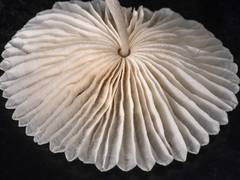 Close-up of a pleated cap of a small gilled mushroom on a tree in Lick Creek Park. College Station, Texas, July 21, 2026  Some immature polypore mushroom at the base of hackberry tree in Wolf Pen Creek Park. College Station, Texas, April 28, 2026  Spores (in KOH, spore print brown) of chestnut brittlestem mushrooms Homophron spadiceum (Psathyrella spadicea) from the base of a hackberry tree, collected in Lick Creek Park. College Station, Texas, November 15, 2023  A symmetrical, bright green mat of terrestrial water-starwort (Callitriche terrestris) growing on the exposed sandy shore of Lake Somerville. This tiny, native semi-aquatic plant behaves as an opportunistic pioneer on recently exposed mud and sand. When a seed germinates on bare, unobstructed ground, it sends out highly branched, creeping stems that radiate outward at an equal rate, rooting at the nodes as they travel. This uniform, radial growth is what creates the nearly perfect circular "cushion" seen here. Texas, February 28, 2026  In this detailed close-up of the desolate Flag Pond basin, the cursed buttercups are entirely absent, leaving behind a stark canvas of severely fractured, gray-brown mud. The features of this dry landscape are two incredibly clear, five-fingered tracks pressed directly into the center of a large, unbroken slab of the baked mud crust. While it is easy to imagine these prints belonging to a large wading bird, avian species almost exclusively leave three- or four-toed, fork-shaped tracks. Instead, these highly distinctive, hand-like imprints with five long, slender, splayed toes are the classic signature of a foraging raccoon. Flag Pond near Nails Creek Unit of Somerville Lake State Park. Texas, March 14, 2026 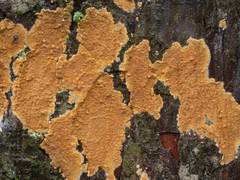 Thin corticioid fungus Hymenochaete cinnamomea (H. fuliginosa complex) on bark of a living tree of farkleberry (Vaccinium) on Closed Trail in Lick Creek Park. College Station, Texas, June 3, 2026 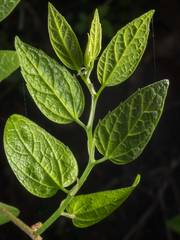 Back lit shoot of hackberry in Lick Creek Park. College Station, Texas, March 7, 2026  Texture of bark of hackberry on Racoon Run Trail in Lick Creek Park. College Station, Texas, December 21, 2010  Velvety brown surface of a resupinate polypore mushroom Fuscoporia (Hymenochaetaceae) on a log of a hardwood tree on Raccoon Run Train in Lick Creek Park. College Station, Texas, December 31, 2019 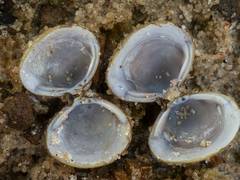 Shells of Asian Clam (Corbicula fluminea, highly successful invasive species) on a sandy bottom of Caney Creek on Caney Creek Trail (Little Lake Creek Loop Trail) in Sam Houston National Forest north from Montgomery. Texas, July 4, 2026  Bark rash lichen (Pyrenula cruenta) on hackberry in Lick Creek Park. College Station, Texas, January 9, 2019  A miniature procession of rust-colored ants traverses the deeply grooved, dry bark of an oak tree. In the center foreground, one ant acts as the focal point, hoisting a freshly cut, bright green slice of an oak leaf high above its head. Because the leaf fragment curves directly over the ant s body like a small green canopy, it perfectly illustrates why this species is often nicknamed the "parasol ant". Surrounding this central figure, three other ants march in the same direction, each carrying large, beaded green oak catkins gripped tightly in their mandibles. These are Texas leafcutter ants (Atta texana), a native species famous for its highly organized and destructive foraging behavior. Working in massive, coordinated trails that can span hundreds of feet, worker ants climb into the canopies of oaks and other trees to systematically slice away fresh, tender vegetation. The workers possess powerful jaws capable of cutting through leaves and flowers with remarkable speed, allowing a large colony to completely strip the foliage from a small tree in a single night. Lake Somerville Trailway near Nails Creek Unit of Somerville Lake State Park. Texas, March 14, 2026  Punctelia, Pertusaria and Phaeographis lichens on tree bark in Lick Creek Park. College Station, Texas, February 20, 2019  Close-up of blue and orange fluorescent lichens on bark of hackberry in ultraviolet light in Lemontree Park. College Station, Texas, November 5, 2024  Young leaves and flowers of hackberry (Sugarberry, Celtis laevigata) in Lemontree Park. College Station, Texas, March 24, 2010.  Polypore fungus Vitreoporus dichrous on a cut surface of a stump of hackberry or oak on Racoon Run Trail in Lick Creek Park. College Station, Texas, August 24, 2022  Crimson warts of bark rash lichen (Pyrenula cruenta) on hackberry in Lick Creek Park. College Station, Texas, January 9, 2019 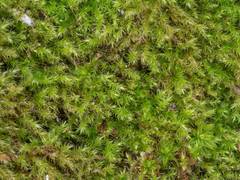 Close-up of green moss in a dried small creek on Closed Trail in Lick Creek Park. College Station, Texas, February 26, 2026  Sunken bloodspot lichen (Haematomma persoonii) on bark of hackberry tree in Lemontree Park. College Station, Texas, January 2, 2019  Bark of dry hackberry (Celtis laevigata) in Washington-on-the-Brazos State Historic Site. Washington, Texas, December 10, 2011  Bark of hackberry (Celtis laevigata) in Washington-on-the-Brazos State Historic Site. Washington, Texas, December 10, 2011  Bark of hackberry (Celtis laevigata) in Washington-on-the-Brazos State Historic Site. Washington, Texas, October 20, 2012  Some odontoid corticioid fungus with irregular surface on a hardwood log (may be elm or hackberry) in Washington-on-the-Brazos State Historic Site. Washington, Texas, January 3, 2023  Polypore fungus Vitreoporus dichrous on upper surface of a stump of hackberry or oak on Racoon Run Trail in Lick Creek Park. College Station, Texas, August 24, 2022 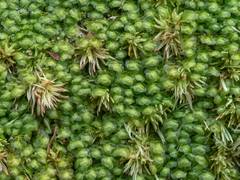 Close-up of Grove Earwort (liverwort Scapania nemorea) on Closed Trail in Lick Creek Park. College Station, Texas, February 26, 2026  Corticioid mushroom Dendrothele macrodens on bark of a recently fallen big hackberry on a pipeline right of way in Lick Creek Park. College Station, Texas, January 9, 2023  Black dots of Sordariomycetes fungi on bark of a fallen tree in wet area in Lick Creek Park. College Station, Texas, February 23, 2024  Rough speckled shield lichen (Punctelia rudecta) on tree bark in Lick Creek Park. College Station, Texas, February 3, 2019  Warts on bark of hackberry (Celtis laevigata) in Washington-on-the-Brazos State Historic Site. Washington, Texas, December 10, 2011  Detail of bark of dry hackberry (Celtis laevigata) in Washington-on-the-Brazos State Historic Site. Washington, Texas, December 10, 2011  Decomposing bark of dry hackberry (Celtis laevigata) in Washington-on-the-Brazos State Historic Site. Washington, Texas, December 10, 2011  Bark of dead hackberry (Celtis laevigata) in Washington-on-the-Brazos State Historic Site. Washington, Texas, December 10, 2011  Texture of bark of hackberry (Celtis laevigata) in Washington-on-the-Brazos State Historic Site. Washington, Texas, November 17, 2012  Warts on bark of hackberry (Celtis laevigata) in Washington-on-the-Brazos State Historic Site. Washington, Texas, January 3, 2010.  Close-up of light brown corticioid (crust) fungus on thin fallen tree from Lick Creek Park. College Station, Texas, August 2, 2022  Texture of sunken bloodspot lichen (Haematomma persoonii) on bark of hackberry tree in Lemontree Park. College Station, Texas, January 2, 2019  Red apothecia of sunken bloodspot lichen (Haematomma persoonii) on bark of hackberry tree in Lemontree Park. College Station, Texas, January 2, 2019 |