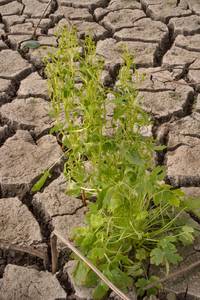
In this wide expanse of the dried Flag Pond basin, the vegetation pattern of the cursed buttercup (Ranunculus sceleratus) has shifted dramatically, becoming highly sparse and widely scattered. Here, the landscape is dominated by pale, heavily baked mud that has contracted and fractured into a vast, repeating network of geometric desiccation polygons. Emerging from these deep, crisscrossing fissures are a few isolated, bright green clumps of buttercup, accompanied only by the dry, curled, and withered stalks of last year s aquatic vegetation. Near Nails Creek Unit of Somerville Lake State Park. Texas, March 14, 2026  Focusing closer, the photograph reveals the intricate, densely packed structure of the cursed buttercup (Ranunculus sceleratus) as it colonizes the dried mud. The plants exhibit a vibrant, fleshy appearance, characterized by deeply lobed, shiny green leaves that vaguely resemble flat-leaf parsley or young celery--giving the plant its alternate name, the celery-leaved buttercup. In this dense thicket, the stout, hollow stems branch frequently, creating a tangled, multi-layered canopy. Tiny, five-petaled pale yellow flowers dot the upper stems, standing out brightly against the dark backdrop of the soil and the deeper green foliage below. Flag Pond near Nails Creek Unit of Somerville Lake State Park. Texas, March 14, 2026  In the caked mud of Flag Pond, a bright green, bushy seedling of cursed buttercup (Ranunculus sceleratus) emerges strongly from the deep fissures. Beside it lies a single, perfectly round, olive-green leaf of an American lotus (Nelumbo lutea) seedling, dotted with a few tiny water droplets that highlight its water-repellent surface. Scattered around these two fresh sprouts are the thick, dried, gray-brown stalks of mature lotus plants from a previous growing season, resting lifelessly across the severely fractured, dry earth. Near Nails Creek Unit of Somerville Lake State Park. Texas, March 14, 2026  In this wider view of the dried Flag Pond basin, the landscape reveals a different growth pattern of the cursed buttercup (Ranunculus sceleratus). Rather than forming a low, continuous carpet, the plants here have grown into distinct, robust clumps separated by wide veins of pale, heavily caked mud. The deep fissures running through the sun-baked earth create a striking geometric web, framing the bright green bushes of buttercup. In the background, a band of dry brown reeds marks the pond s original edge, giving way to a dense tree line under the same overcast, gray sky. Near Nails Creek Unit of Somerville Lake State Park. Texas, March 14, 2026  In this highly desolate section of the dried Flag Pond, the landscape has been reduced to a severe, almost desert-like expanse of deeply fractured earth. The pale, sun-baked mud is completely broken into a continuous, interlocking mosaic of large desiccation polygons, with wide, dark fissures separating the hardened crust. Dead, curled stalks from last year s aquatic plants are sparsely littered across the barren surface, and in the direct center of the frame, a single, vibrant green cursed buttercup (Ranunculus sceleratus) stands entirely alone. Near Nails Creek Unit of Somerville Lake State Park. Texas, March 14, 2026  Caked mud of a dried lake with isolated of the cursed buttercup (Ranunculus sceleratus). Flag Pond near Nails Creek Unit of Somerville Lake State Park. Texas, March 14, 2026  A single, vibrant green cursed buttercup (Ranunculus sceleratus) stands entirely alone in caked mud of Flag Pond near Nails Creek Unit of Somerville Lake State Park. Texas, March 14, 2026 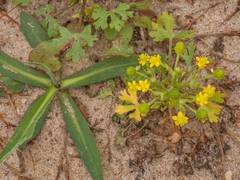 Bloomin plant of cursed buttercup (Ranunculus sceleratus) on a lake shore near Birch Creek Unit of Somerville Lake State Park. Texas, February 28, 2026  Carpet of cursed buttercup (Ranunculus sceleratus) in dried Flag Pond near Nails Creek Unit of Somerville Lake State Park. Texas, March 14, 2026  This composite image documents four stems of Hedeoma hispida (Rough False Pennyroyal) demonstrating the plant s appearance under two different lighting conditions against a dark background. The top panel shows the specimens under standard white light. The stems feature opposite, linear leaves and are covered in fine, bristly hairs, giving the plant its "rough" descriptor. Clusters of tiny, tubular, purplish-blue flowers emerge from the leaf axils along the upper portions of the stems, nestled within spiky, bristly calyces. The overall coloration is a vibrant, natural green with delicate violet floral accents. The bottom panel reveals the same four specimens illuminated by a 365 nm ultraviolet (UV-A) blacklight. Under UV excitation, the plant exhibits striking fluorescence. The previously purplish-blue flowers fluoresce a brilliant, vivid pinkish-red, while the green stems, leaves, and bristly hairs emit a cool, icy blue-white glow. This stark contrast highlights the complex photochemical properties of the plant tissues, transforming the subtle daytime appearance into a dramatic, high-contrast display. College Station, Texas, April 30, 2026 Blooming Rough False Pennyroyal (Hedeoma hispida) both in natural light and under 365 nm ultraviolet (UV-A) blacklight collected on a lawn at crossing of Holleman Drive and Dartmouth Street. College Station, Texas, April 30, 2026  On the dry bottom of Flag Pond, the exposed basin was covered with an almost continuous green-and-yellow carpet of cursed buttercup (Ranunculus sceleratus), turning what is usually open water into a bright spring sheet of bloom. The plants spread densely across the dark, uneven mud, with only a few bare patches and scattered taller shoots breaking the surface of the low, fine-textured vegetation.The broad open expanse, distant tree line, and heavy gray clouds make the scene feel both striking and a little surreal, as if the pond has briefly become a flowering meadow. Near Nails Creek Unit of Somerville Lake State Park. Texas, March 14, 2026  Cursed buttercup (Ranunculus sceleratus) on a shore of Flag Pond at Lake Somerville Trailway near Nails Creek Unit of Somerville Lake State Park. Texas, April 4, 2021  Blooming cursed buttercup (Ranunculus sceleratus) in bloom on a shore of Flag Pond at Lake Somerville Trailway near Nails Creek Unit of Somerville Lake State Park. Texas, April 4, 2021  Blooming cursed buttercup (Ranunculus sceleratus) on muddy shore of Flag Pond at Lake Somerville Trailway near Nails Creek Unit of Somerville Lake State Park. Texas, April 4, 2021  A symmetrical, bright green mat of terrestrial water-starwort (Callitriche terrestris) growing on the exposed sandy shore of Lake Somerville. This tiny, native semi-aquatic plant behaves as an opportunistic pioneer on recently exposed mud and sand. When a seed germinates on bare, unobstructed ground, it sends out highly branched, creeping stems that radiate outward at an equal rate, rooting at the nodes as they travel. This uniform, radial growth is what creates the nearly perfect circular "cushion" seen here. Texas, February 28, 2026  a young, actively growing shoot of eastern poison ivy (Toxicodendron radicans) emerging from the shadows of a thicket. The image is dramatically lit, isolating the central stem and fresh leaves against a nearly pitch-black background, which brings the complex textures and colors of the plant into sharp relief. The lighting emphasizes the plant s characteristic "leaves of three" structure, making the distinct anatomy of the new spring growth unmistakably clear. Wolf Pen Creek Park. College Station, Texas, March 23, 2026  Several rust-colored, spiky-bodied ants can be seen navigating the deeply furrowed bark of an oak tree, acting as a miniature logging crew. Some of the ants are carrying entire green, beaded oak catkins--the tree s string-like flower clusters--while one prominently hoists a freshly cut, bright green section of an oak leaf in its jaws. The ants carry these heavy loads hoisted high over their heads, a posture that resembles someone carrying a sunshade. These are Texas leafcutter ants (Atta texana), a highly destructive but fascinating native species also known as the "town ant" or "parasol ant" due to their unique carrying technique. They climb high into the canopies of oaks and other trees to use their powerful, scissor-like mandibles to slice away fresh foliage, preferring new, tender, high-water-content growth like young leaves and spring catkins. Working in massive, organized trails, a large colony can entirely strip the leaves from a small- to medium-sized tree in a single night, and they frequently travel hundreds of feet from their underground nests to find a suitable harvest. Lake Somerville Trailway near Nails Creek Unit of Somerville Lake State Park. Texas, March 14, 2026  Narrow green leaves of a plant of mustard family on Lake Somerville Trailway in area of Newman Bottom near Nails Creek Unit of Somerville Lake State Park. Texas, February 2, 2021 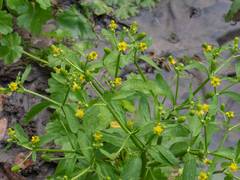 Cursed buttercup (Ranunculus sceleratus) in an oxbow in Lick Creek Park. College Station, Texas, January 4, 2026  Rosette of leaves of some aquatic plant on shores of Flag Pond at Lake Somerville Trailway, near Nails Creek Unit of Somerville Lake State Park. Texas, March 8, 2023 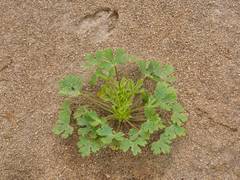 A lush basal rosette of the cursed buttercup (Ranunculus sceleratus) growing in the damp sand of the Lake Somerville drawdown zone, just below the fresh footprint of a passing feral hog. Texas, February 28, 2026  A network of heavily rusted, interconnected pipes is positioned above a patch of bare dirt and dry, dormant brush. Supported by thick vertical stands, the horizontal piping is outfitted with an array of industrial hardware, including multiple pressure gauges (manometers) and a prominently featured red pneumatic control valve. Snaking between these various instruments and the main pipes are several runs of very thin, bright, and shiny silver tubing, creating a sharp visual contrast against the deep rust of the primary framework. Although the complex arrangement of pipes and dials might superficially resemble a distillation apparatus, it is actually a surface wellhead and production manifold used in the oil and gas industry. These structures are critical components installed at the surface of an extraction site to safely control, monitor, and route the high-pressure flow of hydrocarbons coming from an underground well. The various valves act as "chokes" to regulate the flow rate of the extracted oil or gas, while the intricate tubing feeds the product to the manometers and pneumatic controls to constantly monitor system pressure and ensure safe operation. Northern side of Flag Pond on Lake Somerville Trailway near Nails Creek Unit of Somerville Lake State Park. Texas, March 14, 2026  Cursed buttercup (Ranunculus sceleratus) in Lick Creek Park. College Station, Texas, March 10, 2023  A sprawling, multi-stemmed mat of annual trampweed (Facelis retusa) growing on the sandy shore of Lake Somerville, Texas. This tough winter annual is a member of the aster family and a close relative of native cudweeds. It is easily identified by its narrow, gray-green leaves that feature distinctly blunted or notched tips (retuse) and bright white, woolly undersides. At the center of the plant, there are small, tight flower heads beginning to form at the tips of the stems. Texas, February 28, 2026  Mat of a semi-aquatic plant terrestrial water-starwort (Callitriche terrestris) with tiny leaves on a muddy shore of Flag Pond on Lake Somerville Trailway near Nails Creek Unit of Somerville Lake State Park. Texas, March 10, 2021  Cursed buttercup (Ranunculus sceleratus) on Racoon Run Trail in Lick Creek Park. College Station, Texas, March 3, 2025  Hairy leaves of some plant on Lake Somerville Trailway in area of Newman Bottom near Nails Creek Unit of Somerville Lake State Park. Texas, February 2, 2021  Rosette of leaves of some plant on Lake Somerville Trailway in area of Newman Bottom near Nails Creek Unit of Somerville Lake State Park. Texas, February 2, 2021  Some green leaves on Lake Somerville Trailway near Nails Creek Unit of Somerville Lake State Park. Texas, March 14, 2026  This sequence of disjointed stone steps, winding up the leaf-covered slope, exemplifies the "landscape surprise" element typical of the Sergievka Park design. Unlike the straight, formal staircases of the nearby Peterhof Grand Palace, these steps are scattered and uneven, inviting visitors to meander through the forest rather than march directly to a destination. The steps are almost camouflaged by a vibrant mosaic of fallen yellow and brown leaves, making them appear as natural rock formations emerging from the hillside. The staircase sequence gently ascends the steep ravine bank, integrating perfectly with the surrounding old-growth trees and emphasizing the park s wild, preserved character. Old Peterhof, west from Saint Petersburg, Russia, October 13, 2025  Cursed buttercup (Ranunculus sceleratus) on a recent pipeline cutting in Lick Creek Park. College Station, Texas, March 26, 2019  Winter rosette of narrow leaves of a plant of mustard family on Lake Somerville Trailway in area of Newman Bottom near Nails Creek Unit of Somerville Lake State Park. Texas, February 2, 2021  Delicate, fuzzy emergence of new oak foliage in early spring, backlit to highlight its soft pink and green hues. Below the newly unfolding, distinctly lobed leaves dangle the tree s string-like catkins--the male flower clusters that release pollen just as the canopy breaks dormancy. Lake Somerville Trailway near Nails Creek Unit of Somerville Lake State Park. Texas, March 29, 2026  Early spring growth of Berchemia scandens, commonly known as Alabama supplejack or rattan vine. The backlit perspective isolates the young foliage against a dark background, highlighting the bright, translucent green of the newly emerged leaves. At this time of year, these native vines are actively putting out fresh growth as they begin their seasonal climb through the local understory. Lick Creek Park. College Station, Texas, March 25, 2026  Rosette of leaves of some plant on exposed sandy shore near Birch Creek Unit of Somerville Lake State Park. Texas, February 28, 2026  Curled leaves of giant ragweed (Ambrosia trifida) under 2,4-D Ester(?) herbicide in Washington-on-the-Brazos State Historic Site. Washington, Texas, March 29, 2023  Some semi-aquatic plant with tiny yellow flowers on a muddy shore of Flag Pond on Lake Somerville Trailway near Nails Creek Unit of Somerville Lake State Park. Texas, March 10, 2021  Olive-green leaf of an American lotus (Nelumbo lutea) in caked mud of Flag Pond near Nails Creek Unit of Somerville Lake State Park. Texas, March 14, 2026  Single, perfectly round, olive-green leaf of an American lotus (Nelumbo lutea) in caked mud of Flag Pond near Nails Creek Unit of Somerville Lake State Park. Texas, March 14, 2026  Frequently flooded area on Lake Somerville Trailway near Nails Creek Unit of Somerville Lake State Park. Texas, March 29, 2026  Dry leaves of lotus (Nelumbo lutea) in caked mud of Flag Pond near Lake Somerville Trailway near Nails Creek Unit of Somerville Lake State Park. Texas, October 16, 2022  A miniature procession of rust-colored ants traverses the deeply grooved, dry bark of an oak tree. In the center foreground, one ant acts as the focal point, hoisting a freshly cut, bright green slice of an oak leaf high above its head. Because the leaf fragment curves directly over the ant s body like a small green canopy, it perfectly illustrates why this species is often nicknamed the "parasol ant". Surrounding this central figure, three other ants march in the same direction, each carrying large, beaded green oak catkins gripped tightly in their mandibles. These are Texas leafcutter ants (Atta texana), a native species famous for its highly organized and destructive foraging behavior. Working in massive, coordinated trails that can span hundreds of feet, worker ants climb into the canopies of oaks and other trees to systematically slice away fresh, tender vegetation. The workers possess powerful jaws capable of cutting through leaves and flowers with remarkable speed, allowing a large colony to completely strip the foliage from a small tree in a single night. Lake Somerville Trailway near Nails Creek Unit of Somerville Lake State Park. Texas, March 14, 2026  Distorted growth of giant ragweed (Ambrosia trifida) under 2,4-D Ester(?) herbicide in Washington-on-the-Brazos State Historic Site. Washington, Texas, March 29, 2023  Dry oak skeletons in a frequently flooded area near Flag Pond on Lake Somerville Trailway near Nails Creek Unit of Somerville Lake State Park. Texas, March 14, 2026  A perfectly symmetrical winter basal rosette of a yellowcress (Rorippa species, likely Southern marsh yellowcress, Rorippa teres) blooming on the exposed sandy shore of Lake Somerville. This native wetland pioneer is a member of the mustard family (Brassicaceae). During the cooler months, it forms this flat, circular spray of deeply cut (pinnatifid) leaves to anchor firmly in the shifting sand while maximizing sun exposure and avoiding cold winds. At the very center, the plant has just begun to bolt, producing the tiny, four-petaled yellow flowers characteristic of its family. Texas, February 28, 2026  Leaves of hickory(?) on Lake Somerville Trailway near Nails Creek Unit of Somerville Lake State Park. Texas, March 29, 2026  Field of caked mud of Flag Pond near Nails Creek Unit of Somerville Lake State Park. Texas, March 14, 2026  Close-up of caked mud of Flag Pond near Nails Creek Unit of Somerville Lake State Park. Texas, March 14, 2026  Fresh leaves of live oak on Lake Somerville Trailway near Nails Creek Unit of Somerville Lake State Park. Texas, March 14, 2026  Unfolding leaves of honey locust on Lake Somerville Trailway near Nails Creek Unit of Somerville Lake State Park. Texas, March 29, 2026  Growth of red water fern (Azolla filiculoides) overgrowing other plants on shores of Flag Pond at Lake Somerville Trailway, near Nails Creek Unit of Somerville Lake State Park. Texas, March 8, 2023  Entodon seductrix (often called Seductive Entodon Moss or Cord Glaze Moss). The leaves are tightly pressed against the stems (imbricate) rather than sticking out. This makes the branches look like smooth, pale green to yellowish cords or tiny rat tails, which is the defining field mark of the Entodon genus. Scattered throughout the mat are the reproductive structures (sporophytes). They consist of thin, wiry, dark brick-red or mahogany stalks (setae) topped with small cylindrical capsules. The presence of these mature red sporophytes is very common for Entodon seductrix in the winter and early spring. Fort Boggy State Park. Leon County, Texas, February 21, 2026  Green mat of terrestrial water-starwort (Callitriche terrestris) growing on the exposed sandy shore of Lake Somerville. Closer to the lake[CloseCurlyQuote]s edge, individuals of this same species growing in puddles or shallow water will look remarkably different. When submerged or growing in saturated mud, the plant physically alters its cellular growth, producing leaves that are much larger, thinner, and distinctly elongated to maximize their ability to capture diffused light and dissolved gases underwater. Texas, February 28, 2026  Prostrate plant with tiny leaves terrestrial water-starwort (Callitriche terrestris) on wet soil near the lake at Birch Creek Unit of Somerville Lake State Park. Texas, March 18, 2021  Leaves of a plant of carrot family at Lake Somerville Trailway near Birch Creek Unit of Somerville Lake State Park. Texas, April 14, 2024  Prostrate plant with tiny leaves of terrestrial water-starwort (Callitriche terrestris) on a shore near Birch Creek Unit of Somerville Lake State Park. Texas, March 26, 2023  Male plant of the liverwort Asterella tenella (Delicate Starwort). The strange, bright green, elevated, wart-like cushions sitting right on top of the leaves (thalli) are the male reproductive structures, called antheridial pads or male receptacles. Fort Boggy State Park. Leon County, Texas, February 21, 2026  Millipede curled into a tight coil hibernating under an oak log at Lake Somerville Trailway near Birch Creek Unit of Somerville Lake State Park. Texas, December 21, 2019  Young leaves of a plant of pea family in Birch Creek Unit of Lake Somerville State Park, Texas, April 29, 2012  Anglepod Milkvine (Gonolobus suberosus) is a native climbing milkweed recognized by its heart-shaped leaves and distinctive five-angled seed pods. The striking yellow mosaic highlights its intricate veins due to a condition called chlorosis. Lake Somerville Trailway near Nails Creek Unit of Somerville Lake State Park. Texas, March 29, 2026  Cluster of flowers of showy blue star (Amsonia illustris) on Lake Somerville Trailway near Nails Creek Unit of Somerville Lake State Park. Texas, March 29, 2026  Fresh brown spots of corticioid fungus Virgariella (anamorph of Hypoxylon fuscum complex) with some yellow growth around them on dry stems of Japanese privet in Hensel Park. College Station, Texas, March 11, 2024  Giant ragweed (Ambrosia trifida) after application of herbicide that is causing it to wilt and shrivel in Washington-on-the-Brazos State Historic Site. Washington, Texas, March 21, 2020  Yucca plant on Lake Somerville Trailway near Nails Creek Unit of Somerville Lake State Park. Texas, December 21, 2023  Young plant of carrot family on Lake Somerville Trailway near Nails Creek Unit of Somerville Lake State Park. Texas, April 26, 2020  Green leaves of pokeweed (Phytolacca americana) at Lake Somerville Trailway near Nails Creek Unit of Somerville Lake State Park. Texas, April 4, 2021  Some semi-aquatic plant, may be water primrose (Ludwigia), together with Texas balloonwort (Sphaerocarpos texanus) on a muddy shore of Flag Pond on Lake Somerville Trailway near Nails Creek Unit of Somerville Lake State Park. Texas, March 10, 2021  Wintering plant of bluebonnet (Lupinus) on Lake Somerville Trailway in area of Newman Bottom near Nails Creek Unit of Somerville Lake State Park. Texas, February 2, 2021  Emerging plant of bluebonnet (Lupinus) on Lake Somerville Trailway in area of Newman Bottom near Nails Creek Unit of Somerville Lake State Park. Texas, February 2, 2021  Young plant of bluebonnet (Lupinus) on Lake Somerville Trailway in area of Newman Bottom near Nails Creek Unit of Somerville Lake State Park. Texas, February 2, 2021  Mat of a semi-aquatic plant terrestrial water-starwort (Callitriche terrestris) on the lake shore near Birch Creek Unit of Somerville Lake State Park. Texas, March 21, 2026  Winter rosette of a plant of mustard family on Lake Somerville Trailway in area of Newman Bottom near Nails Creek Unit of Somerville Lake State Park. Texas, February 2, 2021  Growth of peppered rock-shield lichen (Xanthoparmelia conspersa) on a sandstone rock at Lake Somerville Trailway near Nails Creek Unit of Somerville Lake State Park. Texas, February 14, 2024  Green leaves of water-primrose (Ludwigia) on a shore of Flag Pond at Lake Somerville Trailway near Nails Creek Unit of Somerville Lake State Park. Texas, April 4, 2021  Green mat of a prostrate plant terrestrial water-starwort (Callitriche terrestris) on wet soil near the lake at Birch Creek Unit of Somerville Lake State Park. Texas, March 18, 2021  Yellow flower of denseflower bladderpod (Lesquerella densiflora) on Lake Somerville Trailway near Nails Creek Unit of Somerville Lake State Park. Texas, March 14, 2026  Yellow foliage of oaks near Flag Pond on Lake Somerville Trailway near Nails Creek Unit of Somerville Lake State Park. Texas, November 21, 2020  Some plant on exposed shore near Birch Creek Unit of Somerville Lake State Park. Texas, February 28, 2026  This comparative photo contrasts a salad in natural light (top) with its hidden chemical fluorescence under 365 nm ultraviolet light (bottom). The glowing blue-white haze on the seemingly empty ceramic plate exposes microscopic traces of organic residue and fats left over from previous meals. The brightest glow comes from the cottage cheese, which emits a brilliant yellow-green light due to its high riboflavin and protein content. The plant ingredients show a more subtle, tissue-specific response: green olives shift to a pale salmon hue from chlorophyll and phenols, while the red pepper[CloseCurlyQuote]s thin cuticles light up in blue-purple tones. In contrast, the water-dense cucumber and tomato slices absorb most of the UV light and remain dark against the glowing background. College Station, Texas, May 2, 2026  Basal cluster of fleshy leaves of butterwort (Pinguicula pumila) in Big Thicket park, on Pitcher Plant Trail. Leaves are covered with special glandular hairs that trap tiny insects. Texas, March 23, 2008  Liverwort Reboulia hemisphaerica with reproductive heads on a trailway near Birch Creek Unit of Somerville Lake State Park. Texas, January 16, 2023  Spotted leaves of Chinese Tallow exhibiting a phenomenon known as the "green island" effect. The infection sites produce or retain cytokinins (plant hormones) that keep the chlorophyll active in that specific spot. As a result, while the rest of the leaf receives the signal to shut down for winter (losing its green chlorophyll and revealing the red anthocyanin pigments), the infected "islands" stay green and photosynthetically active. Bee Creek Park. College Station, Texas, November 7, 2025  Pillow like green mat of terrestrial water-starwort (Callitriche terrestris) with tiny leaves on a shore of Flag Pond at Lake Somerville Trailway near Nails Creek Unit of Somerville Lake State Park. Texas, April 4, 2021  Dry curled leaves of beautyberry at Lake Somerville Trailway near Birch Creek Unit of Somerville Lake State Park. Texas, July 31, 2022  Dry curled leaves of hackberry on the ground at Lake Somerville Trailway near Birch Creek Unit of Somerville Lake State Park. Texas, July 31, 2022  Some shoots with lanceolate leaves at Lake Somerville Trailway under oaks near Flag Pond, near Nails Creek Unit of Somerville Lake State Park. Texas, March 8, 2023  Leaves of bluebonnet (Lupinus) with some whitish fungus(?) at Lake Somerville Trailway near Flag Pond, near Nails Creek Unit of Somerville Lake State Park. Texas, March 8, 2023  Young leaves of water-primrose (Ludwigia) on shores of Flag Pond at Lake Somerville Trailway, near Nails Creek Unit of Somerville Lake State Park. Texas, March 8, 2023  Leaves of tansy mustard (Descurainia pinnata) at Lake Somerville Trailway under oaks near Flag Pond, near Nails Creek Unit of Somerville Lake State Park. Texas, March 8, 2023  Bluebonnet (Lupinus) with wilted leaves because of some whitish fungus(?) at Lake Somerville Trailway near Flag Pond, near Nails Creek Unit of Somerville Lake State Park. Texas, March 8, 2023  Glossy leaves of water-primrose (Ludwigia) on shores of Flag Pond at Lake Somerville Trailway, near Nails Creek Unit of Somerville Lake State Park. Texas, March 8, 2023  Young plant of sow thistle (Sonchus oleraceus) on exposed shore near Birch Creek Unit of Somerville Lake State Park. Texas, February 28, 2026  Young leaves of bluebonnet (Lupinus) with some small white spots at Lake Somerville Trailway near Flag Pond, near Nails Creek Unit of Somerville Lake State Park. Texas, March 8, 2023  Leaves of woolly-white (Hymenopappus artemisiaefolius) on Lake Somerville Trailway near Birch Creek Unit of Somerville Lake State Park. Texas, March 21, 2026  Green leaves of Yaupon holly collected by Texas leaf cutting ants (Atta texana) under oaks on Lake Somerville Trailway in area of Newman Bottom near Nails Creek Unit of Somerville Lake State Park. Texas, February 2, 2021  Basal leaves of woolly-white (Hymenopappus artemisiaefolius) in dew on Lake Somerville Trailway near Birch Creek Unit of Somerville Lake State Park. Texas, March 21, 2026  Mat of terrestrial water-starwort (Callitriche terrestris) with tiny leaves on a muddy shore of Flag Pond on Lake Somerville Trailway near Nails Creek Unit of Somerville Lake State Park. Texas, March 10, 2021  Highway of leaf-cutting ants surrounded by cut leaves of Yaupon holly at Lake Somerville Trailway under oaks near Flag Pond, near Nails Creek Unit of Somerville Lake State Park. Texas, March 8, 2023  Tiny leaves of terrestrial water-starwort (Callitriche terrestris) together with balloonwort on shores of Flag Pond at Lake Somerville Trailway, near Nails Creek Unit of Somerville Lake State Park. Texas, March 8, 2023 |