
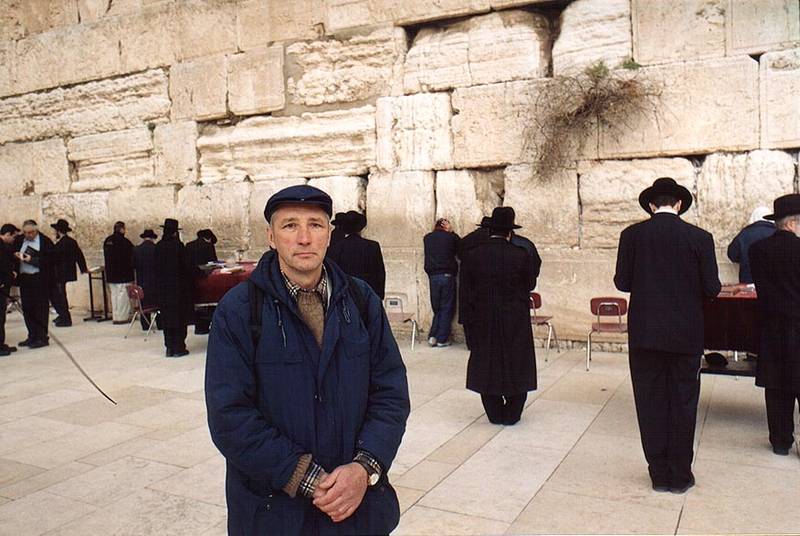

A controversial physicist Sergey PozdneevRussian web-page about S. A. Pozdneyev (a visitor of the university of Beer-Sheva, where he behaved like Ostap BenderStories of Ilya Ilf (1987-1937) & Yevgeny Petrov (1903-1942)) posing in front of the Western, or Wailing Wall. Jerusalem, the Middle East


Album 245: Jerusalem, Jan. 11, 2002
The man in this photo, Sergey Pozdneev, was a visiting physicist from Moscow's Lebedev Physical Institute whose brief stay at Ben-Gurion University in 2001–2002 unfolded like a bizarre academic spy novel. My original caption compared him to Ostap Bender, the charismatic con man of Soviet literature, which proved to be an entirely accurate assessment. He arrived during a unique historical window when underfunded post-Soviet scientists were desperately seeking foreign opportunities, and progressive Israeli institutions were eager to welcome them. Armed with an incredibly persuasive charm and the unassuming face of a traditional Russian intellectual, he secured his fellowship by presenting a heavy Russian monograph published by a legitimate press—a clever credential that established his authority while ensuring his non-Russian-speaking hosts could admire it but not actually evaluate its contents.
Rather than conducting research, Pozdneev spent his fellowship spinning wild, fabricated tales about driving along the volatile Lebanese border with UN peacekeepers or casually eating lunch on restricted military bases. He played on his colleagues' sympathies, claiming to be penniless and overwhelmed by his new surroundings, in order to borrow money from multiple people in the department, myself included. His academic facade began to crack when he produced zero scientific results and somehow severely damaged the university's Unix computer cluster. The technical disaster was so perplexing that the professor who invited him began to seriously suspect he was engaged in espionage or sabotage.
As tensions peaked over his lack of results and unpaid debts, Pozdneev quietly asked for the cheapest way to the airport and vanished. Rather than filing criminal charges, the university handled the fallout administratively by canceling his visa, meaning if he hadn't already fled, he would be detained and deported by border police. It was only after his sudden escape that I contacted his former colleagues in Russia, who confirmed his prior history of plagiarism—finally validating the department's worst suspicions. His elaborate grift caused lasting invisible damage, destroying institutional trust and prompting the department to permanently halt their "experiment" of hiring non-Jewish postdocs. Yet, incredibly, Pozdneev faced no long-term consequences, seamlessly returning to his prestigious institute in Moscow to publish in top Russian physics journals for another two decades. – AI vision


