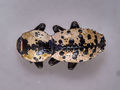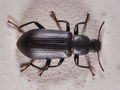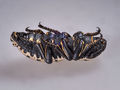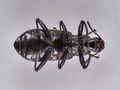
Blister beetle taken from Lick Creek ParkLick Creek: Background Notes. College Station, Texas


Album 1467: College Station, Texas, July 26, 2014
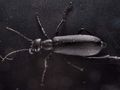
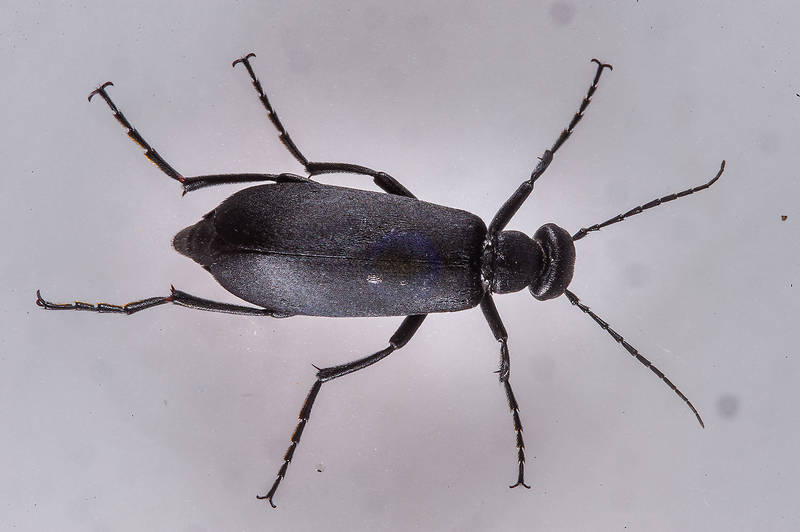
The image presents a photograph of a dark-colored insect with elongated body segments, featuring six visible legs and two antennae protruding from its head.
In terms of size, the insect appears to be approximately 1 centimeter in length, as indicated by the presence of another insect at the bottom left corner of the photo. The background is white or gray, providing a neutral backdrop for the subject.
The caption mentions that this image was taken on July 26, 2014, from Lick Creek Park in College Station, Texas. Although no specific identification is provided, it is likely that the insect depicted is one of the blister beetle species found in the region.
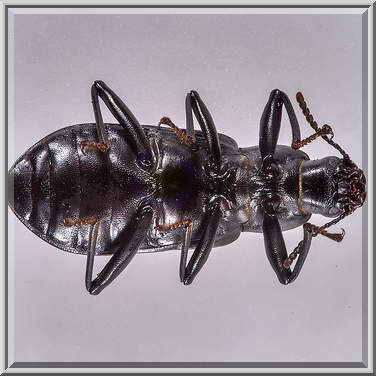
Blister beetles are known for their distinctive appearance and behavior. They have an elongated body shape with a rounded head and thorax, followed by an abdomen with seven visible segments. Their legs are long and slender, while their antennae are short and stubby. These insects are typically brown or black in color, although some species may exhibit variations.
Blister beetles are known to feed on plants, particularly those that produce nectar. They use their sharp mandibles to cut into the plant's tissue and consume its sap. This behavior can sometimes lead to the formation of blisters or welts on human skin if the insect is accidentally crushed or brushed against.
The image provides a clear view of the beetle's body shape, legs, and antennae, making it possible to identify the species based on these characteristics. However, without additional information or context, it is challenging to determine the exact species represented in this photograph.
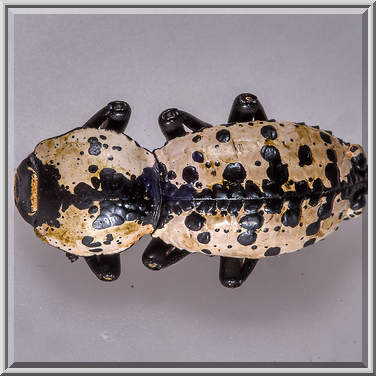
Overall, the image offers a detailed look at a typical blister beetle specimen, showcasing its distinctive features and appearance. – AI vision
🇪🇸 Descripción en español / Spanish Description
Escarabajo de la bulla tomado en Lick Creek Park. College Station, Texas, el 26 de julio de 2014. La imagen presenta una fotografía de un insecto de color oscuro con segmentos alargados del cuerpo, destacando seis patas visibles y dos antenas que sobresalen de su cabeza. En términos de tamaño, el insecto parece medir aproximadamente 1 centímetro de largo, como lo indica la presencia de otro insecto en la esquina inferior izquierda de la foto. El fondo es blanco o gris, proporcionando un telón de fondo neutro para el sujeto. La leyenda menciona que esta imagen fue tomada el 26 de julio de 2014 en Lick Creek Park en College Station, Texas. Aunque no se proporciona una identificación específica, es probable que el insecto representado sea una de las especies de escarabajo de la bulla encontradas en la región. Los escarabajos de la bulla son conocidos por su apariencia y comportamiento distintivos. Tienen una forma alargada del cuerpo con una cabeza redondeada y un tórax, seguido de un abdomen con siete segmentos visibles. Sus patas son largas y delgadas, mientras que sus antenas son cortas y tozudas. Estos insectos suelen ser de color marrón o negro, aunque algunas especies pueden mostrar variaciones. Los escarabajos de la bulla se alimentan de plantas, particularmente aquellas que producen néctar. Usan sus mandíbulas afiladas para cortar el tejido de la planta y consumir su savia. Este comportamiento a veces puede provocar la formación de ampollas o moretones en la piel humana si el insecto se aplasta accidentalmente o se frota contra ella. La imagen proporciona una vista clara de la forma del cuerpo, las patas y las antenas del escarabajo, lo que permite identificar la especie en función de estas características. Sin embargo, sin información o contexto adicionales, es difícil determinar la especie exacta representada en esta fotografía. En general, la imagen ofrece una vista detallada de un típico espécimen de escarabajo de la bulla, mostrando sus rasgos distintivos y apariencia. – Spanish translation