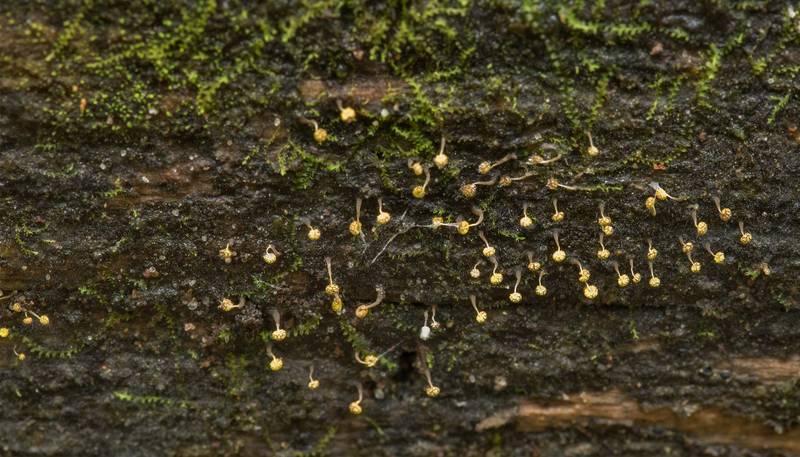

Slime mold Physarum viride on a wet pine without bark on Caney Creek Trail (Little Lake Creek Loop Trail) in Sam Houston National Forest north from Montgomery. Texas


Album 2962: College Station - Sam Houston Forest, Texas, June 10 - 11, 2021
The image features a close-up of a slime mold, specifically Physarum viride, growing on a wet pine without bark. The slime mold is characterized by its yellowish-brown color and irregularly shaped bodies that have begun to grow out from the pine.
The pine in this case has been stripped of all but its outermost layer of bark, which leaves it vulnerable to fungal growth. The dampness of the wood also contributes to the development of fungi. Physarum viride is a type of myxomycete that thrives on decaying organic matter such as dead trees or logs.
Physarum viride belongs to the family Physaraceae and is commonly found in tropical forests where it grows on tree trunks, branches, and leaves. The slime mold is generally yellowish-brown in color, but can also be white, gray, or reddish depending on its age and environment. It grows as a flattened disk shape that gradually develops into irregularly shaped bodies called sclerotia.
The sclerotia are the reproductive structures of the slime mold and contain spores for reproduction. They are typically yellowish-brown in color but can also be white, gray, or reddish depending on their age and environment. The slime mold grows by feeding on bacteria and other microorganisms that break down dead plant matter.
Physarum viride is an important part of the ecosystem because it helps to decompose dead plant material and recycle nutrients back into the soil. It also serves as a food source for various animals such as insects, amphibians, reptiles, birds, and mammals.
Overall, Physarum viride is a fascinating organism that plays a vital role in maintaining the balance of nature by breaking down dead plant matter and recycling nutrients. Its unique appearance and ability to thrive on decaying organic matter make it an interesting subject for study and observation. – AI vision
🇪🇸 Descripción en español / Spanish Description
El moho de limo Physarum viride en un pino húmedo sin corteza en el Sendero Caney Creek (Sendero Little Lake Creek Loop) en el bosque nacional Sam Houston al norte de Montgomery, Texas, el 11 de junio de 2021. La imagen muestra un primer plano de un moho de limo, específicamente Physarum viride, creciendo en un pino húmedo sin corteza. El moho de limo se caracteriza por su color amarillento-marrón y sus cuerpos de forma irregular que han comenzado a crecer desde el pino. El pino en este caso se ha despojado de toda su corteza excepto la capa más externa, lo que lo deja vulnerable al crecimiento fúngico. La humedad de la madera también contribuye al desarrollo de hongos. Physarum viride es un tipo de mixomiceto que prospera en materia orgánica en descomposición como árboles muertos u troncos. Physarum viride pertenece a la familia Physaraceae y se encuentra comúnmente en bosques tropicales, donde crece en troncos, ramas y hojas. El moho de limo generalmente tiene un color amarillento-marrón, pero también puede ser blanco, gris o rojizo dependiendo de su edad y entorno. Crea una forma aplanada que gradualmente se desarrolla en cuerpos de forma irregular llamados esclerocios. Los esclerocios son las estructuras reproductivas del moho de limo y contienen esporas para la reproducción. Suelen ser de color amarillento-marrón, pero también pueden ser blancos, grises o rojizos dependiendo de su edad y entorno. El moho de limo crece alimentándose de bacterias y otros microorganismos que descomponen la materia vegetal muerta. Physarum viride es una parte importante del ecosistema porque ayuda a descomponer el material vegetal muerto y reciclar los nutrientes de vuelta al suelo. También sirve como fuente de alimento para varios animales como insectos, anfibios, reptiles, aves y mamíferos. En general, Physarum viride es un organismo fascinante que desempeña un papel vital en el mantenimiento del equilibrio de la naturaleza al descomponer la materia vegetal muerta y reciclar nutrientes. Su aspecto único y su capacidad para prosperar en materia orgánica en descomposición lo convierten en un tema interesante para estudiar y observar. – Spanish translation