
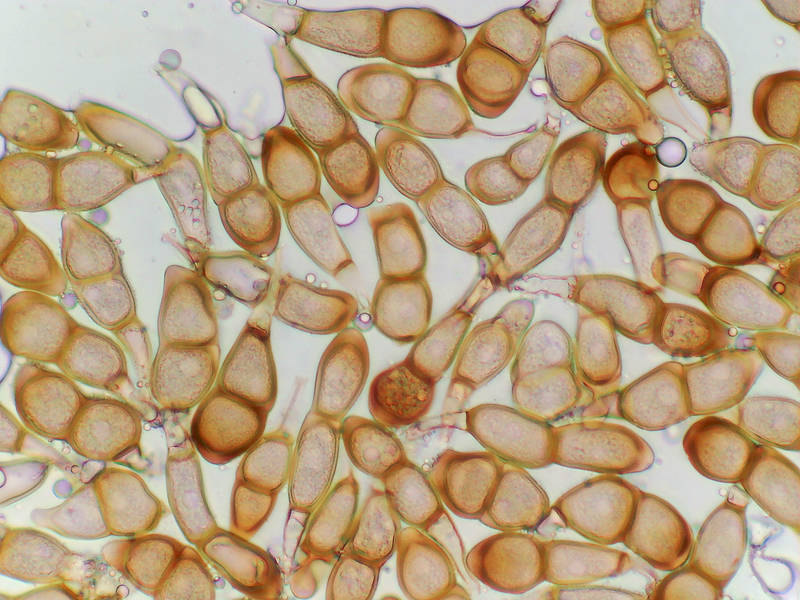

Teliospores (in KOH, low magnification) of cocklebur rust fungus (Puccinia xanthii) from underside of leaves of cocklebur (Xanthium strumarium) collected over sewage line in Lick Creek ParkLick Creek: Background Notes a day before. College Station, Texas


Album 3411: College Station, Texas, August 3 - 16, 2023
The image shows a microscopic view of teliospores from Puccinia xanthii, specifically those found on cocklebur (Xanthium strumarium) leaves collected near sewage in Lick Creek Park in College Station, Texas, on August 13, 2023.
**Key Features**
* The teliospores are long and cylindrical in shape.
* They have a smooth surface with no visible ornamentation or structures.
* Each spore is approximately the same size as those of other rust fungi.
**Coloration**
* The teliospores appear light brown to tan in color due to the presence of melanin, a common pigment found in many fungal species.
* Melanin helps protect the fungus from excessive sunlight and environmental stressors.
**Spore Size**
* Teliospores can vary significantly in size depending on the species and environmental conditions.
* However, this image suggests that these teliospores are relatively small compared to others of Puccinia xanthii found in other environments.
**Environmental Factors**
* The presence of teliospores on cocklebur leaves collected near sewage may indicate that this fungus thrives in areas with high levels of organic matter and nutrient-rich soil.
* This is consistent with the ecological niche occupied by many rust fungi, which often rely on decaying plant material for nutrients.
**Conclusion**
The image provides a detailed view of teliospores from Puccinia xanthii, highlighting their characteristic shape, size, and coloration. The presence of these spores on cocklebur leaves collected near sewage suggests that this fungus has adapted to survive in environments with high levels of organic matter and nutrient-rich soil. – AI vision
🇪🇸 Descripción en español / Spanish Description
Telioesporas (en KOH, baja ampliación) del hongo que causa la rugosidad de los ojitos de la espiga (Puccinia xanthii) de la parte inferior de las hojas de la planta de ojitos de la espiga (Xanthium strumarium) recolectadas sobre una tubería de aguas residuales en Lick Creek Park un día antes. College Station, Texas, 13 de agosto del 2023. La imagen muestra una vista microscópica de telioesporas del hongo que causa la rugosidad de los ojitos de la espiga (Puccinia xanthii), específicamente las encontradas en las hojas de plantas de ojitos de la espiga (Xanthium strumarium) recolectadas cerca de aguas residuales en Lick Creek Park en College Station, Texas el 13 de agosto del 2023. *Características Clave* * Las telioesporas son largas y cilíndricas en forma. * Tienen una superficie lisa sin ornamentación visible o estructuras. * Cada espora tiene aproximadamente el mismo tamaño que las de otros hongos causantes de la rugosidad. **Coloración** * Las telioesporas parecen ser de un color pardo claro a canela debido a la presencia de melanina, un pigmento común en muchas especies fúngicas. * La melanina ayuda a proteger al hongo del exceso de luz solar y estresores ambientales. **Tamaño de espora** * Las telioesporas pueden variar significativamente en tamaño dependiendo de las especies y condiciones ambientales. * Sin embargo, esta imagen sugiere que estas telioesporas son relativamente pequeñas en comparación con otras de Puccinia xanthii encontradas en otros entornos. **Factores Ambientales** * La presencia de telioesporas en las hojas de plantas de ojitos de la espiga recolectadas cerca de aguas residuales puede indicar que este hongo se adapta para sobrevivir en ambientes con altos niveles de materia orgánica y suelo rico en nutrientes. * Esto es consistente con el nicho ecológico ocupado por muchos hongos causantes de la rugosidad, que a menudo se basan en material vegetal en descomposición para obtener nutrientes. **Conclusión** La imagen proporciona una vista detallada de las telioesporas de Puccinia xanthii, destacando su forma característica, tamaño y coloración. La presencia de estas esporas en hojas de plantas de ojitos de la espiga recolectadas cerca de aguas residuales sugiere que este hongo se ha adaptado para sobrevivir en ambientes con altos niveles de materia orgánica y suelo rico en nutrientes. – Spanish translation


