
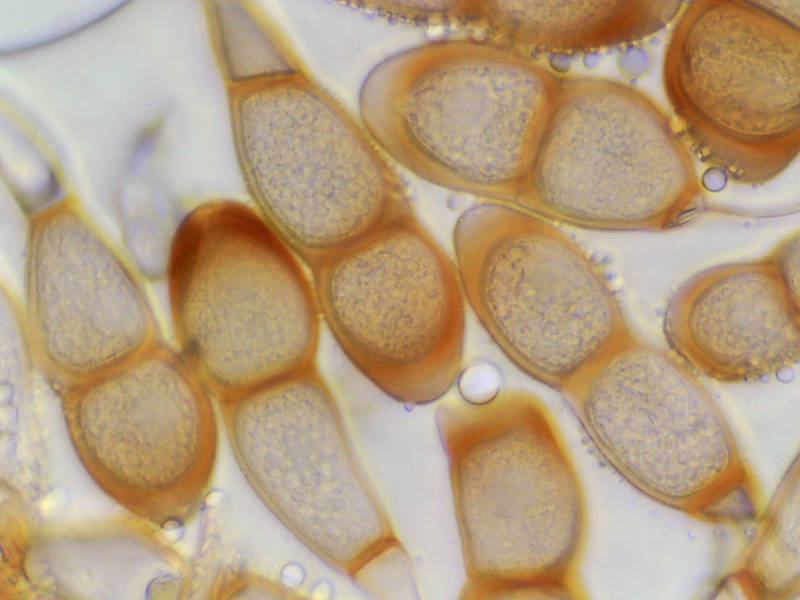

Biseptate teliospores (in KOH) of cocklebur rust fungus (Puccinia xanthii) from underside of leaves of cocklebur (Xanthium strumarium), collected over sewage line in Lick Creek ParkLick Creek: Background Notes a day before. College Station, Texas


Album 3411: College Station, Texas, August 3 - 16, 2023
The image presents an up-close view of teliospores from the cocklebur rust fungus (Puccinia xanthii) observed under a microscope after being immersed in potassium hydroxide (KOH). The teliospores are arranged in biseptate clusters, characterized by two septa within each spore. This distinctive feature is typical of Puccinia species and allows for the identification of this specific rust fungus.
The spores exhibit an ellipsoidal shape with a rounded tip at one end and a tapering end at the other. Their coloration ranges from light brown to dark brown, depending on their maturity. The teliospores are surrounded by a thin layer of mycelium and contain numerous small, spherical structures called sporoblasts within their interior.
In this image, the KOH has been applied to facilitate visualization under the microscope. The KOH dissolves cell walls and other organic material, allowing for clear observation of the spore's internal structure. This technique is commonly used in mycology (the study of fungi) to examine fungal structures at high magnification.
The location from which the sample was collected—Lick Creek Park in College Station, Texas—is significant as it likely provides valuable insights into the environmental conditions that contribute to the presence and proliferation of this particular rust fungus. The timing of collection, on August 13, 2023, is also noteworthy, as it coincides with the late summer season when many plant pathogens are active.
In conclusion, this image offers a detailed look at the teliospores of Puccinia xanthii, highlighting their unique biseptate arrangement and internal structure. The use of KOH in microscopy techniques enhances our understanding of these microscopic organisms and contributes to ongoing research into fungal biology and ecology. – AI vision
🇪🇸 Descripción en español / Spanish Description
Traduzca el siguiente texto del inglés al español:
Las teliosporas biseptadas (en KOH) del hongo roya palma (Puccinia xanthii) de la parte inferior de las hojas de la papa hembra (Xanthium strumarium), recogidas por una alcantarilla en Lick Creek Park un día antes. College Station, Texas, 13 de agosto de 2023. La imagen muestra una vista detallada de las teliosporas del hongo roya palma (Puccinia xanthii) observadas bajo el microscopio después de sumergirlas en hidróxido de potasio (KOH). Las teliosporas están dispuestas en grupos biseptados, caracterizados por dos septos dentro de cada espora. Este rasgo distintivo es típico de las especies Puccinia y permite la identificación de esta roya en particular. Las esporas presentan una forma elipsoidal con una punta redondeada en un extremo y un extremo cónico en el otro. Su coloración varía entre marrón claro y marrón oscuro, dependiendo de su madurez. Las teliosporas están rodeadas por una capa delgada de micelio y contienen numerosas pequeñas estructuras esféricas denominadas esporoblastos en el interior. En esta imagen, se ha aplicado KOH para facilitar la visualización bajo el microscopio. El KOH disuelve las paredes celulares y otros materiales orgánicos, lo que permite observar claramente la estructura interna de la espora. Este procedimiento se usa comúnmente en micología (el estudio de los hongos) para examinar estructuras fúngicas a alto aumento. La ubicación desde la que se recogió la muestra, Lick Creek Park en College Station, Texas, es significativa ya que probablemente proporcione información valiosa sobre las condiciones ambientales que contribuyen a la presencia y proliferación de esta roya en particular. El momento de la recolección, el 13 de agosto de 2023, también es notable, ya que coincide con la temporada tardía del verano cuando muchos patógenos vegetales están activos. En conclusión, esta imagen ofrece una vista detallada de las teliosporas de Puccinia xanthii, destacando su única disposición biseptada y su estructura interna. El uso de KOH en técnicas de microscopía mejora nuestra comprensión de estos organismos microscópicos y contribuye a la investigación continua sobre la biología y ecología fúngica. – Spanish translation


