
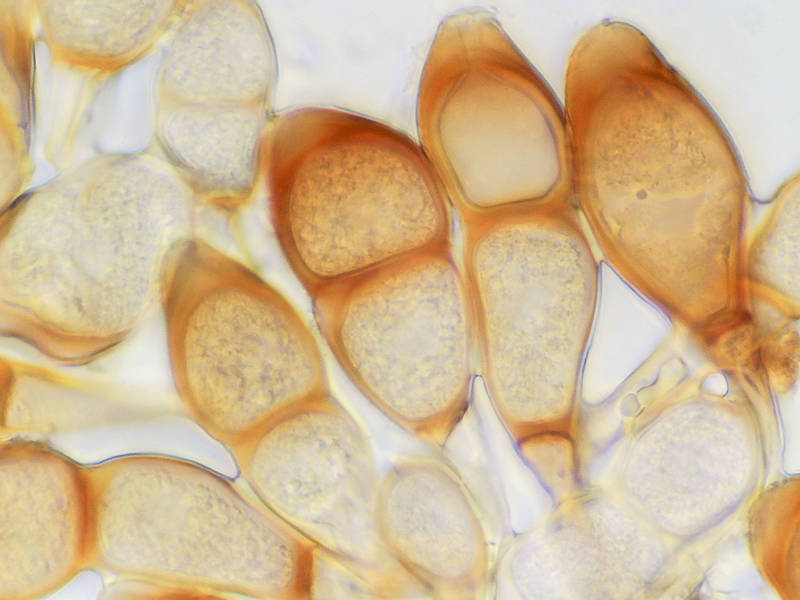

Large teliospores (in KOH) of cocklebur rust fungus (Puccinia xanthii) from underside of leaves of cocklebur (Xanthium strumarium), collected over sewage line in Lick Creek ParkLick Creek: Background Notes a day before. College Station, Texas


Album 3411: College Station, Texas, August 3 - 16, 2023
The image shows large teliospores of the Puccinia xanthii fungus, specifically from cocklebur (Xanthium strumarium) leaves.
In the foreground, several large teliospores are visible against a white background. The teliospores are tan-colored and have an elongated shape with rounded ends. They appear to be irregularly shaped, with some having more pointed tips than others.
The image provides a detailed view of the teliospores' morphology, allowing for closer examination and study of their characteristics. This level of detail is typically achieved through microscopic observation, often using a compound microscope or other specialized equipment designed for observing biological samples at high magnifications.
Given that the sample was collected from leaves near sewage, it's likely that the image was obtained after applying KOH (potassium hydroxide) to the specimen, which would have cleared and stained any cellular structures, allowing them to be visible under a microscope. This method is commonly used in mycology for examining fungal spores, as the alkalinity of the solution helps break down cell walls and reveal internal details.
Overall, this image offers valuable insights into the morphology of Puccinia xanthii teliospores, which could be useful for identifying similar species or understanding their role within ecosystems. – AI vision
🇪🇸 Descripción en español / Spanish Description
Teliósporas grandes (en KOH) del hongo de la roya del capullo (Puccinia xanthii) de la cara inferior de las hojas del capullo (Xanthium strumarium), recolectadas sobre una línea de aguas residuales en Lick Creek Park un día antes. College Station, Texas, 13 de agosto de 2023. La imagen muestra teliósporas grandes del hongo Puccinia xanthii, específicamente de las hojas del capullo (Xanthium strumarium). En primer plano, son visibles varias teliósporas grandes contra un fondo blanco. Las teliósporas son de color tostado y tienen una forma alargada con extremos redondeados. Parecen tener una forma irregular, con algunas que tienen puntas más agudas que otras. La imagen proporciona una vista detallada de la morfología de las teliósporas, lo que permite un examen y estudio más cercanos de sus características. Este nivel de detalle se logra normalmente a través de la observación microscópica, a menudo utilizando un microscopio compuesto u otro equipo especializado diseñado para observar muestras biológicas con altas ampliaciones. Dado que la muestra se recolectó de hojas cerca de aguas residuales, es probable que la imagen se haya obtenido después de aplicar KOH (hidróxido potásico) al espécimen, lo que habría limpiado y teñido cualquier estructura celular, permitiéndolas ser visibles bajo un microscopio. Este método se utiliza comúnmente en micología para examinar esporas de hongos, ya que la alcalinidad de la solución ayuda a romper las paredes celulares y revelar detalles internos. En general, esta imagen ofrece información valiosa sobre la morfología de las teliósporas de Puccinia xanthii, lo que podría ser útil para identificar especies similares o comprender su papel en los ecosistemas. – Spanish translation


