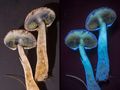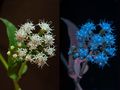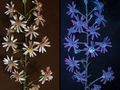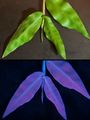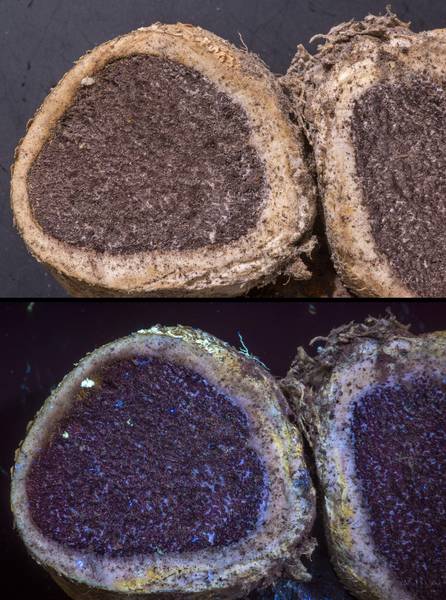

Section of a mushroom Scleroderma polyrhizum when exposed to regular daylight as well as when illuminated by a 365 nm ultraviolet (UV-A) blacklight from Sam Houston National Forest north from Montgomery. Texas


Album 3625: College Station - Sam Houston Forest, Texas, September 23 - 23, 2024
The image is an educational tool for identifying certain types of mushrooms that contain psilocybin and may be used as entheogens or hallucinogenic drugs. The mushroom featured in the image is Scleroderma polyrhizum, which has a bulbous base with radiating fingers. It grows on soil and dung. The caps are smooth, rounded, and 2-8 cm across.
The sample of this mushroom has been exposed to both regular white light (top) and ultraviolet light (bottom). Under normal lighting conditions, the flesh appears as a brownish color. In contrast, the same sample when illuminated by a blacklight shows a vibrant blue-purple hue, revealing an otherwise hidden layer within the mushroom's tissues.
This image demonstrates the use of UV-A fluorescence in identifying psilocybin-containing mushrooms. This method is used to detect these substances without destroying them, allowing for identification and study without harm. The UV light causes a chemical reaction that produces a visible color change, making it easier to distinguish between different types of fungi. – AI vision
🇪🇸 Descripción en español / Spanish Description
La sección de un hongo Scleroderma polyrhizum cuando se expone a la luz regular diurna y cuando se ilumina con una luz negra ultravioleta (UV-A) de 365 nm en el bosque nacional Sam Houston al norte de Montgomery. Texas, septiembre 26, 2024. La imagen es una herramienta educativa para identificar ciertos tipos de hongos que contienen psilocibina y pueden usarse como enteógenos o drogas alucinógenas. El hongo en la imagen es Scleroderma polyrhizum, que tiene una base bulbosa con dedos radiados. Crea raíces en el suelo y estiércol. Las tapas son lisas, redondeadas y miden de 2 a 8 cm de diámetro. La muestra de este hongo se ha expuesto tanto a la luz blanca regular (arriba) como a la luz ultravioleta (abajo). En condiciones de iluminación normal, la pulpa aparece de color parduzco. Por el contrario, la misma muestra cuando se ilumina con una luz negra muestra un tono violeta azulado vibrante, revelando una capa oculta dentro de los tejidos del hongo. Esta imagen demuestra el uso de fluorescencia UV-A en la identificación de hongos que contienen psilocibina. Este método se usa para detectar estas sustancias sin destruirlas, lo que permite su identificación y estudio sin daño. La luz ultravioleta causa una reacción química que produce un cambio de color visible, lo que facilita distinguir entre diferentes tipos de hongos. – Spanish translation