 |
| |||||||||||||||||

| ||||||||||||||||||


| Similar |   |
  |
  |
  |
  |
| |||||||||||||||||||||||||||||
| |||||||||||||||||||||||||||||
| 1996 1997 1998 1999 2000 2001 2002 2003 2004 2005 2006 2007 2008 2009 2010 2011 2012 2013 2014 2015 2016 2017 2018 2019 2020 2021 2022 2023 2024 2025 2026 | |||||||||||||||||||||||||||||
| New version Slide Show Most Popular Full List Statistics Technical Details Home Page | |||||||||||||||||||||||||||||
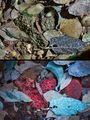
The image presents a comparative analysis of two photographs taken at different times and under distinct lighting conditions. The top photograph captures the scene during regular daylight, while the bottom one was illuminated by a 365 nm ultraviolet (UV-A) blacklight. **Top Photograph** In this frame, a brownish sandstone surface is visible, partially covered with green algae growth. The rock's texture appears slightly rough, with small crevices and holes scattered across its surface. Notably, the color of the rock changes from the top to the bottom of the image, transitioning from light brown at the top to dark brown at the bottom. **Bottom Photograph** The lower photograph was taken after the addition of a 365 nm UV-A blacklight. Upon exposure to this specific wavelength of ultraviolet radiation, the green algae growth exhibits a dramatic change in color, turning bright red or orange-red. In contrast, the rock itself does not display any significant alteration in its appearance. **Comparison and Observations** Upon comparing these two images, it becomes apparent that the presence of UV-A light has a profound impact on the visible properties of the green algae growth, causing them to change color. This phenomenon is likely due to the fact that certain compounds within the algae are fluorescent, emitting light at wavelengths that are not visible to the human eye when illuminated by regular daylight. However, when exposed to 365 nm UV-A radiation, these compounds absorb the energy from the UV light and re-emit it as longer-wavelength light in the visible spectrum. In conclusion, the image effectively demonstrates how different lighting conditions can significantly affect our perception of color and appearance in natural environments. The use of a specific wavelength of ultraviolet radiation highlights the presence of fluorescent compounds within certain organisms, providing valuable insights into their composition and behavior. – AI vision |
La arenisca con algas verdes cuando se expone a la luz del día normal y cuando se ilumina con una luz negra de 365 nm en el Lick Creek Park. College Station, Texas, 8 de noviembre de 2024. La imagen presenta un análisis comparativo de dos fotografías tomadas en diferentes momentos y bajo distintas condiciones de iluminación. La fotografía superior captura la escena durante la luz del día normal, mientras que la inferior fue iluminada con una luz negra de 365 nm. **Fotografía superior** En este cuadro, se puede ver una superficie arenisca pardusca parcialmente cubierta por el crecimiento de algas verdes. La textura de la roca parece ligeramente rugosa, con pequeñas grietas y huecos dispersos por toda su superficie. Cabe destacar que el color de la roca cambia desde la parte superior hasta la inferior de la imagen, pasando de marrón claro a marrón oscuro. **Fotografía inferior** La fotografía inferior se tomó después de agregar una luz negra de 365 nm UV-A. Después de la exposición a esta longitud de onda específica de radiación ultravioleta, el crecimiento de algas verdes exhibe un cambio drástico en el color, volviéndose rojo brillante u naranja rojizo. En contraste, la propia roca no muestra ninguna alteración significativa en su apariencia. **Comparación y observaciones** Al comparar estas dos imágenes, se vuelve evidente que la presencia de luz UV-A tiene un profundo impacto en las propiedades visibles del crecimiento de algas verdes, haciéndolas cambiar de color. Este fenómeno es probablemente debido a que ciertos compuestos dentro de las algas son fluorescentes, emitiendo luz a longitudes de onda que no son visibles para el ojo humano cuando se ilumina con luz diurna normal. Sin embargo, cuando se expone a radiación UV-A de 365 nm, estos compuestos absorben la energía de la luz UV y la reemiten como luz de longitud de onda más larga en el espectro visible. En conclusión, la imagen demuestra eficazmente cómo diferentes condiciones de iluminación pueden afectar significativamente nuestra percepción del color y apariencia en entornos naturales. El uso de una longitud de onda específica de radiación ultravioleta destaca la presencia de compuestos fluorescentes dentro de ciertos organismos, proporcionando valiosas pistas sobre su composición y comportamiento. – Spanish translation |
Keyword variants
high resolution online digital collection
Lick Creek Park images
Berlin on the Brazos
Rock Prairie Rd
Lone Star State
Greens Prairie Road
United States
picture gallery
photo album
nature trails
Nature Park
documentary photographs
daily pics
conservative town
Brazos County
wildlife
TX
travelogue
snapshots
sightseeing
photowalks
photoblog
graphic
fotografias
foto
Bryan
America
Aggieland