 |
| |||||||||||||||

| ||||||||||||||||


| Similar |   |
  |
  |
  |
  |
| |||||||||||||||||||||||||||
| |||||||||||||||||||||||||||
| 1996 1997 1998 1999 2000 2001 2002 2003 2004 2005 2006 2007 2008 2009 2010 2011 2012 2013 2014 2015 2016 2017 2018 2019 2020 2021 2022 2023 2024 2025 2026 | |||||||||||||||||||||||||||
| New version Slide Show Most Popular Full List Statistics Technical Details Home Page | |||||||||||||||||||||||||||
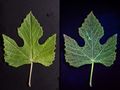
The image presents a striking comparison between two photographs of the same dry leaf of Mustang grape (Vitis mustangensis), showcasing its appearance under regular daylight and under ultraviolet (UV-A) illumination using a blacklight. The purpose of this visual representation is to highlight the differences in how the leaf appears when exposed to different types of light. * **Dry Leaf Appearance Under Regular Daylight:** In summary, the image effectively illustrates how different types of lighting can reveal unique characteristics on a dry leaf. While regular daylight shows the natural aging process of the leaf, UV-A illumination brings out its fluorescent properties, highlighting specific areas where it reacts to ultraviolet light. This contrast underscores the role of light in revealing hidden details within biological samples and could have implications for various scientific studies or applications in fields like botany or materials science. – AI vision |
La hoja seca de la vid Mustang (Vitis mustangensis) cuando se expone a la luz diurna habitual y también cuando se ilumina con una luz negra ultravioleta (UV-A) de 365 nm del Parque Lick Creek. College Station, Texas, 17 de septiembre de 2024. La imagen presenta una sorprendente comparación entre dos fotografías de la misma hoja seca de vid Mustang (Vitis mustangensis), mostrando su apariencia bajo luz diurna habitual y bajo iluminación ultravioleta (UV-A) usando una luz negra. El propósito de esta representación visual es resaltar las diferencias en cómo se ve la hoja cuando se expone a diferentes tipos de luz. * "Hoja Seca bajo Luz Diurna Habitual: * La fotografía izquierda muestra la hoja seca como se vería durante el día con luz diurna habitual. * La coloración es principalmente marrón con algunas áreas más claras, lo que indica un proceso de envejecimiento natural o factores ambientales. * No hay signos visibles de crecimientos inusuales ni anormalidades en esta imagen. * "Hoja Seca bajo Iluminación UV-A: * La fotografía derecha muestra la misma hoja, pero iluminada con una luz negra ultravioleta (UV-A) de 365 nm del Parque Lick Creek, College Station, Texas. * Tras la exposición a la luz UV-A, la hoja presenta marcas naranjas y azules vibrantes alrededor de sus bordes y venas. * Estos colores son indicativos de fluorescencia, un fenómeno común en materiales biológicos cuando absorben radiación ultravioleta. En resumen, la imagen ilustra efectivamente cómo diferentes tipos de iluminación pueden revelar características únicas en una hoja seca. Mientras que la luz diurna habitual muestra el proceso de envejecimiento natural de la hoja, la iluminación UV-A pone de manifiesto sus propiedades fluorescentes, resaltando las áreas donde reacciona a la radiación ultravioleta. Este contraste subraya el papel de la luz en revelar detalles ocultos dentro de muestras biológicas y podría tener implicaciones para diversos estudios científicos o aplicaciones en campos como la botánica o la ciencia de los materiales. – Spanish translation |
Keyword variants
high resolution online digital collection
Lick Creek Park pic
Berlin on the Brazos
Rock Prairie Rd
Lone Star State
Greens Prairie Road
United States
picture gallery
photo album
nature trails
Nature Park
documentary photographs
daily pics
conservative town
Brazos County
wildlife
TX
travelogue
snapshots
sightseeing
photowalks
photoblog
graphic
fotografias
foto
Bryan
America
Aggieland