
Gallery of the Patriotic War of 1812 in Hermitage Museum. Saint Petersburg, Russia, July 22, 2005

Gallery of the Patriotic War of 1812 in Hermitage Museum. Saint Petersburg, Russia, June 10, 2009

Great Patriotic War of 1812 portrait hall in Hermitage Museum. Saint Petersburg, Russia, December 16, 2005

Gallery of the Patriotic War of 1812 in Hermitage Museum. Saint Petersburg, Russia, January 2, 2016

Finnish World War II stone defence fortifications "Mannerheim Line" in a forest near 67-th km train station in Karelian Isthmus 40 miles north from Saint Petersburg. Russia, September 1, 2002

War scene on a shield in Hermitage Museum. Saint Petersburg, Russia, June 3, 2011

Finnish World War II stone defence fortifications "Mannerheim Line" in a forest near 67-th km train station in Karelian Isthmus 40 miles north from Saint Petersburg. Russia, September 1, 2002

A forgotten military hospital cemetery in the spruce woods on a hillside behind the former Toksovo tuberculosis sanatorium in Syargi, Leningrad Oblast. Simple wooden and welded iron crosses rise above mossy burial mounds scattered with colorful artificial flowers, marking the resting place of Red Army soldiers who succumbed to their wounds during World War II when the facility served as an evacuation hospital, as well as subsequent patients who died of severe bone tuberculosis. Near Saint Petersburg. Russia, August 2, 2005

Sculpture damaged by war on the building of 4th Central Research Institute of the Russian Ministry of Defense on Fontanka Embankment. Saint Petersburg, Russia, June 10, 2014

Chinese Theatre, destroyed during the war, in Alexandrovskiy Park of Pushkin (former Tsarskoe Selo, residence of Russian tsars). Near Sankt Petersburg, Russia, October 22, 2000

A World War II soldiers memorial in Myasnitskiy Bor (?), north from Novgorod. Russia, August 1, 2001

First World War exhibition in Marshall Chamber (Ratnaya Palata) in Alexander Park in Pushkin, former Tsarskoe Selo, near Saint Petersburg. Russia, December 27, 2014

A wooden cabin near World War II soldiers memorial in Myasnitskiy Bor (?), north from Novgorod. Russia, August 1, 2001

This constructivist funerary sculpture on the Communist Section of the Alexander Nevsky Lavra marks the 1921 grave of Nikolay Vasilyevich Bakhvalov, remembered in Petrograd lore as one of the pioneer automobile drivers and motor mechanics of early revolutionary Russia. In the chaotic aftermath of the Civil War, professional chauffeurs and mechanics formed an indispensable technical corps operating transport trucks and armored vehicles, prompting local authorities to allocate Bakhvalov a burial site within the monastery s inner courtyard. Eschewing stone stelae and traditional Orthodox funerary emblems, the memorial was fabricated by fellow workers from authentic mechanical components representing the deceased s trade. The structure rests on a concrete plinth anchored by paired cast-iron spoked wheels, surmounted by horizontal spur gears and transmission rings. Heavy roller drive chains--the type utilized in early chain-driven motorcars and industrial machinery--extend upward in a triangular pyramid to meet a central vertical shaft and finial that originally displayed a metal nameplate. Created during the War Communism era, the monument represents a rare surviving specimen of early Soviet Productivist and Proletkult memorial art. By assembling discarded industrial hardware into an emblem of proletarian labor and mechanized modernization directly opposite baroque monastic architecture, the work embodied the early Bolshevik effort to replace religious mourning traditions with a secular cult of the machine. Saint Petersburg, Russia, May 25, 2011

War scene on an ancient coin in Hermitage Museum. Saint Petersburg, Russia, June 3, 2011

Ford car at First World War exhibition in Marshall Chamber (Ratnaya Palata) in Alexander Park in Pushkin, former Tsarskoe Selo, near Saint Petersburg. Russia, December 27, 2014

War scene on a brass dish in Hermitage Museum. Saint Petersburg, Russia, June 3, 2011

Abandoned World War II memorial on territory of Red Banner (Krasnoe Znamia) Textile Factory on Pionerskaya Street in Petrogradskaya Storona neighborhood. Saint Petersburg, Russia, August 9, 2012

Various items at First World War exhibition in Marshall Chamber (Ratnaya Palata) in Alexander Park in Pushkin, former Tsarskoe Selo, near Saint Petersburg. Russia, December 27, 2014

Helmets at First World War exhibition in Marshall Chamber (Ratnaya Palata) in Alexander Park in Pushkin, former Tsarskoe Selo, near Saint Petersburg. Russia, December 27, 2014

This grave marker on the Communist Section of the Alexander Nevsky Lavra commemorates Pyotr Petrovich Petrov (1883-1925), an early Bolshevik revolutionary and Soviet worker-cadre buried during the First Five-Year Plan s formative years. Like many party functionaries interred along the courtyard s central avenues, Petrov died in the mid-1920s during the arduous post-Civil War reconstruction of Petrograd . The memorial consists of a weathered concrete and stone stele characteristic of the modest, egalitarian funerary aesthetic favored for early Soviet party members . Flanked by iron railings and spring greenery, the unadorned headstone preserves an austere, secular tribute to an early Soviet activist laid to rest within the historic monastery courtyard. Saint Petersburg, Russia, May 29, 2014

World War II memorial in Shlisselburg Fortress. Orekhovy Island, Leningradskaya Region, Russia, July 27, 2012

Abandoned graves of solders of Red Army died at the beginning of World War II (1941) in Lutheran Cemetery on Citadel Road in Kronstadt. Saint Petersburg, Russia, July 4, 2010

World War II memorial inside Cathedral ruins in Shlisselburg Fortress. Orekhovy Island, Leningradskaya Region, Russia, July 27, 2012

War bunker of Suurniemi (Mannerheim Line) near Lake Glubokoe. East from Leypyasuo, north from Saint Petersburg, Russia, June 7, 2014

Typewriter at First World War exhibition in Marshall Chamber (Ratnaya Palata) in Alexander Park in Pushkin, former Tsarskoe Selo, near Saint Petersburg. Russia, December 27, 2014

Fall colors of birch trees behind the war monument in Sosnovka Park. Saint Petersburg, Russia, September 29, 2015

This monument on the Communist Section of the Alexander Nevsky Lavra marks the grave of Mikhail Abramovich Fishman (1890-1935), a Bolshevik cadre and Civil War veteran. Prominently situated along the main avenue facing the entrance to Holy Trinity Cathedral, the grave is known locally as the "Sentry" (:0427:0430:0441:043e:0432:043e:0439). The memorial features a full-length, life-size statue of a Red Army soldier standing vigil against a dark, round-topped granite stele. Clad in a belted greatcoat (shinel), cartridge pouches, and a peaked budenovka cloth helmet bearing a star, the bronze-toned figure holds a slung Mosin rifle at attention. Placed directly on monastery ground during the height of militant Soviet secularism, the armed revolutionary guard stands as an unmistakable ideological statement, posted as an eternal sentinel facing the Orthodox cathedral. Saint Petersburg, Russia, October 18, 2016

"War and peace of Vadim Sidur" show in Manezh exhibition hall. Saint Petersburg, Russia, August 17, 2017

Demolished garages in area of former prisoner of war camps in Sosnovka Park. Saint Petersburg, Russia, October 8, 2017

Forest around demolished garages in area of former prisoner of war camps in Sosnovka Park. Saint Petersburg, Russia, October 8, 2017

Piles of garbage from demolished garages in area of former prisoner of war camps in Sosnovka Park. Saint Petersburg, Russia, October 8, 2017

Accumulation of trash from demolished garages in area of former prisoner of war camps in Sosnovka Park. Saint Petersburg, Russia, October 8, 2017

Fall colors of demolished garages in area of former prisoner of war camps in Sosnovka Park. Saint Petersburg, Russia, October 8, 2017

Yellow foliage around demolished garages in area of former prisoner of war camps in Sosnovka Park. Saint Petersburg, Russia, October 8, 2017

Autumn colors around demolished garages in area of former prisoner of war camps in Sosnovka Park. Saint Petersburg, Russia, October 8, 2017

Garbage from demolished garages in area of former prisoner of war camps in Sosnovka Park. Saint Petersburg, Russia, October 8, 2017

Various trash from demolished garages in area of former prisoner of war camps in Sosnovka Park. Saint Petersburg, Russia, October 8, 2017

Yellow foliage near demolished garages in area of former prisoner of war camps in Sosnovka Park. Saint Petersburg, Russia, October 8, 2017

Fall colors of a forest demolished garages in area of former prisoner of war camps in Sosnovka Park. Saint Petersburg, Russia, October 8, 2017

Autumn forest near demolished garages in area of former prisoner of war camps in Sosnovka Park. Saint Petersburg, Russia, October 8, 2017

Littered area of former prisoner of war camps in Sosnovka Park. Saint Petersburg, Russia, October 8, 2017

Fireweed near demolished garages in area of former prisoner of war camps in Sosnovka Park. Saint Petersburg, Russia, October 8, 2017

Yellow leaves carpeting demolished garages in area of former prisoner of war camps in Sosnovka Park. Saint Petersburg, Russia, October 8, 2017

Orange leaves on demolished garages in area of former prisoner of war camps in Sosnovka Park. Saint Petersburg, Russia, October 8, 2017

Autumn view of demolished garages in area of former prisoner of war camps in Sosnovka Park. Saint Petersburg, Russia, October 8, 2017

Accumulation of junk in area of former prisoner of war camps in Sosnovka Park. Saint Petersburg, Russia, October 8, 2017

Yellow leaves on demolished garages in area of former prisoner of war camps in Sosnovka Park. Saint Petersburg, Russia, October 8, 2017

Glacial erratic (a large granite boulder) left behind by the retreating Scandinavian Ice Sheet over 11,000 years ago. The inscription ":041d:0415:0422 :0412:041e:0419:041d:0415" (pronounced Net Voyne), meaning "NO TO THE WAR," is a direct political protest against the ongoing Russian invasion of Ukraine. Activists often paint this slogan in forests, on snow, on frozen rivers, or in elevators to avoid CCTV cameras and police patrols found in city centers. This stone serves as a quiet but firm artifact of internal resistance, standing in the silent forest just kilometers from the station and the dacha community. Kannelyarvi, north from Saint Petersburg, Russia, October 1, 2025

"Alley of Heroes," a section of the cemetery dedicated to Russian soldiers killed in the war in Ukraine. In the foreground stands a permanent black granite monument featuring a detailed engraving of a soldier in combat gear with the "Z" insignia and a stoic epitaph reading, "Having given everything, I will not rise from the dust... I, having killed the fear within myself, fought". The background reveals rows of additional graves densely adorned with wreaths and flags representing various military branches (including the VDV and Naval Infantry) and private military contractors, illustrating the ongoing scale and diverse composition of the casualties. Cemetery of the Victims of January 9, St. Petersburg, Russia, October 4, 2025

The grave of Alexey Vladimirovich Suslov (1976-2024), a 47-year-old casualty whose age reflects Russia s reliance on older reservists and volunteers rather than just young conscripts. His polished black granite monument features a casual color portrait and the epitaph "We were left without you, You remained with us," asserting a continuing spiritual bond despite death. The background juxtaposes the solemn "Alley of Heroes" with modern commercial buildings, visually grounding the war s toll within the everyday urban landscape of St. Petersburg. Cemetery of the Victims of January 9, St. Petersburg, Russia, October 4, 2025

The diverse visual languages of mourning in the "Alley of Heroes," contrasting a solemn monochrome engraving of a soldier in full combat gear--distinguished by the Order of Courage medal--with the vibrant, smiling color portrait of Yuri Bogdanov on the adjacent grave. The background is saturated with a chaotic array of flags, including the black-yellow-white Russian Imperial tricolor and red Soviet banners, visually capturing the "hybrid" ideological landscape, where conflicting historical symbols are merged to support the war effort. Cemetery of the Victims of January 9, St. Petersburg, Russia, October 4, 2025

The ideological complexity of the war s memorialization, dominated by a large red Soviet flag flying prominently over fresh graves, invoking nostalgia for the USSR s military power alongside Russian tricolors and VDV (Airborne Forces) banners. In the foreground, the grave of Arkady Vasilyevich Kovalchuk (1974-2024), who died at age 50, exemplifies the demographic trend of older men bearing a significant share of casualties. The scene is one of dense, vibrant mourning, with mounds of artificial flowers covering the raw earth, set against a backdrop of modern commercial buildings that anchor the cemetery in the contemporary urban landscape. "Alley of Heroes" at Cemetery of the Victims of January 9, St. Petersburg, Russia, October 4, 2025

Wide-angle view of the overwhelming scale of the cemetery s "temporary" sector, where row upon row of fresh earthen graves stretch toward the horizon, each topped with a dense carpet of wreaths and a chaotic thicket of flags. The visual field is dominated by the Russian tricolor, but punctuated by Soviet red banners, VDV (Airborne) flags, and Naval ensigns, reflecting the "hybrid" composition of forces. The raw, unpaved ground and the sheer density of the burials underscore the industrial pace of the war s casualties, set against a mundane urban backdrop that integrates this mass death into daily life. "Alley of Heroes" at Cemetery of the Victims of January 9, St. Petersburg, Russia, October 4, 2025

The dense concentration of recent casualties, with fresh earthen mounds tightly packed together and adorned with the ubiquitous Russian tricolor. In the foreground, the grave of Aleksandr Vladimirovich Dementyev (1962-2025) is marked by a wooden cross and a color portrait, identifying a 63-year-old soldier whose age highlights the heavy toll on older reservists and volunteers. The background reveals the integration of the cemetery into the urban fabric, with modern commercial buildings visible just beyond the sea of flags and wreaths, grounding the war[CloseCurlyQuote]s losses in the everyday reality of St. Petersburg. "Alley of Heroes" at Cemetery of the Victims of January 9, St. Petersburg, Russia, October 4, 2025

The "initial stage" of memorialization, where fresh earthen graves are crowded with temporary wooden crosses and a profusion of military banners, including the VDV (Airborne Forces) and St. Andrew[CloseCurlyQuote]s Naval flags. The foreground features the grave of Mikhail Ilyich Svyatkin (1986-2025), a 39-year-old casualty, whose cross is adorned with a framed photo of him in uniform, exemplifying the typical profile of recent losses. The scene is saturated with patriotic symbols, including a flag depicting a tank with the slogan "Victory will be ours" and another with the Order of the Great Patriotic War, linking the current conflict to historical narratives of Soviet heroism. "Alley of Heroes" at Cemetery of the Victims of January 9, St. Petersburg, Russia, October 4, 2025

The "permanent stage" of memorialization, featuring a row of polished black granite monuments for soldiers such as Andrey Nikolaevich Atlanov (1977-2024) and Danila Denisovich Shutov (2001-2024), a 23-year-old whose age underscores the ongoing loss of young lives. The monuments display diverse portrait styles--ranging from formal military engravings to casual color photos--and are flanked by flags including the VDV (Airborne Forces) banner with the motto "Nobody, but us," reflecting both individual identity and collective unit pride. The orderly arrangement of these finished graves, complete with granite curbs and gravel, stands in contrast to the chaotic temporary sections seen in other places, illustrating the gradual formalization of the war s toll. "Alley of Heroes" at Cemetery of the Victims of January 9, St. Petersburg, Russia, October 4, 2025

Rebuilding of the Forest Building (Russian: Lesnoy Korpus) in a major reconstruction project at the historic Sestroretsk Resort (Sestroretsky Kurort). The original Sestroretsk Resort was a famous health spa complex founded in 1898 by engineer Peter Avenarius. It featured several grand wooden structures, including a massive Kursaal (concert hall), a mud bath facility, and the Forest Building. The resort was a hub for St. Petersburg s elite and intelligentsia in the early 20th century. The original Forest Building was a beautiful wooden hotel and sanatorium building constructed in the early 1900s. It was a key part of the ensemble but was destroyed during World War II. The new structure faithfully replicates the "Northern Art Nouveau" style of the original resort architecture, characterized by its complex roofline, spires, towers, and wooden detailing that harmonizes with the surrounding pine forest and dunes. The exterior appears nearly complete, showing the elaborate wooden facade, the large central dome, and the corner towers with their needle-like spires. The scaffolding indicates that finishing work is still in progress. Saint Petersburg, Russia, October 9, 2025

Turkish Bath, a picturesque pavilion situated on a small peninsula in the Great Pond in Catherine Park. Commissioned by Emperor Nicholas I, this was the last structure built in the imperial park, completed between 1850 and 1852. It was designed by Ippolito Monighetti, who used the appearance of a Turkish mosque as his inspiration. The building features a central gilded dome, a tall minaret crowned with a crescent, and intricate relief ornaments on the white facade. The pavilion serves as a victory monument to the Russo-Turkish War of 1828-1829. Pushkin (former Tsarskoe Selo) near Saint Petersburg, Russia, October 10, 2025

Monument of heroes of Great October Socialist Revolution. It is a mass grave monument dedicated to Red Guards who died during the 1917 October Revolution and the subsequent Civil War. The site originated in 1917 as a burial ground for workers and Red Guards from the nearby Novy Lessner Plant (now the Karl Marx Machine-Building Plant). These fighters were killed in battles against the troops of General Pyotr Krasnov near Pulkovo during the defense of Petrograd. In 1953, a wooden structure was replaced by the current grey granite obelisk seen today. It was designed by architect Yuri Wiesenthal. This monument is a solemn reminder of the intense revolutionary history of the Vyborg Side, a district historically populated by industrial workers who were pivotal to the Bolshevik cause. Lesnoy Park (Lesotekhnicheskiy Universitet), Saint Petersburg, Russia, October 14, 2025

This view of the protest installation outside the Russian Embassy on Pikk Street highlights several direct appeals and condemnations aimed at the Russian government. "STOP KILLING PEOPLE": A large, hand-painted sign on the right bluntly demands an end to the violence. This slogan has become a staple of anti-war protests worldwide. "STOP WAR CRIMINALS": The banner on the bottom left features a missile marked with the Russian flag and the demand to stop "war criminals." This reflects the widespread accusation that Russian leadership is committing war crimes in Ukraine. The large white sheet in the center is covered with drawings of cats in blue and yellow bowties, likely representing innocent lives or perhaps a specific children s art project. The text on the right translates from Estonian: "TO THE VICTIMS OF WARS STARTED BY RUSSIA" (Venemaa poolt alustatud so~dade ohvritele). This frames the current conflict as part of a longer history of Russian aggression. The central drawing includes poignant handwritten messages like "NOBODY LOVES YOU!" and "WE DON T WANT WAR!", expressing a mix of personal disdain for the aggressors and a universal plea for peace. Tallinn, Estonia, October 16, 2025

This view of the installation near the Russian embassy on Pikk Street captures a broader perspective of the protest site, showing how it stretches along the sidewalk in front of the embassy building. The white banner in the foreground originally read "FOR THE VICTIMS OF WARS STARTED BY RUSSIA" (with the Russian translation on the right). However, someone has vandalized the sign by crossing out "RUSSIA" and scrawling "US" and a Star of David (hexagram) over it. This act of vandalism attempts to deflect blame from Russia by invoking anti-American and antisemitic tropes, a tactic often seen in pro-Kremlin disinformation campaigns. On the left side of the street, the building with the distinctive Art Nouveau facade (Pikk 18) houses the Ron Verlin salon, visible through the large arched window. This contrasts the elegant, peaceful commercial life of the street with the raw political conflict playing out just meters away. The fencing extends far down the street, covered in layers of posters, flags, and messages. This indicates the sustained nature of the demonstration, which has become a semi-permanent fixture in the Old Town since the start of the full-scale invasion. Tallinn, Estonia, October 16, 2025

A politically charged scene on Pikk Street (specifically at Pikk 19) in front of the Russian Embassy in Tallinn. The metal barricades lining the street have become a permanent protest installation since Russia s full-scale invasion of Ukraine in February 2022. The barriers are covered in posters, slogans, and artwork condemning the war and Russian leadership. The large banner in the foreground reads "FOR THE VICTIMS OF WARS STARTED BY RUSSIA". Other signs visible on the fence typically document war crimes or satirize political figures. A police officer in a high-visibility yellow jacket is patrolling the area. A constant police presence has been standard here to maintain order given the high tensions surrounding the embassy. The Russian Embassy occupies a historic Art Nouveau building at Pikk 19. Ironically, this street is one of the most picturesque and tourist-heavy routes in the Old Town, creating a surreal juxtaposition between medieval charm and modern geopolitical conflict. Across the street (visible in the background) is the famous Maiasmokk Cafe, the oldest operating cafe in Tallinn, further highlighting the clash between leisure tourism and serious political activism in this specific location. Tallinn, Estonia, October 16, 2025

An informal protest memorial outside the Russian Embassy on Pikk Street combines Ukrainian flags, photographs of war damage, anti-war messages, and portraits of victims of political repression. The embassy has been a gathering place for protests against Russia[CloseCurlyQuote]s full-scale invasion of Ukraine since February 2022; tributes to Alexei Navalny were added following his death in prison on February 16, 2024. A large portrait of Navalny carries the accusation [OpenCurlyDoubleQuote]Putin killed Navalny,[CloseCurlyDoubleQuote] while nearby posters call for freedom for political prisoners and warn against threats to Ukraine and the Baltic states. Flowers, candles, ribbons, and handwritten notes placed along the metal barriers turn the pavement beside the pink, arched-window fac,ade into a shared space for mourning and political dissent. Tallinn, Estonia, August 26, 2026
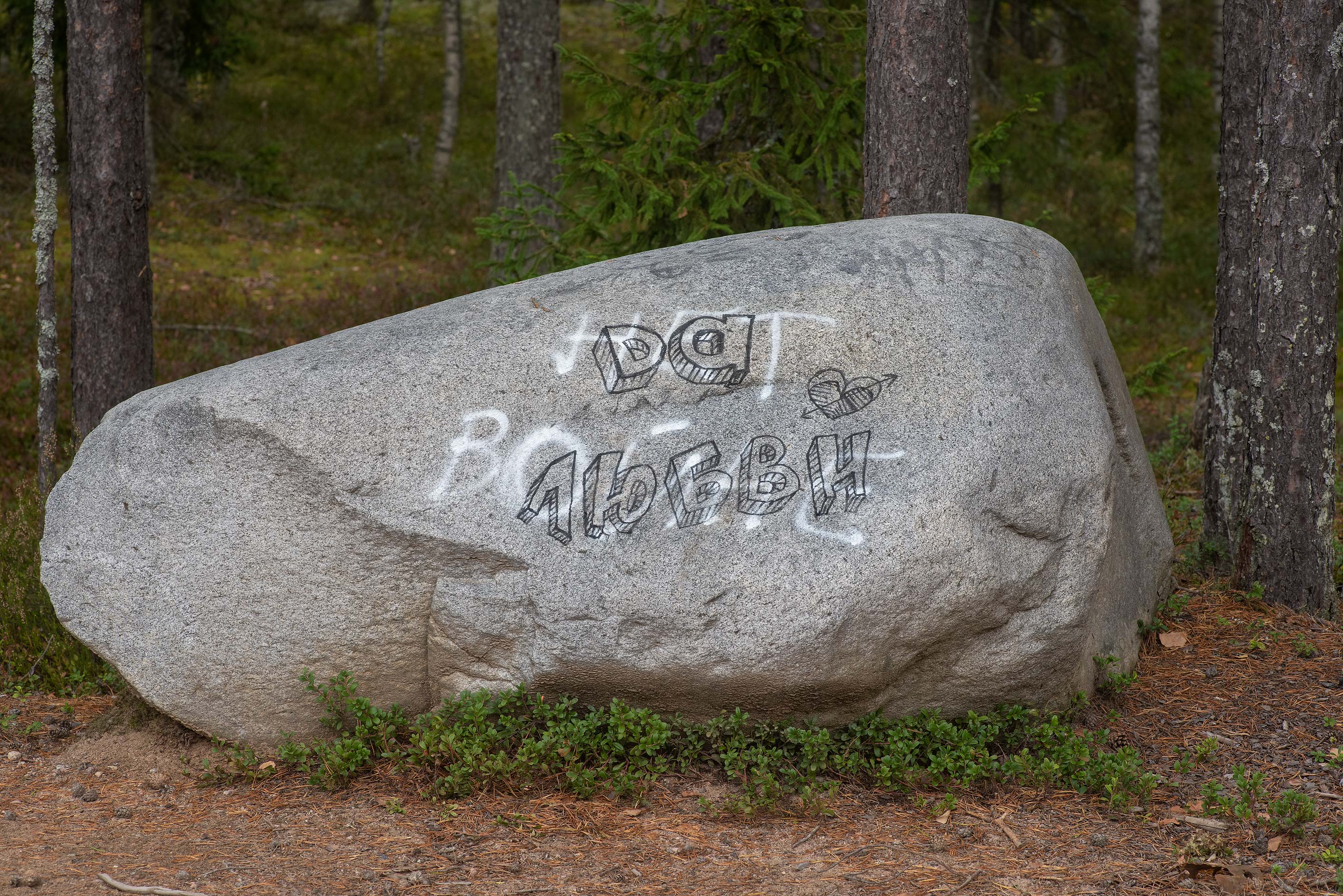
A large granite boulder in a forest bears the inscription [OpenCurlyDoubleQuote]:041d:0415:0422 :0412:041e:0419:041d:0415 / :0414:0430 :043b:044e:0431:0432:0438[CloseCurlyDoubleQuote]--[OpenCurlyDoubleQuote]NO TO WAR / YES TO LOVE[CloseCurlyDoubleQuote] - and a small heart pierced by an arrow. In contemporary Russia, the wording can be read as a quiet act of resistance to Russia[CloseCurlyQuote]s invasion of Ukraine, contrasting military violence with love and human solidarity. Kannelyarvi, north from Saint Petersburg, Russia, September 9, 2026
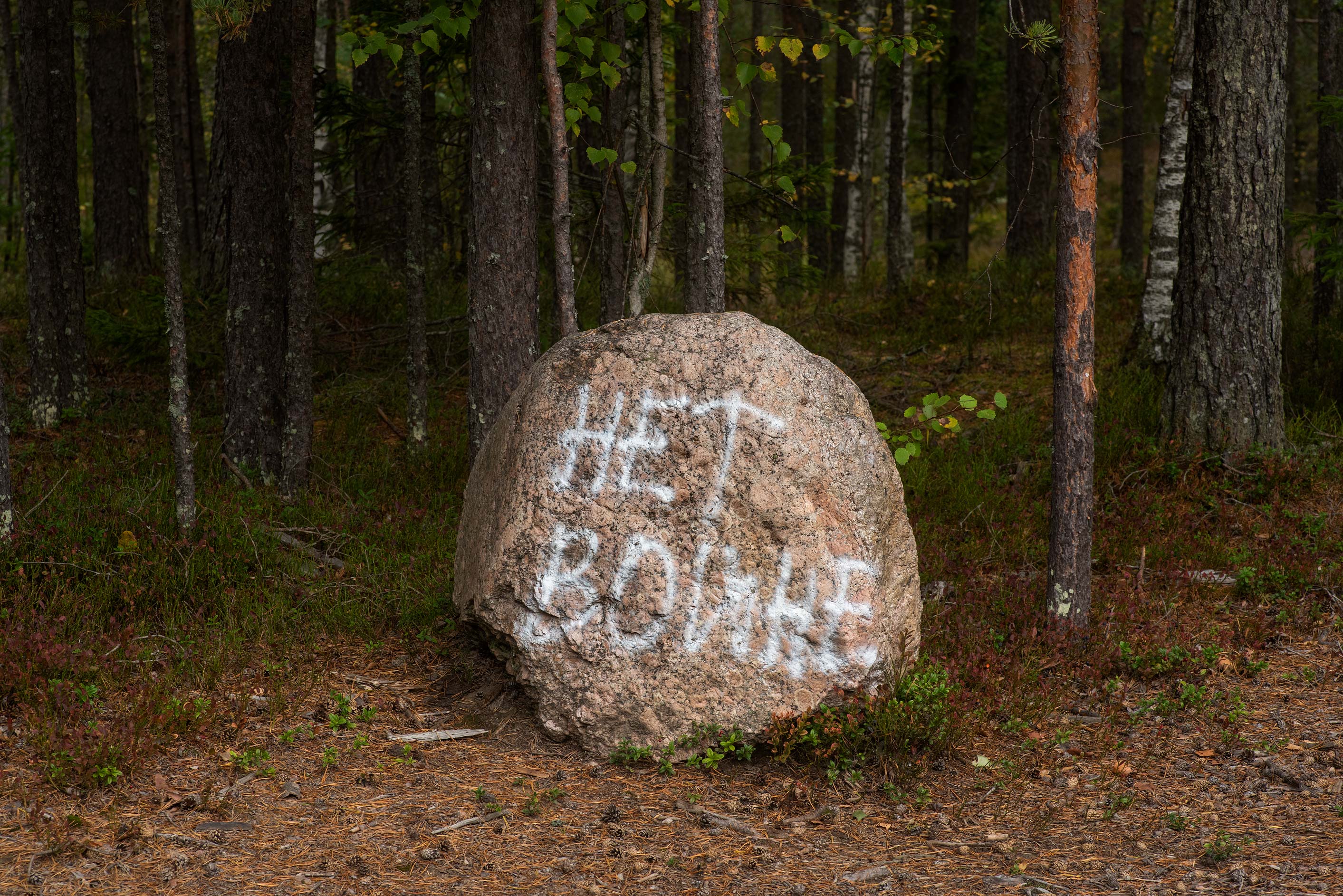
Inscription "NO TO THE WAR" on a granite boulder in a forest. Kannelyarvi, north from Saint Petersburg, Russia, September 9, 2026
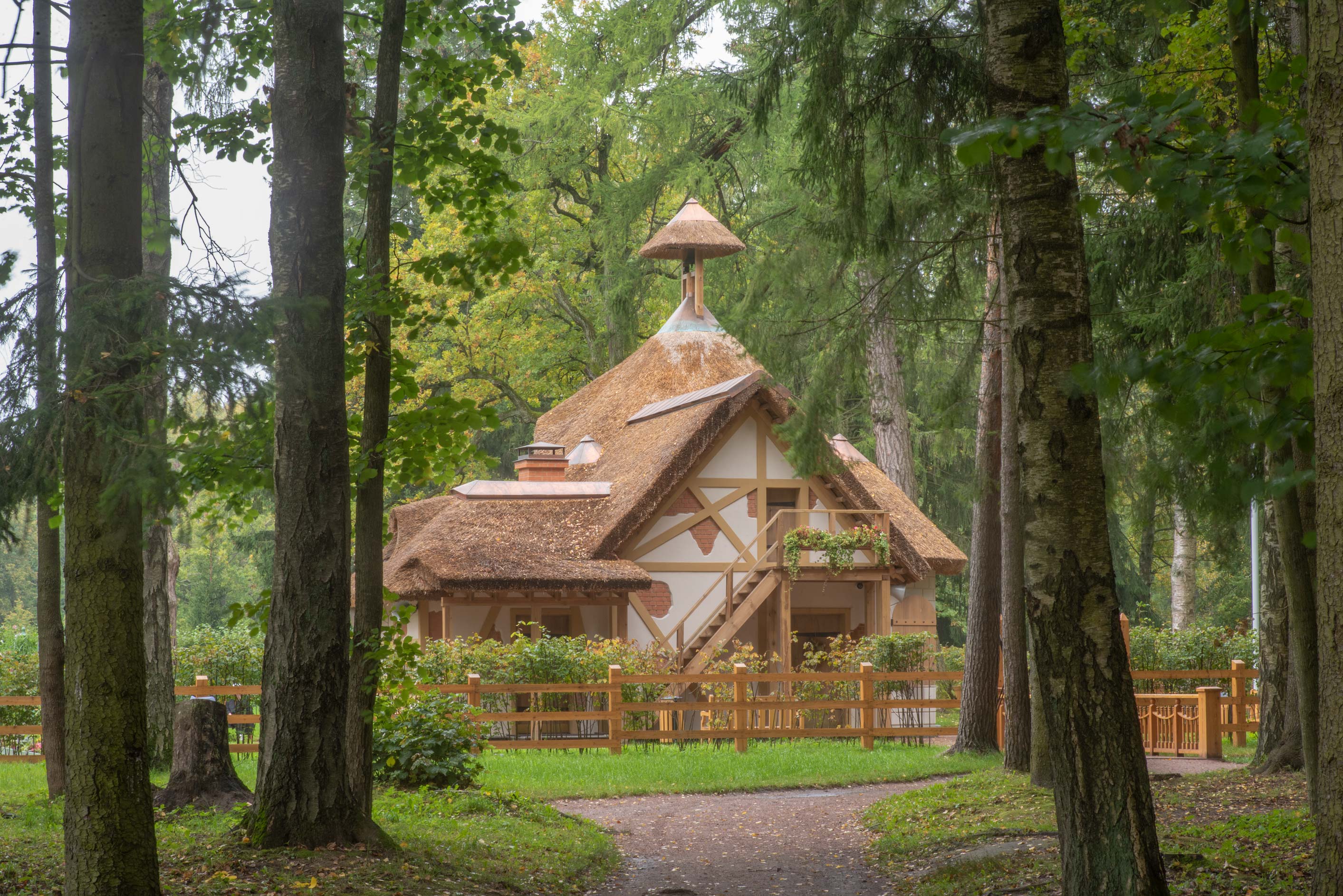
Reconstructed in 2024-2025 after being destroyed during World War II, the Old Chalet Pavilion (Staroye Shale, originally erected in 1780) stands framed by tall woodland trees behind a low wooden fence and flower-filled garden beds. Built as an Enlightenment-era pastoral "rustic hut" for Empress Maria Feodorovna, the timber-framed structure features a steep thatched straw roof topped with a tiny thatched cupola, an exterior wooden staircase, and a flower-box balcony in Pavlovsk Park. Pavlovsk, suburb of Saint Petersburg, Russia, September 13, 2026
